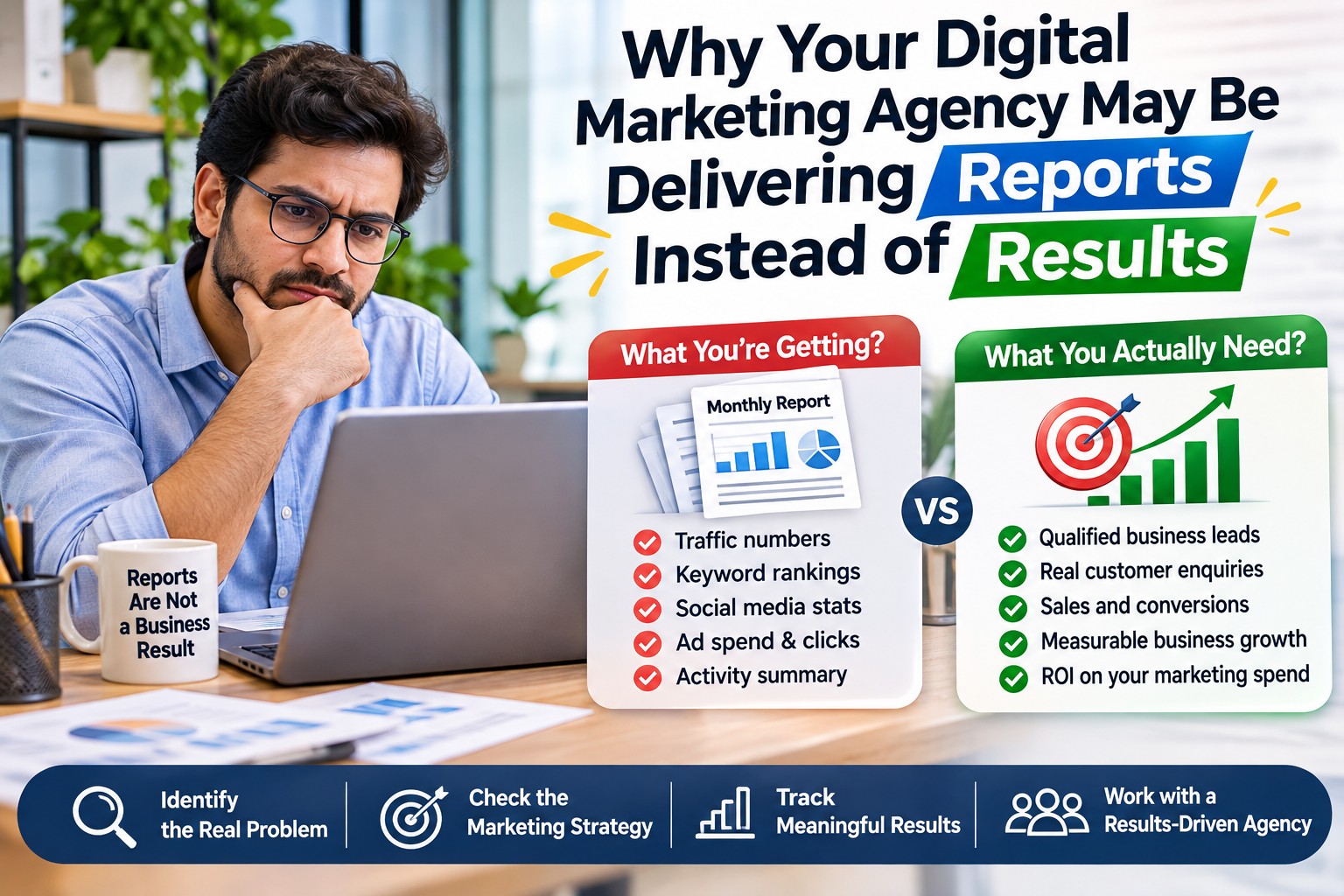
Every month, your digital marketing agency sends you a report.
The report looks professional. There are colourful charts, website traffic numbers, keyword ranking improvements, social media statistics and a list of activities completed during the month.
Your agency tells you that the campaign is progressing well.
But when you look at your business, something does not add up.
Your sales team is not receiving enough genuine enquiries. Your phone is not ringing more often. Your website is not bringing in the number of potential customers you expected. You are still depending on referrals, personal contacts or existing customers to generate business.
You start wondering: If my digital marketing reports look good, why am I not seeing better business results?
This is a reasonable question, and one that every business owner should feel comfortable asking.
Digital marketing reports are important. They help businesses understand what is happening with their websites, advertisements, social media accounts and online campaigns.
The problem begins when reporting becomes the main deliverable rather than a way to understand and improve performance.
A business does not hire a digital marketing agency simply to receive charts and spreadsheets. It invests in marketing to achieve something valuable, whether that means generating qualified leads, attracting relevant customers, increasing sales or building long-term demand.
If your agency is regularly reporting progress but you cannot see how that progress benefits your business, you need to examine what is actually being measured.
This guide explains why digital marketing agencies sometimes focus more on reports than results, how to identify the gaps in your current strategy, which questions to ask and what you can do to make your marketing investment more accountable.
1. Understand the Difference Between Marketing Activities, Performance Metrics and Business Results

One of the biggest reasons businesses become confused about digital marketing performance is that three different things are often presented as though they mean the same thing.
These are marketing activities, performance metrics and business results.
They are connected, but they are not interchangeable.
Marketing activities: What the agency has done
Marketing activities are the tasks completed by the agency.
For example:
-
Publishing eight blog articles.
-
Optimising ten website pages.
-
Creating twenty social media posts.
-
Building new backlinks.
-
Running Google Ads campaigns.
-
Fixing technical website issues.
-
Designing new landing pages.
-
Preparing keyword ranking reports.
These activities may be necessary, but completing them does not automatically mean your business has achieved a result.
Imagine hiring a salesperson who reports that they made 200 calls during the month.
That information tells you the salesperson was active. It does not tell you how many conversations were productive, how many potential customers showed interest or how many sales were made.
Digital marketing activities should be evaluated in a similar way.
Performance metrics: What happened after the work
Performance metrics help measure how people interacted with your marketing.
Examples include:
-
Website clicks and impressions.
-
Keyword positions.
-
Organic search sessions.
-
Advertising clicks.
-
Cost per click.
-
Social media reach.
-
Engagement rate.
-
Landing page conversion rate.
-
Form submissions.
These numbers help the agency understand whether particular activities are working.
For example, increasing visibility for a service-related keyword may be useful because more potential customers can discover your website.
However, a higher keyword ranking does not guarantee that visitors will contact your business.
Business results: What the marketing achieved for your company
Business results are outcomes connected to your commercial objectives.
Depending on your business, these may include:
-
Qualified customer enquiries.
-
Consultation bookings.
-
Product quotation requests.
-
Distributor or dealer enquiries.
-
Completed purchases.
-
Sales opportunities.
-
Revenue from new customers.
-
Reduced customer acquisition costs.
-
Increased repeat purchases.
-
Growth in profitable business segments.
These are the outcomes that help determine whether your marketing investment is worthwhile.
A simple example
Consider a manufacturing business investing in SEO.
| What the agency reports | What the business needs to know |
|---|---|
| Organic traffic increased by 40% | Did relevant buyers visit the website? |
| Twenty keywords reached page one | Were those keywords related to products customers buy? |
| Ten blogs were published | Did the articles attract potential customers or support important product pages? |
| Website impressions doubled | Did visibility increase among the target audience? |
| Fifty form submissions were recorded | How many were genuine business enquiries? |
| Twenty backlinks were acquired | Were the links relevant, credible and useful? |
A report becomes valuable when it connects the work completed with meaningful performance and explains what should happen next.
2. Why Agencies Sometimes Focus More on Reports Than Results

Not every agency that sends activity-heavy reports is intentionally misleading its clients.
Sometimes the problem comes from the way the agency operates, the information available to it or the expectations agreed upon when the project started.
Understanding the reason can help you decide whether the situation can be improved.
Reason 1: The agency is following a fixed monthly checklist
Some agencies sell packages built around a fixed number of activities.
For example, an SEO package might include four blogs, ten backlinks, fifteen keyword optimisations and one monthly report.
The team focuses on completing these tasks because they are the agreed deliverables.
The problem is that the same activities may not be suitable every month.
Your website might need technical improvements before publishing more content. Your important service pages might need stronger information. Your paid campaigns might need better conversion tracking rather than additional advertisements.
If the agency follows a checklist without reviewing your business needs, it can remain busy without making meaningful progress.
What to ask: Why are these activities the priority for our business this month?
Reason 2: Nobody defined what success means
If the initial agreement only mentioned improving SEO, managing social media or increasing website traffic, the agency may be measuring exactly those things.
Meanwhile, you may have expected more sales enquiries.
Both sides could be working with different definitions of success.
This is why a clear objective should be established before starting a campaign.
For example, instead of saying "We want better SEO," a business might say:
"We want to increase relevant organic enquiries for our industrial equipment services in Delhi NCR."
This gives the agency a more useful direction for keyword research, landing page development, content planning and performance measurement.
Reason 3: The agency does not have access to sales information
An agency may be able to see website traffic and form submissions but have no information about what happened after someone contacted your business.
For example, Google Analytics may show that a website generated 100 enquiries.
However, the agency may not know that:
-
Thirty were spam.
-
Twenty were outside your service area.
-
Fifteen were looking for jobs.
-
Ten were existing customers.
-
Fifteen were genuine prospects.
-
Ten could not be contacted.
Without feedback from your sales team, the agency may report 100 conversions even though only fifteen enquiries were relevant.
The solution is to improve lead tracking and communication between marketing and sales.
Reason 4: The agency is reporting the easiest numbers to measure
Website clicks, impressions and social media reach are relatively easy to display.
Qualified leads, customer acquisition cost and revenue contribution are often more difficult to measure because they may require CRM data, call tracking, offline conversion information or sales team feedback.
As a result, some reports contain plenty of available data but very little commercially useful information.
An agency should be transparent about what it can measure, what it cannot measure and what needs to be implemented to improve reporting.
Reason 5: The agency has not updated its strategy
A campaign may start with a reasonable plan but stop improving over time.
The agency continues publishing similar content, targeting the same keywords or running advertisements without addressing the problems revealed by the data.
A useful monthly review should identify what needs to change.
If the same activities continue for months despite poor performance, ask the agency to explain why.
Reason 6: The agency is trying to avoid difficult conversations
Marketing campaigns do not always perform as expected.
Search demand can change. Competitors can become more aggressive. Advertising costs may increase. Website issues can affect conversions.
A responsible agency should discuss these problems openly.
An agency that only highlights positive numbers while avoiding negative performance may be more interested in keeping the client satisfied temporarily than solving the underlying problem.
3. Your Website Traffic Is Increasing, but Your Business Enquiries Are Not
This is one of the most common situations in which a marketing report can look impressive while the business sees limited benefits.
Imagine your website traffic increased from 5,000 to 15,000 monthly visitors.
Your agency celebrates the growth.
However, the number of qualified enquiries remains almost unchanged.
Does this mean the SEO campaign has failed?
Not necessarily. But it does mean you need to investigate whether the additional traffic is relevant and what visitors do after reaching the website.
Check which pages are receiving traffic
A website may receive traffic from different types of pages.
For example:
-
Blog articles.
-
Product pages.
-
Service pages.
-
Category pages.
-
Location pages.
-
Company information pages.
If most traffic growth comes from general informational articles, the visitors may be researching a subject rather than looking for a company to hire.
Informational traffic can still be valuable for building awareness and supporting future purchases. However, it should not automatically be treated as equivalent to immediate customer demand.
Check the search intent behind the keywords
Consider a solar installation company.
Someone searching for "how do solar panels work" may simply want information.
Someone searching for "residential rooftop solar installation company in Delhi" is more likely to be evaluating a service provider.
Both keywords can bring visitors, but they serve different purposes.
Your SEO strategy should consider the relationship between informational searches, commercial searches and your business goals.
Check whether the website encourages enquiries
Even relevant visitors may leave without contacting you if the website does not answer their questions.
Common problems include:
-
Unclear service descriptions.
-
Missing product specifications.
-
No visible contact details.
-
Complicated enquiry forms.
-
Poor mobile experience.
-
Slow or unreliable pages.
-
No information about service locations.
-
Weak trust signals.
-
No clear next step.
If your agency is responsible for website optimisation, these issues should be part of the performance discussion.
Example: Two different traffic outcomes
| Metric | Website A | Website B |
|---|---|---|
| Monthly visitors | 20,000 | 6,000 |
| Total enquiries | 80 | 120 |
| Qualified enquiries | 12 | 60 |
| Qualified lead rate per visitor | 0.06% | 1% |
Illustrative example, not actual client data.
Website B receives less traffic but generates substantially more qualified enquiries relative to its traffic.
The important question is not simply how many people visit your website, but how effectively your website attracts and serves the right audience.
4. Your Agency Is Showing Keyword Rankings but Not Explaining Their Business Value

Keyword ranking reports are common in SEO.
They can help track whether a website is becoming more visible in Google Search.
However, rankings alone do not explain whether your website is attracting potential customers.
Not every keyword has the same commercial value
Suppose a company provides factory licence consulting services.
Compare these searches:
-
What is a factory licence?
-
Factory licence requirements.
-
Factory licence consultant in Delhi.
-
Apply for factory licence online.
-
Factory licence registration services.
These searches reflect different needs.
Some users want information. Others may be looking for professional assistance.
An SEO strategy should identify the keywords most relevant to your services and understand the intent behind them.
Ask for a business-focused keyword report
Your agency should be able to explain:
-
Which keywords are relevant to your main services?
-
Which pages are being optimised for those keywords?
-
Which keywords are attracting organic clicks?
-
Which landing pages generate enquiries?
-
Which important commercial keywords still need improvement?
-
What work is planned to improve their performance?
Do not ignore Search Console data
Keyword tracking tools are useful, but rankings can vary by location, device, search context and time.
Google Search Console provides useful information about the queries for which your website appears, along with impressions, clicks and average position.
Ask the agency to use search performance data alongside keyword tracking rather than relying only on screenshots of selected rankings.
5. Your Agency Reports the Number of Blogs Published but Not Their Purpose

Content marketing can support SEO, educate customers and help people discover your business.
However, publishing more articles does not automatically create more business opportunities.
An agency may report that it published ten blogs during the month without explaining why those topics were selected.
Every article should have a clear purpose
A useful content plan considers:
-
What customers are searching for.
-
Which questions they need answered.
-
How the topic relates to your products or services.
-
Whether your website already covers the subject.
-
Which stage of the buying journey the article supports.
-
How the article connects with relevant service pages.
-
How its performance will be reviewed.
Example of weak and stronger topic selection
Suppose you own a website development company.
A general article such as "What Is a Website?" may attract people who want a basic explanation.
An article such as "How Much Does a Small Business Website Cost in India?" may help potential customers understand budgets and compare development options.
Both topics can be useful, but they serve different audiences and purposes.
The agency should explain why each topic belongs in your content strategy.
Ask what happens after publication
Content should not simply be published and forgotten.
The agency should review whether the article is being discovered, whether it satisfies the intended search query, whether it needs updates and whether readers have a useful path to related information or services.
A blog report should discuss content performance and improvements, not only the number of articles completed.
6. Your Social Media Reports Look Impressive, but Nobody Is Enquiring
Social media reports often highlight follower growth, reach, impressions, likes, comments and shares.
These metrics can be useful, especially when your objective is brand awareness or community engagement.
However, they should be interpreted according to your business goals.
A business that wants qualified B2B enquiries may need a different social media strategy from a consumer brand trying to build awareness.
Understand who is engaging with your content
Imagine a company that sells industrial machinery.
Its social media page receives thousands of likes, but most engagement comes from people who are not involved in industrial purchasing.
The engagement may help with general visibility, but it does not necessarily indicate growing demand for the company's products.
Ask the agency:
-
Who is the content intended to reach?
-
Are we reaching decision-makers or potential buyers?
-
Which posts attract relevant questions?
-
Are people visiting our website?
-
Are we receiving direct messages from potential customers?
-
How does the content support our sales process?
Review the content strategy
A useful social media plan may include product explanations, customer questions, demonstrations, industry insights, company updates and trust-building content.
The right mix depends on the platform and audience.
The agency should not treat posting frequency as the only measure of success.
7. Your Google Ads Agency Is Reporting Clicks Instead of Qualified Leads
Paid advertising can generate traffic quickly, but clicks are not the same as customers.
Every click may cost money.
If your agency reports increasing clicks without explaining conversion quality, you may be spending more without improving your business outcomes.
Understand what the advertising budget is buying
Suppose your campaign has the following performance:
| Metric | Illustrative value |
|---|---|
| Advertising spend | ₹50,000 |
| Website clicks | 2,000 |
| Recorded leads | 100 |
| Qualified leads | 20 |
| Customers acquired | 4 |
In this example:
-
Average cost per click = ₹25.
-
Cost per recorded lead = ₹500.
-
Cost per qualified lead = ₹2,500.
-
Advertising cost per acquired customer = ₹12,500.
These numbers tell a more complete story than clicks alone.
Whether the campaign is profitable depends on revenue, margins, repeat purchases and other costs.
Check the conversion tracking
An advertising platform may record a conversion when someone:
-
Submits an enquiry form.
-
Calls the business.
-
Clicks a contact button.
-
Makes a purchase.
-
Completes another configured action.
Not all these actions are equally valuable.
For example, clicking a phone number does not prove that a completed call occurred or that the caller was a potential customer.
Ask your agency which actions are being counted as conversions and how it verifies their quality.
Review search terms and landing pages
For search advertising, ask whether your ads are appearing for relevant searches.
You should also review whether visitors reach pages that clearly explain the advertised service.
A relevant advertisement leading to a confusing landing page can waste valuable traffic.
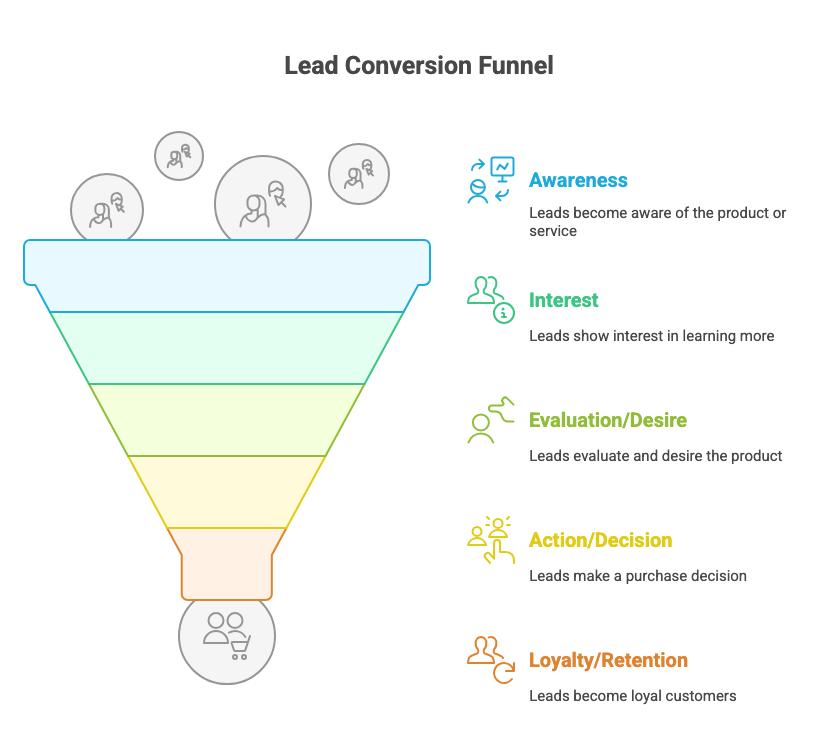
8. Your Agency Is Not Tracking the Complete Customer Journey
Many businesses lose visibility between the moment someone visits their website and the moment they become a paying customer.
This makes it difficult to determine which marketing activities are actually contributing to revenue.
A basic customer journey may look like this:
Search or advertisement → Website visit → Enquiry → Qualified lead → Sales discussion → Proposal → Customer
Different systems may be responsible for different stages.
Google Search Console helps you understand organic search visibility.
Google Analytics 4 can measure website behaviour and configured events.
Advertising platforms provide campaign data.
Your CRM or sales records help track what happens after the enquiry.
Connect marketing and sales information
If possible, record useful details for each enquiry:
-
Date received.
-
Source or campaign.
-
Product or service requested.
-
Customer location.
-
Contact details.
-
Lead status.
-
Assigned salesperson.
-
Qualification outcome.
-
Sale or lost opportunity.
-
Revenue, where available.
This information helps identify whether a marketing channel is producing relevant prospects.
Be aware of tracking limitations
Not every customer journey can be attributed perfectly.
People may use multiple devices, return through different channels, call directly or make decisions after offline conversations.
Consent settings, privacy restrictions and technical limitations can also affect tracking.
The goal is not to claim that every sale can be measured with complete certainty. It is to build a reliable enough reporting process to support better decisions.
9. Your Agency Is Not Explaining Why Performance Has Changed
A report should do more than show whether a number increased or decreased.
It should explain what may have contributed to the change and what the team plans to investigate or improve.
For example, imagine organic traffic falls by 20% in one month.
A weak report might simply state:
"Organic traffic decreased by 20%."
A more useful report would examine whether the decline was related to:
-
Reduced search demand.
-
Changes in keyword visibility.
-
Technical website problems.
-
Important pages losing traffic.
-
Website migrations or redesigns.
-
Tracking changes.
-
Seasonal patterns.
-
Competitor activity.
-
Search engine changes.
The agency should distinguish confirmed causes from possible explanations.
Ask for actions, not just observations
If a problem is identified, the report should explain the next steps.
For example:
| Finding | Follow-up action |
|---|---|
| Important service page losing clicks | Review search queries, page content and technical status |
| Paid campaign receiving irrelevant enquiries | Review targeting, search terms and lead qualification |
| High traffic but low enquiry rate | Review landing page relevance, forms and calls to action |
| Blog traffic increasing without commercial engagement | Review audience intent and links to relevant services |
| Conversion data appears inconsistent | Audit event configuration and reporting definitions |
The purpose of reporting is to support decisions and improvements.
10. Your Agency Keeps Changing the Numbers It Highlights
Be careful when an agency changes its definition of success every month without explaining why.
For example:
In January, the agency highlights website traffic.
In February, traffic declines, so the report focuses on impressions.
In March, impressions fall, so the agency highlights the number of blogs published.
In April, it reports social media reach instead of business enquiries.
Different metrics can legitimately become important at different stages. However, the main business objectives should remain clear.
Establish consistent KPIs
Agree on a small set of important metrics and track them consistently.
For a lead-generation business, these might include:
-
Qualified enquiries.
-
Cost per qualified lead.
-
Enquiry-to-customer conversion rate.
-
Organic performance of key service pages.
-
Campaign spend.
-
Revenue or sales opportunities attributed to marketing, where measurable.
Supporting metrics can still be included, but they should not replace the main objectives without a reason.
11. What a Useful Digital Marketing Report Should Actually Include
A strong report should help you understand three things:
What happened, why it matters and what happens next.
It does not need to contain dozens of pages.
In many cases, a concise report with relevant data and useful explanations is better than a long presentation full of screenshots.
Part 1: Executive summary
Start with a short explanation of overall performance.
For example:
"Organic visibility improved for several important service pages. Website enquiries increased, but the proportion of qualified leads declined. The next month's priority is to review the search queries attracting visitors and improve the enquiry process."
This tells the business owner what deserves attention.
Part 2: Business performance
Include the most relevant outcomes.
| Metric | Previous month | Current month | Change |
|---|---|---|---|
| Website enquiries | 80 | 100 | +25% |
| Qualified leads | 40 | 45 | +12.5% |
| Customers acquired | 8 | 9 | +12.5% |
| Marketing spend | ₹60,000 | ₹65,000 | +8.3% |
Illustrative data.
The report should explain whether the changes are meaningful and what might have influenced them.
Part 3: Channel performance
Break down relevant results by channel.
For example:
-
Organic search.
-
Google Ads.
-
Social media.
-
Email marketing.
-
Referral traffic.
This helps identify where enquiries and customers are coming from.
Part 4: Completed work
List the activities completed during the reporting period.
Include links to important deliverables where appropriate.
For example, if a landing page was redesigned, the agency should identify the page and explain the objective behind the change.
Part 5: Problems and opportunities
The report should include areas that are not performing well.
This is important because marketing improvements often come from identifying problems rather than celebrating positive numbers.
Part 6: Next month's priorities
Explain what the team plans to do next, why those activities matter and whether anything requires approval.
A useful report should help the business owner make decisions rather than simply confirm that the agency was active.
12. How to Calculate Whether Your Marketing Investment Is Producing Value
You do not need to be a marketing expert to understand some basic business calculations.
However, it is important to use consistent definitions and avoid confusing leads with customers.
Cost per lead
Cost per lead measures how much you spend to generate a recorded lead.
Cost per lead = Marketing spend ÷ Number of leads
If you spend ₹40,000 and receive 100 leads, your cost per lead is ₹400.
But this number does not tell you whether those leads are relevant.
Cost per qualified lead
A qualified lead is a prospect who meets your agreed criteria.
Cost per qualified lead = Marketing spend ÷ Qualified leads
If you spend ₹40,000 and receive 20 qualified leads, your cost per qualified lead is ₹2,000.
For many service businesses, this is more useful than the cost of all form submissions.
Customer acquisition cost
Customer acquisition cost measures the cost of acquiring a customer.
Customer acquisition cost = Relevant acquisition costs ÷ New customers acquired
For example, if you spend ₹60,000 on marketing and acquire six customers, the marketing spend per acquired customer is ₹10,000.
A complete customer acquisition cost calculation may also need to include relevant sales expenses and other acquisition costs.
Return on marketing investment
To understand financial performance, compare the contribution generated by marketing with the costs involved.
For example, suppose a campaign generates ₹3,00,000 in attributable sales revenue and the gross margin on those sales is 40%.
The gross profit before marketing costs would be ₹1,20,000.
If the marketing campaign cost ₹50,000, the contribution after that marketing expense would be ₹70,000, before other relevant costs.
This is more informative than comparing advertising spend with revenue alone.
For businesses with long sales cycles, evaluate results over a suitable period rather than expecting every campaign to produce immediate revenue.
13. How to Identify Whether Your Agency Is Avoiding Accountability
An agency should not be blamed for every business problem.
Marketing results can be affected by your pricing, product quality, sales process, availability, customer service and market conditions.
However, the agency should be accountable for the work it agrees to perform and for communicating its findings honestly.
Warning signs worth investigating
The agency refuses to explain its reports.
You should be able to ask what a metric means and why it matters.
The agency cannot show completed work.
If the agreement includes content, technical improvements or campaign optimisation, the agency should be able to identify the relevant deliverables.
The agency does not discuss business objectives.
If your goal is qualified enquiries, the reporting process should acknowledge that goal.
The agency always blames external factors.
Competition and platform changes are real, but the agency should explain how it is responding.
The agency repeats the same strategy despite poor results.
A strategy should be reviewed when evidence suggests that important assumptions are not working.
The agency cannot explain how leads are tracked.
If it reports conversions, it should be able to explain what those conversions represent.
The agency avoids sharing account access.
Your business should retain appropriate ownership and access to its important digital assets.
These signs do not automatically prove misconduct. They indicate that you need clearer explanations and evidence.
14. What to Ask Your Agency During the Next Monthly Meeting
Instead of simply accepting the presentation, use the meeting to understand how the marketing activities support your business.
Here are fifteen questions you can ask.
-
Which activities contributed most to our business objectives this month?
-
How many genuine enquiries came from our marketing campaigns?
-
How many enquiries were qualified?
-
Which website pages generated the most relevant enquiries?
-
Which keywords are bringing potential customers rather than general visitors?
-
Which campaigns are spending money without generating useful outcomes?
-
What has improved compared with the previous month?
-
What has become worse?
-
What problems did your team identify?
-
What changes did you make based on last month's performance?
-
How do you know that the reported conversions are genuine?
-
Which activities should we stop or reduce?
-
What will you prioritise next month?
-
What information or approvals do you need from our business?
-
How will we know whether the revised strategy is working?
You do not need to ask all fifteen questions in every meeting.
Choose the questions most relevant to your current concerns and request written follow-up on important decisions.
15. What to Do If Your Agency Has Been Sending Reports Without Meaningful Progress
If you are dissatisfied with your current marketing results, avoid making a decision based only on frustration.
Start by gathering information.
Step 1: Review the original agreement
Check what the agency actually promised.
Was it responsible for increasing organic traffic, generating leads, managing advertisements or delivering specific activities?
Your expectations should be compared with the agreed scope.
Step 2: Review several months of performance
Look at trends over a reasonable period.
For SEO, one month may be too short to judge the impact of substantial changes.
For paid advertising, you may be able to identify problems sooner, depending on the campaign's volume and available data.
Step 3: Check whether tracking is reliable
Before concluding that a campaign has generated no results, confirm whether enquiries are being recorded correctly.
Check website forms, phone calls, CRM entries and conversion configurations.
Step 4: Request a performance review
Ask the agency to explain what has been achieved, what has not worked and why.
A useful review should focus on evidence rather than blame.
Step 5: Agree on a corrective action plan
The plan should identify:
-
Main problems.
-
Proposed changes.
-
Responsibilities.
-
Implementation dates.
-
Metrics to review.
-
Follow-up meeting dates.
Step 6: Evaluate the response
An agency that acknowledges problems, explains its reasoning and presents a practical improvement plan may still be a suitable partner.
An agency that refuses to answer reasonable questions or repeatedly fails to complete agreed work may require a different decision.
16. When Should You Consider Changing Your Digital Marketing Agency?
Changing agencies can be disruptive.
A new team needs time to understand your business, review existing work and identify priorities.
You may also need to transfer account access, documentation, campaign history and website information.
For these reasons, switching agencies should be based on a careful assessment rather than a single disappointing report.
Consider reviewing alternative agencies when:
-
Important agreed deliverables are repeatedly missed.
-
Reports are consistently inaccurate or misleading.
-
The agency refuses to provide reasonable transparency.
-
There is no clear strategy connected to your objectives.
-
Serious technical or advertising problems are ignored.
-
Communication has broken down.
-
Account ownership or access becomes a recurring issue.
-
The agency is unwilling to review or improve an ineffective approach.
Before ending the relationship, check your agreement and make sure you can obtain the data and assets your business needs.
17. How to Make Your Next Digital Marketing Agency More Accountable
If you decide to hire a new agency, use what you learned from your previous experience.
Do not simply replace one reporting format with another.
Start with business objectives
Explain whether you need qualified enquiries, online purchases, consultation bookings, distributor leads or another outcome.
Agree on measurement definitions
Decide what counts as a lead, qualified lead, conversion and customer.
These definitions should be documented.
Confirm account ownership
Maintain appropriate access to your website, domain, analytics, advertising accounts and other important systems.
Ask for a strategy, not only deliverables
The agency should explain why it recommends particular activities and how they support your goals.
Establish regular reviews
Agree on how often performance will be discussed and what information each review should include.
Provide sales feedback
Your agency needs to know whether its campaigns are attracting the right prospects.
Review and improve
A successful marketing relationship requires continuous learning, testing and adjustment.
No agency can guarantee every business outcome, but it should be able to demonstrate professional work, explain its decisions and respond to evidence.
18. A Practical 30-Day Plan to Improve Marketing Accountability
If your current reporting is not helping you understand performance, the following plan can provide a starting point.
| Period | What to do | Expected output |
|---|---|---|
| Days 1–7 | Review objectives, reports, account access and tracking | List of reporting and measurement gaps |
| Days 8–14 | Audit important campaigns, landing pages and lead data | Findings on traffic relevance and conversion quality |
| Days 15–21 | Agree on KPIs and prioritise improvements | Revised measurement plan and action list |
| Days 22–30 | Implement feasible changes and review initial data | Updated dashboard and next-stage priorities |
This plan is intended to improve visibility and accountability. It is not a promise that all marketing problems will be solved within thirty days.
Some improvements may require development work, additional data or more time to produce measurable results.
19. How Business Owners Can Build a Simple Monthly Marketing Scorecard
You do not need a complicated dashboard to begin measuring useful outcomes.
Start with a few metrics that reflect your business.
For a service-based company, a monthly scorecard could include:
| Metric | Why it matters |
|---|---|
| Marketing spend | Shows the amount invested |
| Total enquiries | Measures incoming interest |
| Qualified enquiries | Shows how many prospects fit your business |
| Sales meetings | Indicates movement toward a purchase |
| Proposals sent | Shows genuine sales opportunities |
| Customers acquired | Measures completed acquisitions |
| Revenue from acquired customers | Helps evaluate commercial contribution |
| Important landing page performance | Helps identify where improvements are needed |
Use the same definitions each month so the numbers remain comparable.
If your business has a long sales cycle, also track the progress of opportunities generated in previous months.
A lead received in January may become a customer in March. Reporting only January's immediate sales could underestimate the value of that campaign.
20. The Real Purpose of Digital Marketing Reporting
A marketing report should help your business make better decisions.
It should show where your money is going, what the agency has completed, how customers are responding and which activities deserve more attention.
Good reporting also makes it easier to identify problems before they become expensive.
For example, if an advertising campaign starts attracting irrelevant enquiries, the agency should investigate the cause rather than continue spending the same budget without changes.
If an important service page is losing search visibility, the agency should review the available evidence and decide whether technical, content or competitive factors need attention.
If website enquiries increase but sales remain unchanged, the marketing and sales teams should examine lead quality and the follow-up process.
This is what useful reporting looks like.
It does not simply describe the past. It helps guide future action.
Conclusion: Your Marketing Reports Should Explain Business Progress, Not Replace It
A digital marketing report is valuable only when it helps you understand what is happening and what your business should do next.
Traffic growth, keyword rankings, social media engagement and advertising clicks all have a place in performance measurement. But they should not be used to hide the absence of progress toward your actual objectives.
If your agency sends detailed reports every month but you are unsure whether your marketing investment is producing value, start asking more specific questions.
Find out which activities are attracting relevant customers, how enquiries are being measured, what happens after a lead is generated and which improvements are planned.
You do not need to demand guaranteed sales or immediate results. You do need clear information, realistic expectations and accountability for the agreed work.
Need a digital marketing strategy that focuses on more than monthly reports?
At SEOspade, we help businesses approach SEO, website design and development, social media marketing and paid advertising with clear objectives and measurable performance in mind.
Whether you are reviewing your current marketing activities or planning a new strategy, understanding the connection between marketing work and business outcomes is an important first step.
Visit SEOspade to discuss your business requirements and explore the services that may support your growth.