Your business needs more customers from Google. You want your website to appear when people search for your products or services, attract the right visitors and generate enquiries without depending entirely on paid advertising.
You understand that search engine optimisation (SEO) can help. But before investing, you face an important decision:
Should you hire an SEO agency or build your own in-house SEO team?
At first, the choice may seem simple.
An SEO agency charges a monthly fee and provides services through an external team. An in-house SEO employee works directly for your company and focuses on your website.
But the decision becomes more complicated when you consider the actual work involved.
Who will research your competitors? Who will fix technical SEO problems? Who will write and optimise content? Who will coordinate with developers? Who will monitor Google Search Console? Who will handle website migrations, structured data, internal linking and performance analysis?
And most importantly, who will take responsibility for improving the visibility of your business in search results?
Hiring the wrong person or agency can waste money, delay important website improvements and leave your business struggling to compete online.
On the other hand, the right SEO operating model can help you build a website that consistently attracts relevant visitors and creates more opportunities to generate enquiries and sales.
There is no universal answer. A small business with a limited budget may benefit from an external agency, while a large company with several websites may need a dedicated internal team. Some businesses achieve the best balance by combining both.
This guide compares SEO agencies and in-house teams in detail, including costs, skills, responsibilities, working processes, advantages, limitations and long-term business value.
By the end, you should have a clearer understanding of which option makes sense for your business.
1. What Is an SEO Agency?

An SEO agency is an external company that helps businesses improve their visibility in organic search results.
Instead of hiring and managing individual SEO employees, you engage a company to provide agreed SEO services.
Depending on the agency and contract, those services may include:
-
Website SEO audits.
-
Keyword and competitor research.
-
Technical SEO.
-
On-page optimisation.
-
Content planning and optimisation.
-
Internal linking.
-
Website architecture improvements.
-
Local SEO.
-
Structured data implementation guidance.
-
Backlink and digital PR strategies.
-
Search performance monitoring.
-
SEO reporting and consultation.
Some agencies also offer website development, design, content writing and other digital marketing services.
How does working with an SEO agency usually work?
The process generally starts with a discussion about your business, target customers, competitors and website.
The agency reviews your existing online presence and recommends a strategy.
Once the project begins, the agency works on the activities included in the agreement.
For example, if your company sells industrial equipment, the agency may research how factory owners, procurement managers and distributors search for those products.
It may then recommend improvements to product categories, service pages, technical SEO, website content and enquiry tracking.
You pay the agreed fee, provide necessary information and approvals, and review progress regularly.
Who should consider an SEO agency?
An agency can be suitable for businesses that:
-
Do not have an internal SEO department.
-
Need several SEO skills but cannot hire a full team.
-
Want specialist support for technical SEO.
-
Need help with content and website optimisation.
-
Are expanding into new locations or service categories.
-
Want external expertise without managing multiple SEO employees.
-
Need additional capacity for an existing marketing team.
However, agencies differ significantly in experience, staffing, service quality and pricing. Hiring an agency does not automatically mean receiving every SEO service.
2. What Is an In-House SEO Team?

An in-house SEO team consists of employees who work directly for your business and manage SEO activities internally.
The team may include one SEO executive, a senior SEO manager or several specialists, depending on the size of the company.
A small in-house SEO setup
A small business might hire one SEO specialist responsible for:
-
Keyword research.
-
On-page optimisation.
-
Website audits.
-
Content planning.
-
Search Console monitoring.
-
SEO reporting.
-
Coordination with writers and developers.
However, one employee may not be equally skilled in every area of SEO.
For example, someone experienced in keyword research and content optimisation may have limited knowledge of JavaScript rendering, server configuration or complex website migrations.
A larger in-house SEO department
A larger company may employ:
| Role | Main responsibility |
|---|---|
| SEO Manager | Strategy, priorities, team management and performance |
| Technical SEO Specialist | Crawling, indexing, website architecture and technical issues |
| SEO Executive | Keyword research, on-page work and ongoing optimisation |
| Content Strategist | Content planning, search intent and editorial direction |
| SEO Content Writer | Creating and updating useful website content |
| Digital PR / Outreach Specialist | Relevant mentions, editorial outreach and link acquisition |
| SEO Analyst | Performance analysis, reporting and measurement |
Not every company needs all these positions. Some responsibilities may be shared with existing development, editorial or marketing teams.
Who should consider an in-house SEO team?
An internal team may make sense when:
-
SEO is a major long-term business priority.
-
Your website requires daily optimisation.
-
You manage a large number of products or pages.
-
SEO decisions need close coordination with internal departments.
-
You have sufficient budget for hiring, tools and training.
-
You want to build long-term SEO knowledge within the company.
-
Your business operates several websites or markets.
The main advantage is direct integration with your business. The main challenge is building and maintaining the right capabilities.
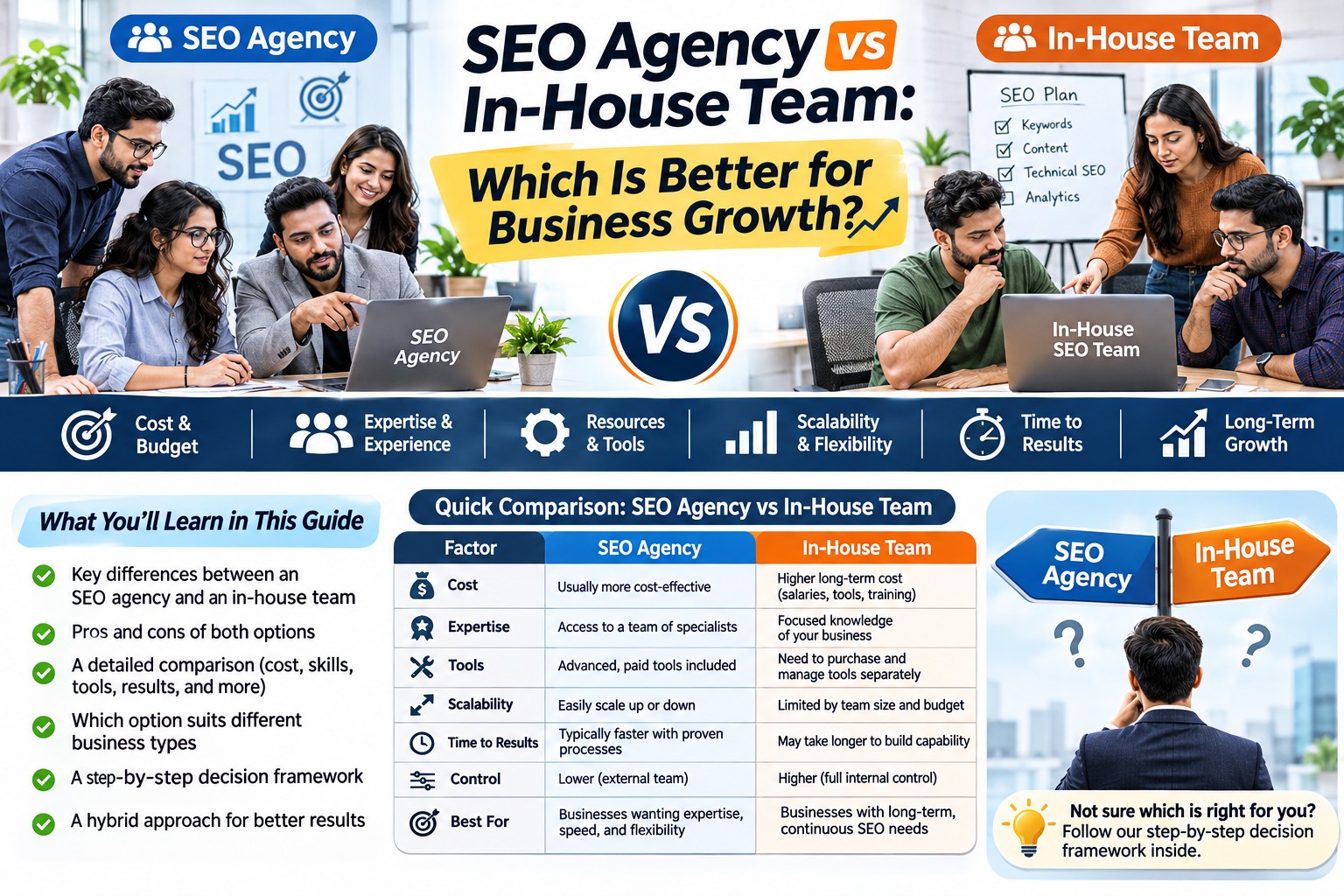
3. SEO Agency vs In-House Team: Quick Comparison

Before looking at individual factors, here is an overview.
| Factor | SEO Agency | In-House SEO Team |
|---|---|---|
| Hiring | Contract an external provider | Recruit employees |
| Expertise | Depends on agency specialists and scope | Depends on employees hired |
| Initial setup | Often simpler than building a full department | Requires recruitment and onboarding |
| Business knowledge | Needs onboarding and regular communication | Can develop deep internal knowledge |
| Technical SEO | May provide specialist access | Requires suitable internal expertise |
| Content production | Depends on contract and agency resources | Requires writers or editorial support |
| Control | Managed through agreed scope and approvals | Direct management and prioritisation |
| Scalability | May increase capacity through a revised agreement | Requires more hiring or resource allocation |
| Tools | Some may be included in agency fees | Usually purchased or provided by employer |
| Communication | Requires coordination with an external team | Direct access to internal colleagues |
| Accountability | Based on contract and service delivery | Based on employee roles and management |
| Knowledge retention | Documentation and handover are important | Knowledge can remain internally |
| Long-term cost | Retainer or project-based expense | Salaries, benefits, tools and overhead |
| Best fit | Businesses needing external capability and flexibility | Businesses needing sustained internal ownership |
Neither model guarantees rankings, leads or sales.
The quality of the strategy, implementation and business support matters more than the label attached to the team.
4. Cost Comparison: Is an SEO Agency Cheaper Than an In-House Team?

Cost is often the first factor business owners consider.
However, comparing an agency's monthly fee with one employee's salary does not provide a complete picture.
An agency fee may cover several specialists, but their time is shared across clients and limited by the contract.
An employee's salary covers an internal role, but the business may also need to pay for recruitment, tools, additional staff and other expenses.
Cost of hiring an SEO agency
SEO agency fees vary depending on:
-
Website size.
-
Competition.
-
Geographic target.
-
Number of services or products.
-
Technical complexity.
-
Content requirements.
-
Number of markets.
-
Scope and expected level of support.
For illustration, imagine three possible monthly budgets in India:
| Monthly budget | Possible type of engagement |
|---|---|
| ₹20,000–₹35,000 | Limited-scope SEO support for a smaller website |
| ₹35,000–₹75,000 | Broader ongoing SEO activities, depending on scope |
| ₹75,000+ | More extensive SEO work or specialist support |
These are hypothetical planning bands, not verified market averages or guarantees of service quality.
A ₹30,000 retainer may include a useful set of activities at one agency and a very limited scope at another.
Always ask for a written breakdown of what is included.
Cost of building an in-house SEO team
Consider an illustrative setup for a growing business in India.
| Position | Example monthly salary |
|---|---|
| SEO Manager | ₹60,000 |
| SEO Executive | ₹30,000 |
| Content Writer | ₹25,000 |
| Total base salaries | ₹1,15,000 |
Annual base salaries would be ₹13,80,000.
This excludes employer contributions, recruitment, equipment, software, training and other overhead.
The company may also need access to developers, designers or technical specialists.
These are example salaries for comparing operating models, not claims about current market compensation.
A realistic annual cost example
Suppose an SEO agency charges ₹45,000 per month.
Annual retainer cost:
₹45,000 × 12 = ₹5,40,000
Now suppose an in-house team has monthly base salaries of ₹1,15,000.
Annual salary cost:
₹1,15,000 × 12 = ₹13,80,000
The difference in this example is ₹8,40,000 before other costs.
However, the comparison is not automatically fair.
The in-house team may provide substantially more dedicated working hours, while the agency may provide specialist expertise across different functions.
The agency might also charge separately for content, development or outreach.
What should you compare instead?
Compare the total cost of obtaining the capabilities and work your business actually needs.
Ask:
-
How many hours of specialist work are required?
-
Which skills are essential?
-
Does the website need regular development support?
-
How much content needs to be created?
-
What software is required?
-
Who will manage the work?
-
How quickly will priorities change?
Key takeaway: An agency can be more cost-effective when you need several skills at limited capacity. An internal team can become economically attractive when you need substantial, continuous SEO work and can keep employees productively engaged.
5. Expertise: Can One SEO Employee Match an Entire Agency?

SEO is not one single activity.
It involves several disciplines, including technical website performance, content relevance, search behaviour, information architecture, data analysis and implementation.
This creates an important hiring challenge.
A strong SEO specialist may have broad knowledge, but no single person is equally experienced in every possible SEO problem.
Technical SEO
Technical SEO can involve:
-
Crawling and indexing.
-
Robots.txt configuration.
-
XML sitemaps.
-
Canonical tags.
-
Redirects.
-
Pagination.
-
Duplicate URLs.
-
JavaScript rendering.
-
Structured data.
-
Core Web Vitals.
-
Server response issues.
-
Website migrations.
Some issues can be handled by an SEO specialist. Others require collaboration with developers or infrastructure teams.
An agency with genuine technical SEO expertise may provide access to people who have worked on different platforms and website structures.
An in-house specialist can also develop deep technical knowledge, particularly when working on the same website over time.
Content SEO
Content SEO involves more than adding keywords to articles.
It requires understanding search intent, identifying useful topics, avoiding unnecessary page overlap, improving existing pages and connecting content to relevant business services.
An agency may have content strategists and writers available.
An in-house team may have better access to product managers, sales teams and subject matter experts.
Both can produce excellent content when research, editing and subject knowledge are handled properly.
Data analysis
SEO analysis requires understanding what the numbers mean.
For example, a traffic decline may be caused by seasonal demand, a technical issue, a change in search visibility or a tracking problem.
An experienced analyst should investigate the evidence rather than assume every decline is caused by a Google update.
Both agency and internal analysts need access to reliable data and the ability to interpret it.
Which option wins on expertise?
The answer depends on the actual people involved.
A highly experienced in-house SEO manager may outperform a weak agency.
A specialist agency may provide capabilities that a small internal team cannot reasonably maintain.
Do not assume that an agency automatically has more expertise or that an employee automatically understands SEO better.
Evaluate skills, experience and demonstrated work.
6. Business Understanding: Who Will Understand Your Customers Better?
In-house teams often have an advantage when it comes to direct access to business information.
Employees can speak regularly with sales teams, product managers, customer support staff and senior management.
This can help them understand:
-
Customer requirements.
-
Product specifications.
-
Pricing.
-
Common objections.
-
Competitor differences.
-
Sales cycles.
-
Customer feedback.
-
New business priorities.
An agency must usually obtain this information through onboarding, meetings and ongoing communication.
Example: A B2B manufacturing company
Imagine a company manufacturing industrial pumps.
The business sells different pumps for different applications, industries and operating conditions.
An internal employee may learn directly from the engineering and sales teams which specifications matter to buyers.
An external agency may initially know less about the products.
However, an agency that conducts proper interviews, studies technical documentation and reviews customer enquiries can develop a useful understanding of the business.
How to make either model work
The SEO team should have access to people who understand the products and customers.
For example, content about industrial equipment should be reviewed by someone with relevant technical knowledge.
SEO research can identify what customers search for, but subject matter experts help ensure that the information is accurate and useful.
The strongest model is not necessarily the one with the closest physical proximity. It is the one that consistently connects SEO decisions with real customer needs.
7. Speed of Execution: Which Option Gets Work Done Faster?
Many businesses assume that an agency can start delivering results immediately.
Others assume that an in-house employee will work faster because they are always available.
Neither assumption is reliable.
There are two separate questions:
-
How quickly can the team begin useful work?
-
How quickly can the recommended changes be implemented?
Agency onboarding
An agency may already have tools, workflows and specialists available.
This can make it easier to begin audits, research and planning without recruiting employees.
However, the agency still needs time to understand your website, business and priorities.
It may also depend on your internal team for access and approvals.
In-house recruitment
Building an internal team can take longer because you need to:
-
Prepare job descriptions.
-
Interview candidates.
-
Evaluate technical knowledge.
-
Negotiate compensation.
-
Complete joining formalities.
-
Provide training and onboarding.
Once the employee understands the company, ongoing coordination may become faster.
The development bottleneck
A major reason SEO projects move slowly is that recommendations are not implemented.
For example, an SEO specialist may identify incorrect canonical tags, duplicate URLs or website performance problems.
If no developer is available, those issues can remain unresolved regardless of whether the SEO specialist works internally or externally.
Before choosing a model, ask who will implement technical recommendations.
What about SEO results?
Neither option can guarantee faster rankings simply because of its operating model.
Search performance depends on the quality of implementation, competition, search demand, website condition and other factors.
A good agency can produce strong work. A good internal team can do the same.
The important issue is whether the business has a clear process for completing priorities.
8. Control and Accountability: Who Manages SEO Better?
With an in-house team, management usually has more direct control over daily work.
You can assign tasks, change priorities, hold internal meetings and coordinate with other departments.
With an agency, work is managed through the agreed scope, project plans and communication arrangements.
Both models require accountability.
In-house accountability
A company can set employee responsibilities and review performance.
However, an employee may be working on several internal requests at the same time.
For example, the SEO manager may be asked to support website development, prepare reports, assist the content team and handle urgent management requests.
Without clear priorities, important SEO work may be delayed.
Agency accountability
An agency should provide:
-
Defined responsibilities.
-
Agreed deliverables.
-
Regular progress updates.
-
Clear reporting.
-
Issue tracking.
-
Escalation procedures.
-
Review meetings.
The contract should explain what is included and what requires additional approval.
Who is responsible for business outcomes?
SEO performance is influenced by several departments.
An agency may recommend improving service pages, but the business must provide accurate information.
An internal SEO employee may identify a technical issue, but the development team must implement the fix.
A useful accountability system identifies who owns each task and how progress will be measured.
Avoid making one person or agency responsible for outcomes that depend on decisions outside its control.
9. SEO Tools: Agency Subscriptions vs Internal Software Costs
Professional SEO work often uses multiple tools.
Examples include:
-
Google Search Console.
-
Google Analytics 4.
-
Google Tag Manager.
-
Screaming Frog SEO Spider.
-
Ahrefs.
-
Semrush.
-
PageSpeed Insights.
-
Looker Studio.
-
Log analysis tools.
-
Website crawlers and auditing platforms.
Some tools are free. Others require paid subscriptions.
How agencies handle tools
Agencies may already subscribe to several tools and spread those costs across client projects.
However, not every subscription or tool capability is necessarily included in the retainer.
Ask which tools the agency uses and whether any additional licences are required.
How in-house teams handle tools
An internal SEO team may require dedicated subscriptions.
The business should consider:
-
Subscription costs.
-
User limits.
-
Project limits.
-
Training requirements.
-
Data retention.
-
Tool administration.
Do expensive tools guarantee better SEO?
No.
Tools provide information, but people must interpret it.
For example, a crawler may identify thousands of URLs with similar titles.
A knowledgeable SEO specialist needs to determine whether those URLs represent a real problem, which pages matter and what changes are appropriate.
The quality of analysis and implementation matters more than the number of subscriptions.
10. Content Production: Which Model Is Better for SEO Content?
Content can be one of the largest ongoing parts of an SEO strategy.
Businesses may need:
-
Service pages.
-
Product descriptions.
-
Category pages.
-
Buying guides.
-
Industry articles.
-
FAQs.
-
Location-specific content.
-
Case studies.
-
Comparison pages.
-
Updates to existing articles.
Agency content teams
An agency may provide writers, editors and SEO specialists who work together.
This can be convenient when the business needs regular content production.
However, quality depends on the writers' research, editing standards and understanding of the industry.
In-house content teams
Internal writers may have easier access to company knowledge.
They can interview salespeople, product specialists and customer support teams.
However, they still need SEO direction and editorial standards.
Avoid publishing content only to meet monthly targets
Whether content is produced internally or externally, each page should have a clear purpose.
Before approving a topic, ask:
-
Who is the intended reader?
-
What question does the page answer?
-
Does the topic support a product or service?
-
Does the website already cover the subject?
-
What unique information can the business provide?
-
How will the content be reviewed?
-
What will make it useful to the reader?
For example, a medical device manufacturer may benefit more from accurate, detailed product information and practical purchasing guidance than from large volumes of generic healthcare articles.
A practical content workflow
The SEO specialist identifies search demand and page opportunities.
A subject expert provides technical information.
A writer prepares the content.
An editor checks clarity and accuracy.
The SEO team reviews page structure, internal links and search relevance.
The business approves important claims.
This workflow can operate within an agency, an internal team or a hybrid model.
11. Technical SEO: When Specialist Support Becomes Essential
Some websites have relatively simple technical requirements.
Others contain thousands or millions of URLs, complex filters, multiple languages, JavaScript applications or custom content management systems.
The more complex the website, the more important technical expertise becomes.
Common technical challenges
Large e-commerce websites: Product variations, faceted navigation, duplicate URLs and category architecture.
News websites: Rapid publication, indexing, sitemaps, pagination, structured data and archive management.
B2B websites: Product categories, multilingual content, technical documentation and service pages.
Multi-location businesses: Location architecture, duplicate content risks and local relevance.
Custom CMS websites: URL generation, canonical logic, redirects, structured data and technical implementation.
When an agency may be useful
A specialist agency may have experience with problems that your internal team encounters only occasionally.
For example, a website migration may require expertise in URL mapping, redirects, metadata preservation, staging reviews and post-launch monitoring.
Hiring a permanent specialist for an occasional migration may not be necessary.
When in-house technical SEO makes sense
If your website is constantly changing, an internal technical SEO specialist can work closely with developers and product managers.
This can be valuable for large websites where SEO needs to be considered during every release.
A common mistake
Businesses sometimes hire an SEO executive and expect that person to solve every technical issue.
A better approach is to define the actual technical requirements and provide the right development and specialist support.
12. Scalability: Which Option Can Support Business Expansion?
Your SEO requirements may change as the business grows.
You might start with one website and later add:
-
New product categories.
-
Additional services.
-
More cities.
-
International markets.
-
New languages.
-
Separate brand websites.
-
E-commerce functionality.
Scaling with an agency
An agency may be able to increase the resources assigned to your project.
For example, you might add technical SEO support, content production or international SEO expertise.
However, scaling generally requires changes to the scope, budget and delivery arrangements.
Scaling with an in-house team
An internal department can grow by hiring more employees.
This provides dedicated capacity, but recruitment and training take time.
You also need managers capable of coordinating the work.
Which model is more flexible?
An agency may offer greater flexibility for short-term specialist requirements or fluctuating workloads.
An internal team may be better suited to large, predictable workloads that require continuous attention.
The right choice depends on how much SEO work your business needs and how frequently that requirement changes.
13. SEO Agency vs In-House Team for Different Business Types
The best operating model depends heavily on your business.
Small businesses and local service providers
Examples include:
-
Clinics.
-
Local consultants.
-
Home service businesses.
-
Small professional firms.
-
Local retailers.
These businesses may not need a full-time SEO department.
Their priorities may include local search visibility, service pages, Google Business Profile management, website improvements and enquiry tracking.
A suitable agency or experienced consultant may provide the required expertise without the expense of building a team.
B2B manufacturers and industrial suppliers
Manufacturing companies often have specialised products and long sales cycles.
SEO may involve technical product information, industry-specific keywords, category pages and distributor enquiries.
A useful arrangement may combine an external SEO specialist with an internal product or marketing contact who can provide accurate information.
E-commerce businesses
An e-commerce website may have hundreds or thousands of product pages.
SEO can require frequent coordination with merchandising, development, content and analytics teams.
A growing e-commerce business may benefit from an internal SEO owner, supported by an agency for specialist work.
News and publishing websites
News websites often require continuous SEO attention.
Their teams may need to manage article publishing, indexing, sitemaps, internal linking, evergreen content and technical issues.
An in-house SEO team can be valuable because editorial and technical decisions happen frequently.
External specialists can still help with audits, migrations and complex problems.
SaaS and technology companies
Software businesses may need product-led content, technical documentation, comparison pages, international SEO and close collaboration with product teams.
An internal SEO strategist can be useful for aligning search priorities with product development.
An agency may help with technical audits, content scaling or specialist campaigns.
Large enterprises
Enterprises may operate several websites across countries, languages and business divisions.
They often need internal SEO leadership because search optimisation affects product, engineering, content, legal and marketing decisions.
Agencies can support specific projects, markets or specialist requirements.
14. What Happens When Your SEO Manager Leaves the Company?
Employee turnover is an important but often overlooked factor.
Suppose your company has one SEO manager responsible for strategy, tools, reporting and website optimisation.
If that employee resigns, the business may lose operational continuity.
The company then needs to recruit and train a replacement.
Reduce dependency on one person
Maintain documentation covering:
-
SEO strategy.
-
Website structure.
-
Important keywords and landing pages.
-
Technical issues.
-
Completed changes.
-
Access permissions.
-
Reporting dashboards.
-
Ongoing projects.
-
Developer requirements.
-
Content plans.
Can agencies have continuity problems?
Yes.
An agency may change account managers or specialists. Service quality can decline if handovers are poor.
Ask the agency how it documents work and manages staff changes.
The goal is to make SEO knowledge accessible to the business, regardless of who performs the work.
15. Hidden Costs Businesses Often Overlook
The obvious cost of SEO is usually the monthly agency fee or employee salary.
However, there are other expenses.
Hidden costs of an in-house team
-
Recruitment and interview time.
-
Employee benefits and statutory contributions.
-
Computers and equipment.
-
Software subscriptions.
-
Training.
-
Management time.
-
Additional specialist support.
-
Staff turnover.
-
Temporary gaps in capability.
Potential additional costs of an agency
-
Content writing outside the retainer.
-
Website development.
-
Landing page design.
-
Specialist technical projects.
-
Paid outreach or publisher fees.
-
Additional markets or websites.
-
Extra reporting requirements.
-
One-time setup work.
-
Third-party subscriptions.
Neither model should be assumed to include everything.
Ask for a clear scope and total budget before making a decision.
16. How to Compare SEO Return on Investment Fairly
SEO ROI should not be judged only by keyword rankings or traffic growth.
The business should consider the commercial value generated and the cost of achieving it.
However, SEO can influence customers at different stages of their buying journey, and not every benefit can be attributed perfectly.
Example: Comparing two SEO operating models
Consider the following hypothetical annual figures.
| Metric | SEO Agency | In-House Team |
|---|---|---|
| Annual SEO operating cost | ₹6,00,000 | ₹15,00,000 |
| Qualified organic leads | 300 | 600 |
| Cost per qualified lead | ₹2,000 | ₹2,500 |
| Customers acquired | 30 | 72 |
| Cost per acquired customer | ₹20,000 | ₹20,833 |
These numbers are illustrative, not performance benchmarks.
The in-house team generates more customers, but it also costs more.
The agency has a slightly lower acquisition cost in this example.
Which option is better depends on factors such as customer value, profitability, available budget, capacity and long-term business requirements.
Consider the sales cycle
A B2B company may receive an enquiry in January and close the sale in June.
A report that only measures immediate monthly revenue may undervalue earlier SEO activity.
Where possible, track qualified enquiries, sales opportunities, customer acquisition and revenue over an appropriate period.
Do not forget implementation costs
If the SEO team recommends changes that require developers or designers, those costs should be considered when evaluating the full investment.
17. The Hybrid Model: Combining an In-House Team With an SEO Agency
For some businesses, the most effective solution is not choosing between an agency and an internal team.
It is combining their strengths.
A hybrid SEO model typically involves an internal employee who owns the business priorities and an external agency that provides additional expertise or execution capacity.
How a hybrid SEO team works
The internal team may handle:
-
Business priorities.
-
Product knowledge.
-
Internal coordination.
-
Content approvals.
-
Developer communication.
-
Sales feedback.
-
SEO roadmap ownership.
The agency may handle:
-
Technical audits.
-
Keyword and competitor research.
-
Specialist recommendations.
-
Content optimisation.
-
Digital PR.
-
SEO reporting support.
-
Website migration assistance.
The responsibilities can be adjusted to the business.
Example: A growing manufacturing company
Suppose a manufacturing company has a marketing manager who understands the products and target customers but does not have advanced technical SEO expertise.
Instead of hiring a complete SEO department, the company engages an SEO agency.
The marketing manager provides business information, approves priorities and coordinates with the internal development team.
The agency conducts SEO research, identifies website improvements and supports implementation.
This arrangement can combine internal business knowledge with external specialist skills.
Avoid duplicated responsibilities
A hybrid model can become inefficient when both teams assume the other is responsible for a task.
For example, the agency may recommend updating product descriptions, while the internal team assumes the agency will publish them.
Create a responsibility matrix.
| Activity | Internal team | Agency |
|---|---|---|
| Business objectives | Owns | Advises |
| Keyword research | Reviews | Leads |
| Product information | Provides | Uses |
| Content drafting | Supports | Leads if contracted |
| Technical audit | Reviews | Leads |
| Website implementation | Coordinates | Supports if contracted |
| Performance reporting | Reviews | Prepares or supports |
| Sales feedback | Provides | Analyses |
This is one possible arrangement. The final responsibilities should be agreed in writing.
18. When Should You Hire an SEO Agency?
An SEO agency may be the more practical option when:
You do not have an SEO team
If nobody in your company has the necessary SEO expertise, an agency can help establish a strategy and identify priorities.
Your budget cannot support several specialists
You may need technical SEO, content planning and analytics support without having enough work or budget to employ separate specialists full-time.
Your website has specific technical problems
An agency with relevant expertise may help investigate crawling, indexing, migrations or other specialised issues.
You need flexible capacity
If your workload changes frequently, an agency may be able to adjust resources through an agreed scope.
Your marketing team needs additional support
An existing marketing manager may benefit from external SEO specialists rather than building a separate department.
You want an independent review
An external team can assess your current strategy and identify issues that internal staff may have overlooked.
However, you should still evaluate the agency's actual experience, communication and proposed deliverables.
19. When Should You Build an In-House SEO Team?
An internal SEO team may be the better option when:
SEO is central to your business
If organic search is a major acquisition channel, dedicated internal ownership may be valuable.
Your website changes every day
Large e-commerce, news and marketplace websites may require continuous coordination between SEO, development and content teams.
You need close collaboration with internal departments
SEO decisions may affect product launches, website releases, merchandising and editorial workflows.
You have enough ongoing work
A full-time employee or team makes more sense when there is a substantial and consistent workload.
You can invest in experienced leadership
Hiring several junior employees without strong SEO direction may create management and quality problems.
An experienced SEO leader can help establish priorities, train staff and build reliable processes.
You want to develop internal knowledge
Over time, an internal team can build detailed knowledge of your website, customers and business operations.
20. Common Mistakes When Hiring an SEO Agency
Hiring an external provider does not remove the need for due diligence.
Avoid these mistakes.
Choosing the cheapest agency without reviewing the scope: A low fee may mean limited specialist time or missing services.
Expecting guaranteed rankings: No agency controls Google's organic ranking systems.
Not asking who will work on your account: The sales representative may not be the person responsible for execution.
Ignoring technical implementation: Recommendations cannot help if important changes are never made.
Measuring only traffic: Relevant enquiries and commercial outcomes should also be considered.
Not providing business information: Agencies need accurate product and customer knowledge.
Giving away account ownership: Maintain appropriate control over your website and analytics.
Accepting vague monthly reports: Ask for completed work, findings, outcomes and next steps.
21. Common Mistakes When Building an In-House SEO Team
Internal hiring has its own risks.
Hiring one junior employee to handle everything
A junior SEO executive may be capable of useful work but may not have the experience to lead a complex SEO strategy independently.
Hiring without evaluating technical knowledge
SEO candidates should be assessed against the actual responsibilities of the role.
For example, a technical SEO role should involve practical questions about crawling, indexing, redirects, canonical tags and website architecture.
Expecting the SEO team to perform development work
SEO specialists can identify technical requirements, but they may need developers to implement changes.
Not providing proper tools
Employees need appropriate access to website data and tools.
Measuring performance only by keyword rankings
Set objectives that reflect relevant visibility, website improvements and business outcomes.
Failing to establish processes
Without documentation, reporting and task management, an internal team can become reactive rather than strategic.
22. Questions to Ask Before Hiring an SEO Agency
Use these questions during your agency evaluation.
-
Have you worked with businesses in our industry?
-
What SEO problems do you see on our website?
-
What would you prioritise during the first three months?
-
Who will manage our project?
-
Who will handle technical SEO?
-
Do you have content and development support?
-
Which activities are included in the monthly fee?
-
What work will cost extra?
-
How will you measure performance?
-
How will you track qualified organic enquiries?
-
How often will we receive updates?
-
What happens if the strategy needs to change?
-
Can you show relevant case studies?
-
Who will own the reports, accounts and data?
-
What are the cancellation and handover terms?
Look for clear explanations rather than unrealistic promises.
23. Questions to Ask Before Hiring an In-House SEO Specialist
If you decide to build an internal team, evaluate candidates through practical work and discussion.
Useful questions include:
-
How would you audit our website?
-
How would you identify commercially relevant keywords?
-
What would you do if important pages were not being indexed?
-
How would you handle duplicate URLs?
-
How would you improve internal linking?
-
How would you evaluate an existing blog strategy?
-
What would you check before a website migration?
-
How would you work with developers?
-
Which SEO tools have you used?
-
How would you measure organic enquiries?
-
How would you prioritise tasks with limited resources?
-
Can you explain an SEO project you have personally managed?
Consider a practical assignment using a sample website or a limited audit.
Do not rely only on certificates, years of experience or familiarity with tool names.
24. A Step-by-Step Framework to Choose the Right SEO Model
If you are still unsure, follow this process.
Step 1: Define your business objective
Do you want more local enquiries, B2B leads, online sales, product visibility or expansion into new markets?
Write down your main objective before comparing options.
Step 2: Assess your website
Consider the website's size, technical complexity, content quality, existing traffic and competition.
A small service website has different requirements from a large e-commerce platform.
Step 3: Identify the skills required
List the work your business needs.
For example:
-
Technical SEO.
-
Content strategy.
-
On-page optimisation.
-
Local SEO.
-
Analytics.
-
Digital PR.
-
Website development.
Step 4: Estimate the workload
Determine which activities require daily attention and which are periodic.
This helps identify whether you need dedicated employees or external support.
Step 5: Calculate the full budget
Include salaries or agency fees, software, content, development, recruitment and other relevant costs.
Step 6: Evaluate internal resources
Check whether your existing marketing, content and development teams can support SEO implementation.
Step 7: Compare the options
Evaluate cost, expertise, capacity, control, implementation speed and long-term needs.
Step 8: Choose a responsible owner
Whether you hire an agency or employees, someone should own the SEO roadmap and coordinate decisions.
Step 9: Establish performance measurement
Agree on the metrics that matter to your business.
Step 10: Review the arrangement regularly
As your website and business grow, your SEO operating model may need to change.
A company that starts with an agency may later hire an internal SEO manager. A business with an internal team may bring in external specialists for complex projects.
Your initial choice does not have to be permanent.
25. SEO Agency vs In-House Team: Which Should You Choose?
The following decision guide can help.
| Your situation | Option worth considering |
|---|---|
| Small business with no SEO employees | SEO agency or consultant |
| Limited budget and several specialist needs | Agency with a clearly defined scope |
| Large website requiring daily SEO decisions | In-house SEO ownership |
| Existing marketing team lacking technical SEO | Specialist agency |
| Multiple websites with continuous SEO work | In-house team, potentially with agency support |
| Occasional website migration or technical project | Specialist agency or consultant |
| Growing business with internal marketing manager | Hybrid model |
| Enterprise with multiple departments and markets | In-house leadership plus external specialist support |
These are starting points, not fixed rules.
For example, a small business with a highly skilled SEO founder may not need an agency. A large business may outsource most SEO work successfully if it has strong internal ownership and coordination.
A simple way to make the decision
Ask yourself:
Do we need a dedicated person working on SEO every day, or do we need access to several specialists for a defined amount of work?
If your business needs a broad range of skills but cannot justify multiple full-time hires, an agency may be appropriate.
If SEO is a continuous operational priority requiring close involvement with several departments, internal ownership may be more valuable.
If both are true, consider a hybrid approach.
26. How to Measure Success After Choosing Your SEO Model
After selecting an agency or building an internal team, establish a consistent performance review.
Review the work completed
Check whether agreed tasks were completed and implemented correctly.
Monitor search visibility
Review relevant search queries, organic clicks, impressions and important landing pages.
Evaluate content performance
Check whether your content reaches the intended audience and answers useful questions.
Track technical improvements
Monitor important crawling, indexing and website performance issues.
Measure qualified enquiries
Where possible, connect organic enquiries with sales feedback.
Review commercial outcomes
Evaluate customer acquisition and revenue contribution over a suitable period.
Adjust the strategy
Use performance data to decide what should continue, change or stop.
The purpose is not to make the SEO team produce a larger report. It is to make better decisions about business growth.
Conclusion: Choose the SEO Model That Fits Your Business, Not Just Your Budget
The decision between an SEO agency and an in-house team should not be based only on monthly fees or assumptions about which option produces faster results.
Both models have strengths and limitations.
An SEO agency can be useful when your business needs specialist expertise, flexible support and access to several SEO capabilities without hiring a complete department.
An in-house team can be valuable when SEO is a major long-term priority, your website requires frequent changes and close coordination with internal departments is essential.
For some businesses, combining internal ownership with external expertise provides a practical balance.
Before making a decision, consider your website, competition, available resources, technical requirements, content needs and business objectives.
Most importantly, remember that SEO growth depends on the quality of the strategy, the work completed and the ability to turn relevant search visibility into business opportunities—not simply whether the team is internal or external.
Need SEO Support Without Building a Complete In-House Team?
At SEOspade, we help businesses approach search engine optimisation with a focus on technical improvements, relevant search visibility, useful content and business objectives.
Whether you are starting SEO for the first time, looking for specialist support for your existing marketing team or reviewing your current SEO strategy, the right starting point is understanding what your website actually needs.
Explore SEOspade's services and discuss how an external SEO partnership could fit your business requirements.