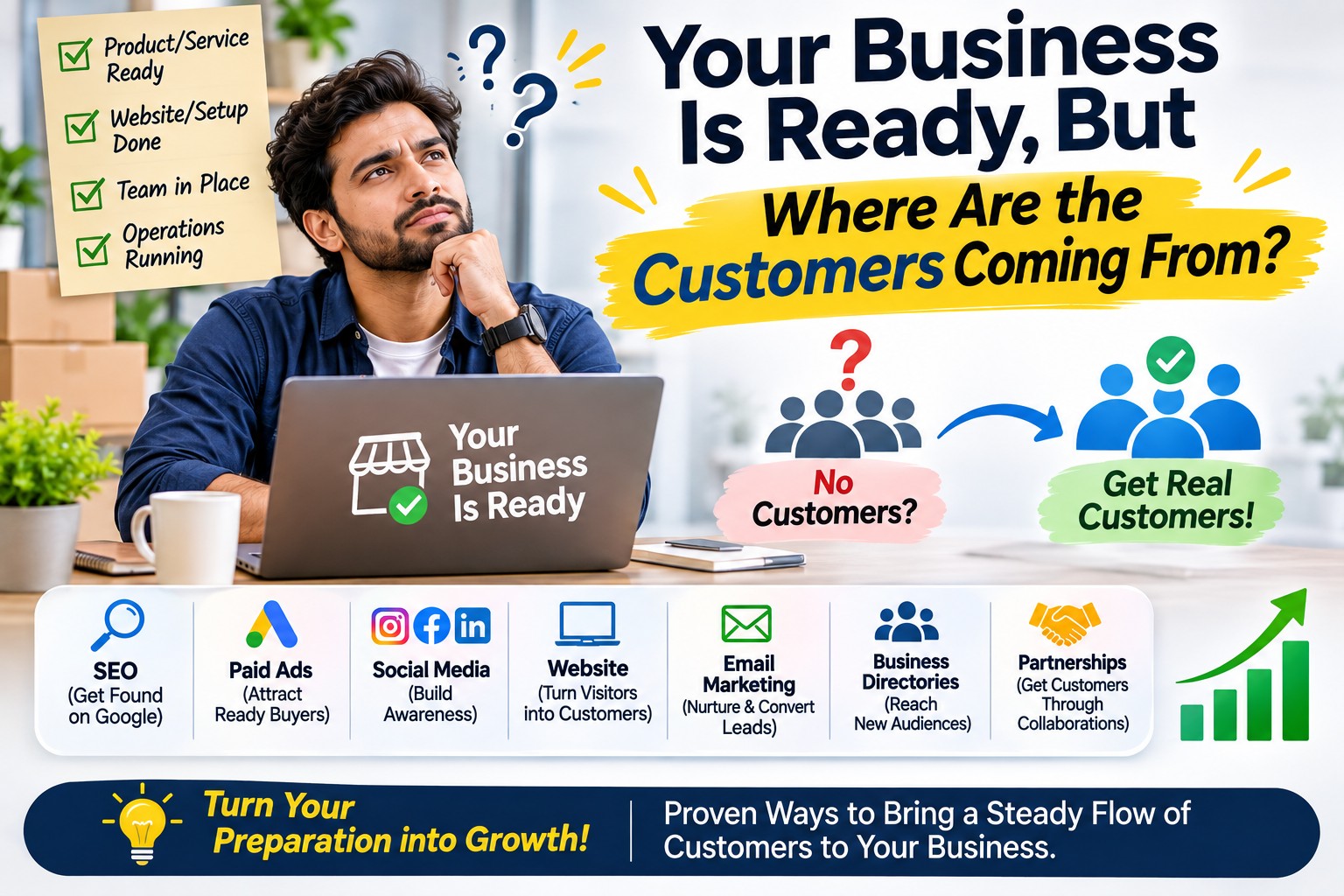
You have registered your business, finalised your products or services, arranged an office or workspace, hired the people you need and perhaps even launched a professional website.
Everything seems ready.
You have spent weeks or months preparing for this moment. You have invested your savings, purchased equipment, created a company logo, arranged suppliers and worked hard to make sure you can deliver what customers need.
Now you are waiting for enquiries.
A few days pass. Your phone is quiet.
You check your business email, but there are no serious enquiries. You visit your website analytics and notice that only a handful of people have visited. Your social media posts receive a few likes, mostly from people you already know.
You start asking yourself an uncomfortable question:
My business is ready, but where are the customers going to come from?
This is one of the most important questions a new business owner can ask.
Starting a business and attracting customers are two different challenges. You can have an excellent product, experienced employees, competitive prices and a well-designed office, but none of these automatically guarantees that people will discover your business.
Customers need a reason to look for you, a way to find you, enough information to trust you and a clear path to purchase.
If you have not planned how those things will happen, your business may be operationally ready but commercially unprepared.
The solution is not necessarily to spend heavily on advertisements or hire a large sales team immediately.
First, you need to understand whether people want what you offer, who those people are, how they currently solve their problems and what would make them consider your business.
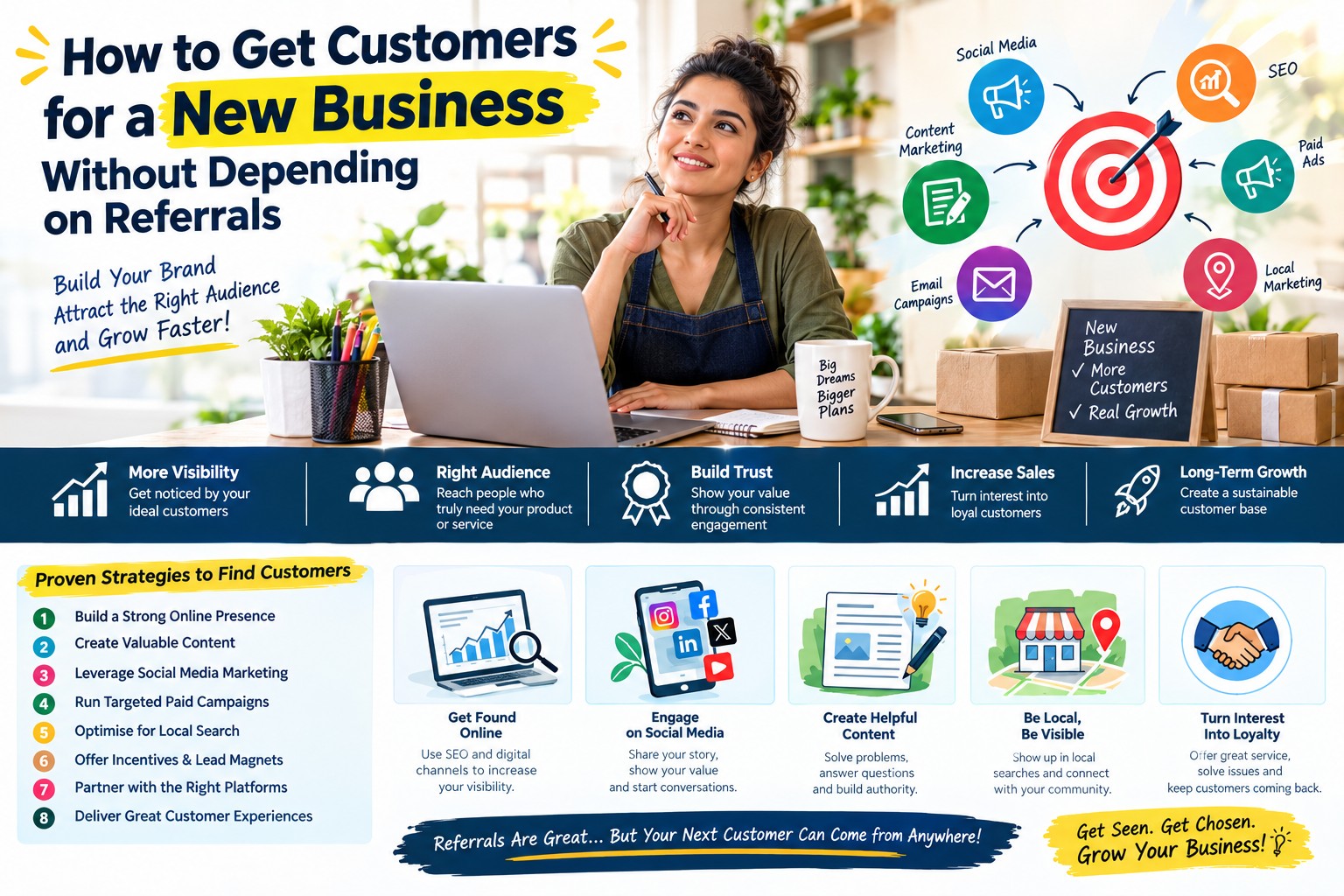
This guide explains how to move from having a business that is ready to operate to having a practical system for attracting enquiries, learning from potential customers and developing a sustainable sales pipeline.
1. A Business Can Be Fully Set Up and Still Not Be Ready for Customers

When starting a business, most owners naturally focus on getting everything ready for operations.
They arrange registrations, purchase equipment, develop products, recruit employees, design packaging, create websites and organise finances.
These activities are important.
However, they answer one question:
Can we deliver our product or service?
They do not answer another equally important question:
Who is going to buy it, and how will they find us?
Consider a company that has invested ₹10 lakh in setting up a manufacturing unit.
It has machinery, workers, raw materials and production capacity.
But if the owner has not identified potential distributors, wholesalers, retailers or businesses that purchase the manufactured product, production capacity alone will not generate orders.
The same problem can affect a consulting firm, digital agency, software company, local service provider or online store.
Operational readiness versus customer readiness
| Operational readiness | Customer acquisition readiness |
|---|---|
| Product or service is ready | Target customers are identified |
| Office or workspace is arranged | Potential buyers know how to discover the business |
| Employees are hired | Sales and enquiry responsibilities are assigned |
| Website is launched | Website explains the offer and supports enquiries |
| Pricing is decided | Pricing has been tested against customer expectations |
| Business registrations are completed | Relevant marketing and sales channels are selected |
| Delivery process is prepared | Customer follow-up process is established |
Both sides matter.
A business that generates demand but cannot deliver may disappoint customers.
A business that can deliver but cannot attract customers may struggle to cover its expenses.
The objective is to develop both capabilities together.
2. Before Marketing Your Business, Check Whether There Is Real Customer Demand

One of the most expensive mistakes a new business can make is assuming that people will buy a product simply because it is useful.
A product can solve a genuine problem without enough customers being willing or able to pay for it at your chosen price.
Before spending heavily on marketing, investigate whether people are actively looking for the solution you provide.
Start with the problem, not the product
Instead of asking, "How can I promote my service?" begin with:
"What problem makes someone need this service?"
For example, a company offering website development might serve businesses that:
-
Have recently started operating and need an online presence.
-
Have an outdated website that does not represent their business properly.
-
Want to generate more enquiries through their website.
-
Need a product catalogue for distributors.
-
Want to accept online orders.
-
Need specific functionality for customers or employees.
Each situation represents a different customer need.
The same website development service may need to be presented differently depending on the customer's problem.
Speak with potential customers
Before finalising your marketing approach, try to speak with people who match your target audience.
Ask practical questions:
-
How do you currently solve this problem?
-
What difficulties do you experience?
-
Have you paid for a similar solution before?
-
What did you like or dislike about it?
-
How do you usually find service providers?
-
What information do you need before making a purchase?
-
What would make you consider a new company?
Avoid asking only, "Would you buy my product?"
People may respond positively to be polite, even when they have no intention of purchasing.
Questions about past behaviour, current problems and actual spending often provide more useful information.
Look for evidence of demand
Possible signals include:
-
People actively searching for relevant products or services.
-
Existing businesses selling comparable solutions.
-
Customers requesting quotations.
-
Businesses discussing the problem in relevant communities.
-
Potential buyers agreeing to a product demonstration.
-
Genuine enquiries after a small marketing test.
-
Customers willing to place an order or pay for a trial.
No single signal guarantees success.
The more evidence you gather, the better informed your marketing decisions become.
3. Identify Your First Realistic Customer Segment

Many new businesses describe their target audience too broadly.
A business owner might say:
"Every company needs our service."
That may sound promising, but it does not tell you where to begin.
Different customers have different budgets, requirements and purchasing processes.
A new business usually has limited time and resources. It is more practical to start with a clearly defined group of potential customers.
Example: A new digital marketing company
Instead of targeting every business in India, the agency might initially focus on:
"Small manufacturing companies in Delhi NCR that have websites but receive very few online enquiries."
This gives the business a clearer direction.
It can research relevant companies, understand their websites, identify common problems and develop suitable service offerings.
Build a basic customer profile
| Question | Example answer |
|---|---|
| Who is the customer? | Owner of a small manufacturing business |
| Where are they located? | Delhi NCR |
| What is the problem? | Limited online enquiries |
| What are they using now? | Referrals, directories and occasional advertisements |
| What might they need? | Website improvements, SEO and lead generation |
| Who makes the decision? | Owner or managing director |
| What concerns might they have? | Budget, trust, previous marketing experience and return on investment |
The profile should be based on research and conversations, not just assumptions.
Start narrow, then expand
A focused customer segment can help you:
-
Write more relevant marketing messages.
-
Identify suitable prospects.
-
Develop clearer service pages.
-
Understand common objections.
-
Compare your offering with alternatives.
-
Improve your sales conversations.
Once you learn what works, you can consider additional customer groups.
4. Understand What Customers Are Doing Before They Discover Your Business
Customers do not begin their buying journey by searching for your company name if they have never heard of you.
They usually begin with a problem or requirement.
A business owner may search Google for a service provider.
A procurement manager may compare suppliers.
A homeowner may ask for local recommendations.
A founder may research how much a website costs.
A company director may ask a colleague about suitable consultants.
Your task is to understand these behaviours and make your business visible at relevant points.
Map the customer's buying journey
A typical journey may include:
Problem recognition: The customer realises something needs to be solved.
Research: The customer looks for information or potential solutions.
Comparison: The customer evaluates providers, prices, experience and suitability.
Enquiry: The customer contacts one or more businesses.
Decision: The customer chooses a provider or decides not to purchase.
Experience: The customer receives the product or service and evaluates the outcome.
Your marketing should support the stages relevant to your business.
Example: A company looking for an industrial supplier
A procurement manager may begin by searching for a particular product specification.
They might then compare manufacturers, check product catalogues, request quotations and ask about minimum order quantities or delivery timelines.
A supplier with clear technical information and an easy quotation process may be easier to evaluate than one with only a generic homepage.
This illustrates why customer acquisition begins with understanding the buying process, not simply increasing website traffic.
5. Find Out Why Customers Would Choose You Over an Existing Business

Your potential customers probably already have alternatives.
They may be using an established supplier, buying from a local competitor, handling the work internally or choosing not to solve the problem immediately.
A new business must give customers a credible reason to consider changing their current approach.
Do not rely only on saying you offer quality
Almost every company claims to provide high-quality products, reliable services and excellent customer support.
These statements mean little unless you explain what customers can expect.
For example, a packaging supplier might differentiate itself through:
-
Suitable material options for specific products.
-
Clear minimum order quantities.
-
Custom packaging capabilities.
-
Transparent quotation requirements.
-
Defined production and delivery processes.
A consulting firm might focus on specialist expertise, a clear service scope or better communication.
Identify your actual advantages
Ask:
-
Can we serve a customer group that competitors overlook?
-
Can we explain our service more clearly?
-
Do we offer useful specialisation?
-
Is our process simpler?
-
Can we provide relevant technical expertise?
-
Do we offer a different service model?
-
Can we demonstrate a specific benefit?
Your advantages must be genuine.
Do not promise the fastest delivery, lowest price or guaranteed results unless you can support those claims.
6. Your Website Is Live, but Can Customers Actually Find It?
Launching a website is an important step, but it does not automatically create visibility.
A new website may receive very little traffic because people do not know it exists and search engines have not yet developed strong signals about its relevance.
Even when visitors arrive, they may leave if the website does not explain what the business offers.
Review the website from a customer's perspective
Open your homepage and imagine you know nothing about the company.
Can you understand within a few seconds:
-
What the business sells?
-
Who the products or services are for?
-
Where the business operates?
-
Why someone should consider it?
-
What to do next?
If not, improve the message before spending more money to attract visitors.
Create useful service or product pages
A service page should answer practical customer questions.
For example, a commercial cleaning service page might explain:
-
Types of premises served.
-
Services included.
-
Service areas.
-
How quotations are prepared.
-
Scheduling arrangements.
-
Relevant equipment or methods.
-
How to request an inspection.
A manufacturing product page may need specifications, materials, applications, packaging information and quotation options.
The information should match what customers need before making contact.
Check the technical basics
Make sure:
-
The website works on mobile devices.
-
Important pages load reliably.
-
Contact forms work.
-
Navigation is understandable.
-
Pages are accessible to search engines where appropriate.
-
Important pages are linked internally.
-
Business contact information is accurate.
-
Analytics and enquiry tracking are configured appropriately.
A visually attractive website is not enough if customers cannot use it effectively.
7. Decide Whether Customers Are Already Searching for Your Services on Google
Google Search can be an important customer discovery channel when people actively look for products or services like yours.
But search demand varies by industry.
Some businesses serve customers who already know exactly what they need.
Others sell new or unfamiliar solutions that customers may not know how to search for.
This distinction matters when deciding how much to invest in SEO.
Example of existing search demand
A customer may search for:
-
Commercial cleaning services in Delhi.
-
Industrial packaging manufacturer.
-
Website development company for small business.
-
Rooftop solar installation company.
-
Accounting services for startups.
These searches suggest that the customer has identified a requirement.
A relevant business page may help them evaluate your offering.
Example of demand that needs education
Suppose your business offers an unfamiliar software tool that solves a problem customers do not yet recognise as something software can address.
Potential customers may not search for your product category.
You may need educational content, demonstrations, outreach or partnerships to explain the problem and solution before search demand develops.
What to check before investing in SEO
Research:
-
Whether people search for your services.
-
Which terms they use.
-
Whether those searches indicate commercial interest.
-
Which businesses currently appear.
-
What information the top results provide.
-
Whether your website can offer something genuinely useful.
-
Which pages should be prioritised.
SEO is valuable when it fits your market, but it should not be selected only because other businesses use it.
8. Don't Spend on Google Ads Until You Understand What Happens After the Click
Paid advertising can help a new business test whether relevant people respond to its offer.
However, advertisements do not solve every business problem.
If the product is poorly positioned, the website is confusing or the sales process is weak, additional traffic may simply increase spending.
Prepare before launching a campaign
Confirm that:
-
Your target customer is clearly defined.
-
Your product or service has a clear offer.
-
The landing page matches the advertisement.
-
Customers can submit enquiries easily.
-
Conversion tracking is configured.
-
Someone is responsible for responding.
-
You have a realistic testing budget.
Start with one clear objective
For example, a B2B company might test advertisements for quotation requests related to one important product category.
This is easier to evaluate than promoting ten unrelated services simultaneously.
Evaluate lead quality, not just clicks
Suppose a campaign produces 100 enquiries.
If most enquiries are unrelated to your services, the campaign may need changes even if the reported cost per lead looks attractive.
Review the actual customer requirements and the cost of qualified opportunities.
Know when to stop or adjust
Set a review process before spending.
If the campaign attracts irrelevant searches, change the targeting.
If visitors do not enquire, review the landing page and offer.
If enquiries arrive but do not become sales, investigate lead quality, pricing and follow-up.
Avoid increasing the budget until you understand the problem.
9. Choose Your First Marketing Channel Based on How Customers Buy
A common mistake is to start SEO, Instagram, LinkedIn, Google Ads, email marketing and directory listings all at once.
A new business may not have the budget or staff to manage everything properly.
Instead, choose the channel most closely connected to your customer's behaviour.
| Business situation | Channel worth evaluating first | Reason |
|---|---|---|
| Customers actively search for local services | Google Search and eligible Google Business Profile | Supports local discovery |
| Buyers search for specific products | Product-focused SEO or search advertising | Reaches people researching known requirements |
| Customers are identifiable B2B decision-makers | Targeted outreach and LinkedIn | Allows direct contact with relevant organisations |
| Products are highly visual | Suitable visual social platforms | Helps demonstrate products |
| The offering is unfamiliar | Educational content, demonstrations and outreach | Helps customers understand the solution |
| Buyers compare several providers | Detailed website pages and relevant search visibility | Supports evaluation and trust |
These are possible starting points, not guaranteed solutions.
Your market research should determine the final choice.
10. Start Customer Conversations Before Spending Heavily on Marketing
One of the fastest ways to learn about your market is to speak directly with potential customers.
This does not mean aggressively selling to everyone you know.
It means identifying relevant people and asking useful questions about their needs.
Prepare a list of suitable prospects
For a B2B business, research organisations that may genuinely benefit from your services.
For a local service business, identify relevant neighbourhoods, customer groups or complementary businesses.
Focus on learning
Your first conversations should help you understand:
-
Whether the problem is important.
-
How customers currently solve it.
-
What they find frustrating.
-
What they expect from a provider.
-
How they compare alternatives.
-
What information would help them decide.
Offer a clear next step
If someone has a relevant requirement, suggest an appropriate next action.
This might be a consultation, product demonstration, quotation or site visit.
Do not force a sales pitch on someone who is not interested.
Record what you learn
After several conversations, look for repeated patterns.
For example, you may discover that customers are more concerned about delivery reliability than price.
That insight could influence your website, advertisements and sales proposals.
11. Prepare an Offer That Makes It Easier for Customers to Take the First Step
Customers may hesitate to contact a new business because they do not know what to expect.
A clear initial offer can reduce uncertainty.
This does not necessarily mean giving discounts.
It means making the next step simple and understandable.
Examples of useful first-step offers
For a website development company:
"Request a website development estimate based on your requirements."
For a commercial cleaning business:
"Schedule a site assessment for a cleaning quotation."
For a software provider:
"Book a demonstration to see how the system works."
For a manufacturing supplier:
"Share your product specifications to receive a quotation."
For a consulting firm:
"Discuss your requirements and understand the proposed scope of work."
Explain what happens next
Customers should know whether they will receive a call, quotation, meeting invitation or request for additional details.
Avoid vague promises such as "Get instant results" when your service requires a detailed assessment.
12. Build Trust Before Asking Customers to Spend Money
Established businesses may have years of customer reviews, completed projects and brand recognition.
A new business may have none of these.
That creates uncertainty for buyers.
Your job is to reduce that uncertainty through accurate information and professional behaviour.
Show who is behind the business
Explain the relevant experience of founders and team members.
If your team has worked on similar projects before starting the company, describe that experience accurately.
Do not claim those projects were completed by your new company if they were not.
Explain your process
Describe how you handle enquiries, prepare quotations, deliver work and provide support.
A clear process can help customers understand what working with you will involve.
Provide genuine evidence
Depending on your business, this may include:
-
Product photographs.
-
Demonstrations.
-
Team qualifications.
-
Relevant certifications.
-
Samples.
-
Technical specifications.
-
Pilot projects.
-
Genuine customer feedback.
-
Transparent terms.
Avoid invented credibility
Do not publish fabricated reviews, unsupported client counts, false awards or logos of companies that have not authorised their use.
Trust is difficult to build and easy to lose.
13. Make Sure Your Business Can Respond When Customers Finally Contact You
Generating enquiries is only half the challenge.
A new business may lose opportunities because nobody is responsible for handling them.
Imagine a potential customer submits an enquiry on Friday afternoon.
Nobody responds until Tuesday.
By then, the customer may already have contacted several competitors.
Assign responsibility
Decide who will:
-
Monitor website enquiries.
-
Answer business calls.
-
Respond to emails.
-
Prepare quotations.
-
Schedule meetings.
-
Follow up with prospects.
-
Update sales records.
Even a one-person business needs a simple process.
Create an enquiry record
Track:
| Field | Purpose |
|---|---|
| Customer name | Identify the prospect |
| Contact information | Enable follow-up |
| Product or service required | Understand the enquiry |
| Enquiry source | Identify the marketing channel |
| Date received | Track response and progress |
| Lead status | Know what happens next |
| Next action | Avoid forgotten opportunities |
| Final outcome | Understand sales performance |
A spreadsheet may be enough initially.
As enquiry volume grows, a CRM can make the process easier to manage.
Respond with useful information
Avoid sending the same generic message to every prospect.
Read the enquiry, understand the requirement and explain the next step.
If you cannot provide the service, communicate that clearly.
Professional communication helps build credibility.
14. Understand Why Customers Are Not Buying, Even When They Enquire
Sometimes the problem is not attracting enquiries.
It is converting those enquiries into paying customers.
If people regularly contact your business but do not purchase, investigate what happens during the sales process.
Possible reasons
Pricing does not match expectations. Customers may not understand the value or may be comparing different service scopes.
The offer is unclear. They may not know exactly what is included.
The business lacks sufficient credibility. Customers may hesitate to trust a new provider.
The response is slow. Prospects may move to competitors.
The enquiry is not relevant. Marketing may be attracting the wrong audience.
The purchasing process is complicated. Customers may find it difficult to get a quotation or complete an order.
The customer is not ready. Some enquiries come from people researching future requirements.
Ask why opportunities are lost
Where appropriate, ask prospects for feedback.
Record the reasons without pressuring them.
Over time, this can help you improve pricing explanations, service packages, proposals and customer targeting.
15. How Much Should You Spend on Marketing Before Your First Customers Arrive?
There is no universal amount that every new business should spend.
Your budget should depend on your available funds, expected margins, customer value and the cost of reaching relevant prospects.
Separate setup costs from marketing costs
You may already have spent money on:
-
Business registration.
-
Office space.
-
Equipment.
-
Product development.
-
Website development.
-
Employee salaries.
-
Software.
-
Inventory.
These are not all customer acquisition expenses.
Marketing costs may include:
-
Advertising spend.
-
SEO services.
-
Content creation.
-
Landing page development.
-
Outreach tools.
-
Marketing software.
-
Campaign management.
Understanding the difference helps you plan more accurately.
Calculate what a customer is worth
Suppose your service sells for ₹30,000.
Your direct delivery cost is ₹18,000.
That leaves ₹12,000 before marketing expenses and other overheads.
If acquiring one customer costs ₹10,000, the remaining contribution may be too small to support the business.
If customer acquisition costs ₹3,000, the economics may be more attractive.
Actual calculations should also consider repeat purchases, refunds, overheads and the sales cycle.
Protect your cash flow
Do not spend your entire remaining budget on advertising because you are anxious to generate customers.
Set a testing budget you can afford.
Decide what evidence you need before increasing spending.
If results are weak, investigate the offer, targeting and conversion process before committing more money.
16. Calculate How Many Customers Your Business Actually Needs
A new business should not set customer targets based only on impressive numbers.
The number of customers you need depends on revenue per customer, margins, fixed costs and delivery capacity.
Example: A service business
Suppose your business has monthly fixed operating costs of ₹80,000.
You earn an average contribution of ₹10,000 per completed customer project after direct delivery costs, but before fixed operating expenses.
You would need approximately eight such projects per month to cover those fixed costs, before accounting for other costs or profit goals.
This gives you a starting point for planning.
Work backwards from sales
Suppose you want eight customers per month.
If 20% of qualified leads become customers, you would need approximately forty qualified leads.
If half of your total enquiries are qualified, you would need approximately eighty enquiries.
These are illustrative assumptions.
Your actual conversion rates may be very different.
The important idea is to connect customer targets with the number of genuine opportunities required.
A simple planning example
| Stage | Illustrative monthly target |
|---|---|
| Total enquiries | 80 |
| Qualified enquiries | 40 |
| Customers acquired | 8 |
| Qualified-lead-to-customer conversion | 20% |
This type of planning can help you decide whether your marketing goals are realistic.
17. Create a Customer Acquisition Plan Before Expanding Your Business
Many founders begin planning a second office, hiring additional employees or purchasing more inventory before establishing reliable demand.
Expansion can increase expenses before revenue catches up.
A customer acquisition plan helps you decide which activities deserve attention first.
Your plan should answer seven questions
-
Who are our priority customers?
-
What problem do we solve for them?
-
Why would they consider our business?
-
Where can we reach them?
-
What will encourage them to enquire?
-
How will we convert enquiries into customers?
-
How will we measure whether the process works?
Assign ownership
Even a small business should know who is responsible for marketing, enquiries, sales follow-up and reporting.
If one person handles several responsibilities, define when those tasks will be completed.
Review the plan regularly
Customer acquisition should not be a one-time exercise.
Review what is happening, learn from customers and make adjustments.
The goal is to build a process that becomes more reliable as you gather evidence.
18. A Practical 30-Day Plan for a Business That Is Ready but Has No Customers
If your business is already operational and you are unsure what to do next, use the following plan as a starting point.
Days 1–5: Investigate the market
Identify your priority customer segment.
Research comparable businesses and alternatives.
Speak with potential customers.
Find out how they currently discover providers and what information they need before purchasing.
Outcome: A clearer understanding of who you should target and why.
Days 6–10: Improve your offer
Review your product or service descriptions.
Clarify what is included, how pricing works and what customers should expect.
Prepare answers to common questions.
Outcome: An offer that is easier for potential customers to evaluate.
Days 11–15: Prepare customer-facing assets
Review your website or business profile.
Fix important contact problems.
Create or improve the most relevant service pages.
Prepare genuine photographs, demonstrations or examples.
Outcome: A professional and usable online presence.
Days 16–20: Start reaching relevant prospects
Choose one suitable acquisition method.
Depending on your business, this could involve direct outreach, local search optimisation, a small advertising test or a relevant industry platform.
Outcome: Initial customer conversations and market feedback.
Days 21–25: Review enquiries
Check who is responding.
Identify common customer questions and objections.
Review whether your targeting is attracting relevant prospects.
Outcome: Better information about the quality of demand.
Days 26–30: Adjust the approach
Improve the offer, website, outreach or campaign based on what you have learned.
Decide what to continue, stop or test next.
Outcome: A more informed customer acquisition plan for the following month.
This plan does not guarantee customers within thirty days. It is intended to replace guesswork with research, action and measurable learning.
19. What to Do If You Have Tried Marketing but Still Have No Customers
If you have already invested in marketing without generating customers, do not immediately assume that you need a larger budget.
First, identify where the process is failing.
Situation A: Nobody is discovering your business
Possible causes include limited visibility, unsuitable channels or insufficient marketing activity.
Review where your customers search and whether your business appears in those places.
Situation B: People see your business but do not visit
Your message may not be relevant or compelling enough.
Review the audience, advertisement, search snippet or content.
Situation C: People visit but do not enquire
The website may not answer their questions, build enough trust or provide a clear next step.
Review the landing pages and enquiry process.
Situation D: People enquire but are not suitable customers
Your targeting or messaging may be attracting the wrong audience.
Review customer intent, search terms and qualification criteria.
Situation E: Qualified customers enquire but do not buy
Review your pricing, proposal quality, response time, credibility and sales process.
Situation F: Customers buy once but do not return
Investigate customer satisfaction, product suitability, service delivery and whether repeat purchasing is relevant to your business.
Each problem requires a different solution.
Spending more money on advertisements will not necessarily solve a poor sales process, and redesigning your website will not automatically create demand for an unsuitable offer.
20. How Different Types of New Businesses Should Approach Customer Acquisition
New manufacturing business
Focus on identifying the industries and organisations that purchase your products.
Provide technical information, product specifications and quotation options.
Research distributors, wholesalers and procurement teams.
Depending on the market, industry directories, search visibility and targeted outreach may be useful.
New consulting company
Identify a specific problem your expertise can solve.
Explain your services, process and relevant experience.
Develop informative service pages and professional content.
Consider targeted outreach and appropriate professional networks.
New local service business
Make it easy for nearby customers to discover and contact you.
Where eligible, use a Google Business Profile.
Provide clear service areas, contact information, genuine photographs and practical service details.
New e-commerce business
Focus on product demand, pricing, product page quality, delivery information, checkout experience and customer trust.
Test suitable acquisition channels and track completed purchases rather than clicks alone.
New digital marketing agency
Identify businesses with a clear need for your services.
Create useful service pages, demonstrate relevant expertise and develop a credible portfolio.
Consider search visibility, founder-led outreach, professional networking and carefully controlled advertising tests.
Do not promise leads or rankings you cannot guarantee.
21. Build a Sales Pipeline Instead of Waiting for Random Enquiries
A sales pipeline helps you understand how potential customers move from initial interest to purchase.
For a new business, even a simple pipeline can improve organisation.
Suggested pipeline stages
New prospect: A relevant potential customer has been identified.
Contacted: Your business has initiated a suitable conversation.
Interested: The prospect has expressed a genuine requirement.
Qualified: The requirement matches your services.
Proposal sent: Pricing or scope has been shared.
Discussion: Questions, revisions or negotiations are ongoing.
Won: The customer has agreed to purchase.
Lost or deferred: The opportunity did not proceed or has been postponed.
Why this matters
Without a pipeline, you may not know:
-
How many genuine opportunities exist.
-
Which prospects need follow-up.
-
Why customers are not purchasing.
-
Whether your marketing is producing suitable leads.
-
What sales activity is likely to happen next.
You do not need expensive software immediately.
A properly maintained spreadsheet can provide useful visibility when you are starting.
22. Common Mistakes to Avoid After Launching a New Business
Waiting for customers to arrive automatically. A new business needs deliberate discovery and sales activity.
Assuming a website guarantees enquiries. A website must be discoverable, relevant and useful.
Trying to sell to everyone. Focus on a realistic customer segment.
Copying competitor marketing without research. Their customers, budgets and advantages may be different.
Spending heavily before testing demand. Validate assumptions through research and controlled experiments.
Using discounts as the only selling point. Explain genuine value and suitability.
Ignoring customer questions. Repeated questions can reveal gaps in your offer or website.
Failing to follow up. Interested prospects can be lost through poor communication.
Measuring only traffic or followers. Track qualified opportunities and customers.
Expanding operations too early. Make sure demand and delivery capacity are reasonably aligned.
Expecting one channel to work forever. Review performance and reduce unnecessary dependence on a single source.
Giving up without understanding the cause. Identify whether the problem is demand, visibility, targeting, trust, pricing or sales execution.
23. A Business Launch Readiness Checklist That Includes Customers
Before considering your launch complete, review the following.
-
We know who our first target customers are.
-
We understand the main problem our business solves.
-
We have spoken with potential buyers.
-
We have evidence of interest in our offering.
-
Our pricing and service scope are understandable.
-
We know how customers currently find similar businesses.
-
Our website or customer-facing profile explains our offering.
-
Customers can contact us without difficulty.
-
We have chosen an initial customer acquisition channel.
-
We have a realistic testing budget.
-
Someone is responsible for handling enquiries.
-
We have a process for quotations and follow-up.
-
We track the source and status of opportunities.
-
We understand our basic customer acquisition economics.
-
We have a plan for reviewing and improving our approach.
Completing this checklist does not guarantee sales, but it helps ensure that customer acquisition receives as much attention as business setup.
Conclusion: A Business Is Not Truly Ready Until It Has a Plan to Find Customers
Starting a business requires commitment, money and effort.
You may have completed every registration, prepared your services, hired employees and launched a website. These are important achievements, but they do not automatically create customer demand.
If customers are not coming, the first step is not necessarily to spend more money.
Understand who needs your offering, why they would buy it, how they find alternatives and what prevents them from choosing your business.
Then create a practical plan to reach those people, explain your value, handle enquiries and measure what happens.
You do not need to become visible everywhere or attract thousands of visitors immediately.
You need to begin reaching the right people, learning from their responses and improving the process that turns interest into customers.
Your business may already be ready to serve customers. The next priority is making sure the right customers can discover it.
Need Help Building an Online Customer Acquisition Plan?
At SEOspade, we help businesses improve their digital presence through SEO, website design and development, content, social media marketing and paid advertising.
If you have launched a business but are unsure how potential customers will find you, a useful starting point is to review your target market, existing online presence and the marketing channels most relevant to your services.
Explore SEOspade's services and discuss your business requirements to understand which digital marketing activities may be appropriate for your goals and budget.