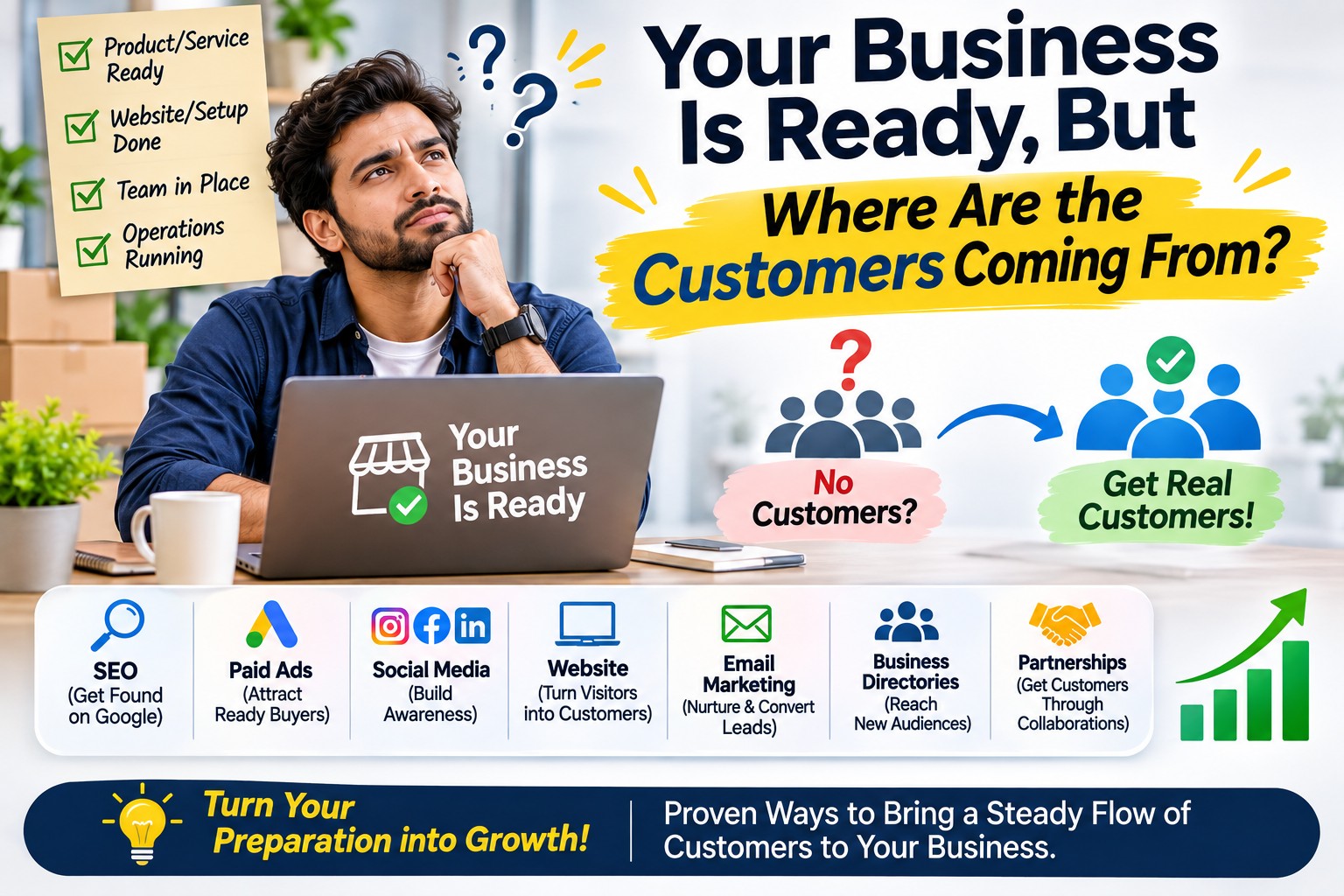
You have started a business. Your products or services are ready, you have invested money in setting things up, and you are prepared to serve customers.
But there is one problem: you do not have enough customers yet.
Perhaps your first few customers came through friends, relatives, former colleagues or people you already knew. Someone recommended your business, and you received an enquiry. Another person shared your phone number, and you got a small order.
That is a good beginning.
However, after a few weeks or months, those enquiries may slow down.
You cannot keep asking the same people to recommend your business. You also cannot predict when someone will refer a customer to you.
This creates a difficult situation. You have a business to run, expenses to manage and possibly employees to pay, but you do not know where your next customer will come from.
The good news is that referrals are not the only way to find customers.
People search Google when they need products and services. They compare businesses online, read reviews, visit websites, watch videos, ask questions on social media and contact companies that appear trustworthy.
Your new business can become part of that process.
You do not necessarily need a large advertising budget, thousands of social media followers or a well-known brand. You need to understand who your customers are, where they look for solutions and what will convince them to contact you.
This guide explains how to attract customers without depending on referrals, how to choose suitable marketing channels, what to do with a limited budget and how to build a customer acquisition system that can support your business over time.
1. Why Depending Only on Referrals Can Limit a New Business

Referrals are valuable because people often trust recommendations from someone they know.
A satisfied customer may recommend your business to friends, colleagues or other companies. This can bring customers who already have some confidence in your services.
You should continue encouraging genuine recommendations.
The problem is not referrals themselves. The problem is having no other dependable way to attract customers.
You cannot control when referrals arrive
Suppose you operate a website development company.
One month, three former colleagues recommend your services, and you receive five projects.
The next month, nobody makes a recommendation.
Your team may be available for work, but you have no new enquiries.
This makes it difficult to plan your revenue, workload and business expenses.
Your network may not contain enough potential customers
Friends and relatives may want to support your business, but they may not know people who need your services.
For example, if you provide industrial machinery maintenance, your customers may be factory owners and plant managers.
Your personal network may not contain enough of these decision-makers.
You need ways to reach people outside your existing contacts.
Referrals can limit geographical growth
A local network may help you find customers in your neighbourhood or city.
However, if you want to expand into other cities or serve customers across India, you need visibility beyond your personal connections.
Online search, targeted advertising and business outreach can help you reach relevant audiences in new markets.
Referrals may create inconsistent revenue
A business with irregular enquiries may struggle to forecast sales.
This can make hiring, inventory planning and expansion difficult.
Building additional customer acquisition channels can reduce your dependence on any single source.
The goal is not to stop receiving referrals. It is to make sure your business can attract customers even when referrals are slow.
2. First, Understand Exactly Who Your Customers Are

Before investing in SEO, Google Ads, social media or any other marketing activity, identify the people most likely to buy from you.
Many new businesses make the mistake of trying to reach everyone.
They believe that more people seeing their business will automatically mean more customers.
But a marketing campaign aimed at the wrong audience can consume time and money without generating useful enquiries.
Identify the problem your business solves
Start with a simple question:
Why would someone pay for your product or service?
For example:
-
A website development company helps businesses create professional websites.
-
A solar installation company helps homeowners or businesses install solar power systems.
-
A legal compliance consultancy helps companies complete relevant registrations and compliance requirements.
-
A commercial cleaning company helps offices maintain clean workplaces.
-
A packaging supplier helps manufacturers source packaging materials.
Your marketing should explain the customer's problem and how your business can solve it.
Define your ideal customer
Write down the following details:
| Question | Example: B2B website development company |
|---|---|
| Who is the customer? | Small business owners, founders and directors |
| What do they need? | A professional business website |
| Why do they need it? | To showcase services and attract enquiries |
| Where are they located? | Delhi NCR and other selected markets |
| What might concern them? | Cost, quality, delivery time and support |
| What could influence their decision? | Portfolio, clear pricing, process and credibility |
Your answers will be different depending on your industry.
Understand who makes the purchasing decision
In B2B businesses, the person researching your services may not be the person approving the purchase.
For example, a procurement executive may search for suppliers, but a business owner or department head may approve the final order.
Your website and marketing content should provide information useful to both people.
Identify buying triggers
A buying trigger is a situation that makes someone start looking for a solution.
For example:
-
A new company needs its first website.
-
A factory is expanding and needs additional equipment.
-
A business is opening another office.
-
A restaurant is preparing to launch.
-
A company is unhappy with its current service provider.
-
A homeowner wants to reduce electricity costs.
Understanding these situations helps you create more relevant marketing messages.
3. Find Out Where Potential Customers Search for Businesses Like Yours

Once you know your target customers, identify how they look for solutions.
Different businesses attract customers through different channels.
A local repair service may receive enquiries from Google Maps. A B2B manufacturer may benefit from industry-specific searches, supplier directories and direct outreach. A fashion brand may find customers through social platforms and online shopping.
Do not assume every business needs to be active everywhere.
Common customer discovery channels
| Channel | Most useful when |
|---|---|
| Google Search | Customers actively search for your products or services |
| Google Maps | Customers look for local businesses or service providers |
| Business website | Buyers need detailed information before contacting you |
| You want to reach professionals and B2B decision-makers | |
| Instagram and Facebook | Visual content, communities or audience targeting are relevant |
| Google Ads | You want to test demand from people searching for solutions |
| Industry directories | Customers compare suppliers or specialist providers |
| Email outreach | You can identify suitable business prospects |
| Partnerships | Other businesses serve a similar customer audience |
How to research your market
Start by searching Google as a potential customer would.
For example, if you provide commercial cleaning services, search:
-
Office cleaning services in Delhi.
-
Commercial cleaning company near me.
-
Corporate housekeeping services.
-
Office deep cleaning service provider.
Review the types of businesses appearing in the results.
Notice whether customers are likely to compare prices, service details, reviews, location or previous work.
Also review relevant online communities, directories and social platforms.
You are trying to understand the customer's buying process, not simply copy your competitors.
4. Build a Professional Website That Helps Customers Trust Your Business

A website can act as your business's online office.
Potential customers may discover you through Google, advertisements, LinkedIn or other channels, but they often want more information before making an enquiry.
A clear, useful website helps them understand what you offer and whether your business is suitable for their requirements.
What should a new business website include?
A clear homepage
Explain what your business does, who it serves and how customers can contact you.
Avoid a homepage filled with vague statements that do not explain your services.
Dedicated service or product pages
Each important service should have enough information to help customers make a decision.
For example, a company offering SEO, website development and paid advertising should explain those services separately.
About Us page
Tell visitors who runs the business, what experience the team brings and how the company works.
Contact page
Include accurate contact information and a straightforward enquiry process.
Examples of work
Where relevant, show real projects, product photographs, demonstrations or completed work.
Frequently asked questions
Answer practical questions about pricing, delivery, service areas, timelines, requirements and support.
Make the website easy to use on mobile
Many customers will discover your website on their phones.
Check whether:
-
Text is readable.
-
Navigation works properly.
-
Buttons are easy to select.
-
Forms are simple.
-
Important pages load reliably.
-
Contact information is visible.
Give visitors a clear next step
A potential customer should not have to search for a way to contact you.
Depending on your business, useful calls to action include:
-
Request a quotation.
-
Book a consultation.
-
Get a project estimate.
-
Schedule a site visit.
-
Ask about availability.
-
Speak with our team.
The wording should match what customers actually want.
5. Use Google SEO to Reach People Already Looking for Your Services
Search engine optimisation, or SEO, helps make your website easier for search engines to discover, understand and present for relevant searches.
For a new business, SEO can be especially valuable when potential customers already search for the products or services you offer.
However, SEO should not simply focus on bringing the largest possible number of visitors.
The priority should be attracting people whose needs match your business.
Target keywords with commercial intent
Imagine you have started a residential solar installation company.
Potential customers may search:
-
Residential solar installation company.
-
Solar panel installation for home.
-
Rooftop solar installation services.
-
On-grid solar system installation.
-
Solar company for home in Delhi.
These searches can indicate interest in hiring a provider or comparing services.
Your website should contain useful pages that explain the relevant services.
Create pages around genuine service differences
Suppose you offer three distinct services:
-
Residential solar installation.
-
Commercial rooftop solar installation.
-
Solar system maintenance.
Separate pages may be useful because customers have different requirements.
However, creating multiple nearly identical pages for small keyword variations can lead to unnecessary duplication.
For example, you generally do not need separate pages for "home solar installation service" and "solar installation service for home" if both describe the same offering and search intent.
Optimise the basics
Important SEO activities include:
-
Writing clear page titles and descriptions.
-
Using descriptive headings.
-
Explaining products and services in sufficient detail.
-
Improving website navigation.
-
Adding relevant internal links.
-
Fixing important technical issues.
-
Ensuring pages can be crawled and indexed when appropriate.
-
Using accurate structured data where relevant.
-
Improving the user experience.
Set realistic expectations
A new website may take time to develop organic visibility, especially in competitive industries.
SEO should be treated as a continuing investment rather than a method that guarantees immediate enquiries.
Track the visibility of important pages, relevant organic clicks and the enquiries those pages generate.
6. Create a Google Business Profile If Your Business Is Eligible
If you operate a business that serves customers at a physical location or meets customers in person within a service area, a Google Business Profile may help you appear in relevant local search and Maps experiences.
Eligibility depends on Google's business representation rules. Online-only businesses generally are not eligible.
Complete your business information
Where applicable, provide:
-
Accurate business name.
-
Relevant business category.
-
Business address or service area.
-
Contact details.
-
Operating hours.
-
Website link.
-
Business description.
-
Relevant photographs.
-
Services or products.
Use genuine business information.
Add photographs that help customers evaluate you
Depending on your business, useful photographs might show:
-
Your office or premises.
-
Your team.
-
Products.
-
Equipment.
-
Completed projects.
-
Work being carried out.
Avoid uploading misleading images that do not represent your business.
Ask genuine customers for reviews
After completing work, you can invite customers to share honest feedback.
Do not buy reviews or offer incentives in exchange for positive ratings.
A detailed genuine review may help future customers understand what it is like to work with your company.
Keep information updated
If your business hours, contact details or service information change, update your profile.
Accurate information makes it easier for customers to contact you.
7. Use Google Ads to Test Customer Demand
SEO can take time to build visibility.
Google Ads can help you reach people searching for relevant products or services while you develop your longer-term organic presence.
However, paid advertising requires planning.
A new business should not simply start spending money without understanding its target audience and the value of a potential customer.
Start with a specific service
If you offer multiple services, consider testing one with clear demand and a defined target audience.
For example, a website development company might initially advertise a specific website development service rather than every service it offers.
This makes it easier to evaluate performance.
Choose relevant search terms
Focus on searches that indicate a need for your service.
Review the actual search terms triggering advertisements and exclude irrelevant traffic where appropriate.
Use a suitable landing page
Do not automatically send every advertisement to your homepage.
If someone searches for commercial rooftop solar installation, the landing page should explain that service.
It should answer questions and provide a clear enquiry option.
Track genuine enquiries
Measure meaningful actions such as completed forms, qualified calls or purchases.
A click is not the same as a lead, and a lead is not automatically a customer.
Begin with a controlled test budget
The appropriate budget depends on competition, cost per click, customer value and conversion rates.
Start with an amount your business can afford to test, monitor the results and make changes based on evidence.
Avoid increasing spending simply because the campaign is generating clicks.
8. Use LinkedIn to Find B2B Customers Without Waiting for Introductions
If your business sells to other businesses, LinkedIn can help you identify relevant professionals and organisations.
It can be particularly useful for agencies, consultants, manufacturers, software companies, professional service providers and other B2B businesses.
The objective should be to build relevant professional relationships, not send the same sales message to hundreds of people.
Identify the right decision-makers
Depending on your services, you may want to reach:
-
Founders.
-
Business owners.
-
Managing directors.
-
CEOs.
-
Marketing heads.
-
Operations managers.
-
Procurement managers.
-
Plant managers.
-
Finance or compliance leaders.
Choose roles based on who is likely to need or influence the purchase of your services.
Improve your profile
Your profile should clearly explain:
-
What you do.
-
Who you help.
-
The problems you solve.
-
Relevant experience.
-
Examples of your work.
-
How someone can contact you.
A clear professional profile makes it easier for potential customers to understand your business.
Start conversations naturally
Instead of immediately sending a long sales pitch, look for relevant opportunities to connect.
You can comment thoughtfully on industry discussions, share useful information and contact people when there is a genuine business reason.
For example, if you provide website development services, you might contact a business owner whose company has recently launched a new product and offer a relevant observation or useful suggestion.
Keep the message brief and respectful.
Do not depend on mass messaging
Sending large numbers of generic messages may damage your reputation and produce poor-quality conversations.
A smaller number of well-researched contacts is often a better starting point.
9. Use Social Media to Make Your Business Easier to Discover and Understand
Social media can help potential customers learn about your business before they are ready to purchase.
It can also give them reasons to trust you.
However, social media marketing should be based on the audience you want to reach.
You do not need to publish on every platform.
Choose platforms that suit your business
For example:
-
A local bakery may benefit from visual content on Instagram.
-
A B2B consulting company may find LinkedIn more relevant.
-
A home improvement business may benefit from demonstrations and project videos.
-
A consumer brand may use Facebook or Instagram to reach selected audiences.
These are starting points, not fixed rules.
Publish content that answers customer questions
Useful content ideas include:
-
How your service works.
-
Common mistakes customers should avoid.
-
What customers should check before purchasing.
-
Product demonstrations.
-
Project examples.
-
Frequently asked questions.
-
Behind-the-scenes work.
-
Genuine customer experiences.
Show evidence of your work
If you have completed projects, share real examples with the necessary permissions.
Explain what the customer needed, what you provided and what the outcome was.
Do not invent customer testimonials or exaggerate results.
Make contacting you easy
Include accurate business details and clear contact options.
If someone asks a question, respond professionally and within a reasonable time.
Social media can support trust and enquiries, but it should not be treated as successful only because your posts receive likes.
10. Use Helpful Content to Attract Customers Before They Are Ready to Buy
Some customers are ready to purchase immediately.
Others need information before making a decision.
They may be comparing options, estimating costs or trying to understand which service is suitable.
Helpful content allows your business to reach people during this research stage.
Write about real customer questions
For example, a website development company could answer:
-
What should a small business website include?
-
How much does a business website cost?
-
What should you ask a website developer before hiring?
-
Why is a business website not generating enquiries?
A packaging supplier could explain:
-
How to choose packaging materials for different products.
-
What information to provide when requesting a packaging quotation.
-
How packaging requirements affect manufacturing costs.
Avoid creating content only for search volume
A keyword may receive many searches but have little connection to your business.
Choose topics that are relevant to your customers and that your business can explain accurately.
Connect informational content with your services
If an article explains how to select a service provider, it may be helpful to link to the relevant service page.
The link should support the reader rather than interrupt the article with repeated sales messages.
Update important articles
Review content when products, prices, regulations, services or customer requirements change.
For subjects involving legal or regulatory requirements, use reliable official sources and keep the information current.
11. Find Customers Through Relevant Business Directories and Industry Platforms
Business directories can help customers discover suppliers and service providers.
Their usefulness depends on your industry.
For example, some B2B buyers use supplier directories to compare manufacturers, wholesalers or service providers.
Local customers may use business listings or maps to find nearby companies.
Choose directories carefully
Before creating a listing, check:
-
Whether the platform serves your target audience.
-
Whether the business category is relevant.
-
Whether the listing provides useful information.
-
Whether customers can contact you.
-
Whether the platform has a credible reputation.
-
Whether paid listing fees are justified.
Keep business information consistent
Use accurate contact details, service descriptions and website links.
Avoid creating misleading listings or paying for large numbers of low-quality directory links purely for SEO.
Track directory enquiries
Ask customers how they discovered your business or use suitable tracking methods.
This helps you understand which listings deserve continued attention.
12. Build Partnerships That Introduce Your Business to New Audiences
You do not need to rely only on personal referrals to benefit from business relationships.
Partnerships can help you reach customers through organisations that serve a similar audience.
The difference is that you develop a deliberate business relationship with clear mutual value.
Look for complementary businesses
For example:
| Your business | Potential partner |
|---|---|
| Website development company | Branding consultant or business registration firm |
| Commercial interior design company | Office furniture supplier |
| Solar installation company | Electrical contractor or property consultant |
| Accounting consultancy | Business advisory firm |
| Packaging supplier | Product manufacturer or fulfilment provider |
Create a useful partnership offer
Explain how your services complement the partner's business.
For example, a company registration consultant may work with founders who later need websites.
A website development agency may help those founders establish their online presence.
The relationship should benefit the customer, not simply exchange contact details without permission.
Respect customer consent
Do not share personal contact information without an appropriate basis or permission.
A good partnership should preserve trust and comply with applicable privacy and marketing requirements.
13. Use Direct Outreach to Reach Customers Who May Need Your Services
Direct outreach can be useful when you can clearly identify organisations that may benefit from your services.
This approach is particularly relevant for B2B businesses.
However, outreach works best when it is researched, relevant and respectful.
Create a focused prospect list
For example, a commercial cleaning company could research offices, coworking spaces or other businesses within its service area.
A B2B software provider might identify companies whose operations match its product's intended use.
Do not build a list simply because the businesses are nearby or easy to contact.
Research before contacting prospects
Try to understand:
-
What the company does.
-
Whether your service is relevant.
-
Whether it operates in your target market.
-
Who handles the relevant decisions.
-
Whether there is a reasonable basis for contacting it.
Write a short, specific message
A useful message should explain why you are contacting the company and what value you may offer.
Avoid exaggerated claims or pretending to have a personal relationship.
Follow up without becoming intrusive
A prospect may not respond immediately.
A polite follow-up can be appropriate, but repeated unwanted messages can damage your reputation.
Respect opt-outs and applicable marketing communication rules.
14. Turn Website Visitors Into Genuine Business Enquiries
Attracting visitors is only part of customer acquisition.
Your website must also help interested people take the next step.
This is often called conversion rate optimisation.
Explain your offer clearly
A visitor should quickly understand:
-
What you provide.
-
Who the service is for.
-
Which problems you solve.
-
What information is needed to get started.
-
How to contact you.
Reduce unnecessary form fields
A new customer may not want to complete a long form just to ask a question.
Request only the information you genuinely need at the initial stage.
For example:
-
Name.
-
Business email or phone number.
-
Required service.
-
Short description of the requirement.
You can collect additional details later.
Provide relevant trust signals
Useful trust signals may include:
-
Genuine project examples.
-
Accurate company information.
-
Team experience.
-
Relevant certifications.
-
Transparent service processes.
-
Real customer feedback.
-
Clear contact information.
Do not use fabricated reviews, invented client logos or unsupported guarantees.
Make the next step clear
A button saying "Submit" is functional, but a more specific call to action may help users understand what happens next.
For example:
"Request a Project Estimate"
or
"Book a Consultation"
Use wording that matches the action your business can actually provide.
15. Respond Quickly and Professionally to New Enquiries
A marketing campaign can generate good leads, but your business may still lose customers if nobody follows up properly.
New businesses often focus on attracting enquiries while overlooking what happens after someone contacts them.
Create a simple lead-handling process
Decide:
-
Who receives new enquiries.
-
Who is responsible for responding.
-
How enquiries are recorded.
-
What information should be collected.
-
When follow-ups should happen.
-
How the final outcome is tracked.
A practical example
Suppose a potential customer submits a quotation request.
Your process could be:
-
Confirm that the enquiry was received.
-
Review the customer's requirement.
-
Contact the customer during appropriate business hours.
-
Ask relevant questions.
-
Share the quotation or next steps.
-
Follow up at a reasonable time.
-
Record whether the enquiry became a customer.
The exact process depends on your business.
Do not rely on memory
Even a basic spreadsheet can help you manage enquiries when you are starting.
As your volume grows, a CRM may become useful.
Record enough information to understand where each lead came from and what happened afterward.
16. Build Trust When Nobody Knows Your New Business
Established businesses often benefit from brand recognition, reviews and a history of completed projects.
A new business may not have those advantages.
That does not mean customers will refuse to work with you.
It means you need to make it easier for them to evaluate your credibility.
Be transparent about your experience
If your company is new but your team has relevant professional experience, explain that accurately.
Do not present projects completed for previous employers as though they were delivered by your new company.
You can describe team members' experience while making the distinction clear.
Explain your working process
Customers may feel more comfortable when they understand what happens after contacting you.
For example:
-
Initial discussion.
-
Requirement review.
-
Proposal or quotation.
-
Agreement and scheduling.
-
Service delivery.
-
Review and support.
Answer difficult questions
Be prepared to explain:
-
Pricing.
-
Delivery timelines.
-
Payment terms.
-
Scope of work.
-
Revision or change policies.
-
Support arrangements.
-
Relevant limitations.
Clear answers can be more persuasive than exaggerated promotional claims.
Use genuine proof
As your business completes projects, collect permission-based testimonials, photographs, reviews and case studies.
Over time, these assets can help reduce the uncertainty new customers feel.
17. How Much Should a New Business Spend on Getting Customers?
There is no fixed marketing budget suitable for every new business.
A company selling expensive industrial equipment may have very different customer acquisition economics from a local bakery or online store.
Before spending, understand how much a new customer is worth to your business.
Estimate your customer economics
Suppose you provide a service priced at ₹25,000.
Your direct cost of delivering the service is ₹15,000.
That leaves ₹10,000 in gross contribution before marketing and other business expenses.
If acquiring a customer costs ₹8,000, there may be little left to cover overheads and profit.
If acquiring a customer costs ₹2,000, the economics may be more attractive.
This is why marketing decisions should consider margins, repeat business and customer value.
Example starting budgets
The following figures are illustrative planning scenarios, not recommended minimums or guaranteed spending levels.
| Monthly budget | Possible approach |
|---|---|
| ₹0–₹5,000 | Improve business profiles, website basics, direct outreach and useful content |
| ₹5,000–₹15,000 | Focused content, local marketing and small advertising tests where viable |
| ₹15,000–₹30,000 | More structured SEO or advertising work, depending on competition and service costs |
| ₹30,000+ | Broader testing and optimisation if the business can support the investment |
In competitive markets, advertising costs or professional service fees may make some activities impractical at lower budgets.
Do not divide a small budget across too many channels.
It is often better to execute one or two relevant methods properly.
18. Choose Customer Acquisition Channels Based on Your Type of Business
Not every marketing method works equally well for every business.
Use the following examples to decide where to begin.
Local service business
Examples include electricians, cleaning companies, repair services and local consultants.
Potential priorities:
-
Eligible Google Business Profile.
-
Local service pages.
-
Genuine customer reviews.
-
Local search advertising.
-
Clear contact and booking options.
B2B manufacturing or supply business
Potential priorities:
-
Product and category pages.
-
Industry-specific SEO.
-
Detailed specifications.
-
Relevant supplier directories.
-
LinkedIn and targeted outreach.
-
Quotation request forms.
Professional service business
Examples include consultants, accountants, agencies and legal service providers.
Potential priorities:
-
Clear service pages.
-
Helpful educational content.
-
Search visibility for relevant services.
-
Credibility and team information.
-
LinkedIn relationship building.
-
Consultation booking options.
E-commerce business
Potential priorities:
-
Product page quality.
-
Product search visibility.
-
Suitable shopping advertising.
-
Customer reviews.
-
Email marketing with consent.
-
Checkout improvements.
-
Repeat customer engagement.
New digital agency
Potential priorities:
-
Service-specific landing pages.
-
Relevant SEO content.
-
Project examples.
-
Founder-led LinkedIn outreach.
-
Targeted search advertising where affordable.
-
Clear enquiry and consultation processes.
These are starting points. Customer research and actual campaign performance should determine the final mix.
19. Build a Simple Customer Acquisition Funnel
A customer acquisition funnel describes the steps people take before becoming customers.
Understanding this journey can help you identify where potential business is being lost.
Stage 1: Discovery
A person becomes aware of your business through Google, an advertisement, social media, a directory or outreach.
Your objective is to reach relevant people.
Stage 2: Consideration
The person reviews your website, compares services, reads information or looks for evidence of credibility.
Your objective is to answer questions and build trust.
Stage 3: Enquiry
The person contacts your business, requests a quotation or books a consultation.
Your objective is to make contacting you easy.
Stage 4: Qualification
You determine whether the enquiry is relevant.
Your objective is to understand the requirement and decide whether you can help.
Stage 5: Conversion
The customer accepts the proposal or completes the purchase.
Your objective is to provide a clear and professional buying experience.
Stage 6: Retention
You deliver the service and maintain the customer relationship.
Your objective is to provide value that encourages repeat business and genuine recommendations.
Example customer journey
A factory owner searches Google for an industrial equipment supplier.
They discover a relevant product page, review specifications and submit a quotation request.
Your sales team contacts them, confirms the technical requirements and sends a proposal.
The customer compares suppliers and places an order.
This is a more useful model than simply measuring how many people visited the website.
20. Measure Which Marketing Activities Actually Bring Customers
If you do not track your marketing activities, you may continue spending money on methods that are not producing useful results.
Start with a few simple measurements.
Track enquiry sources
Ask customers how they discovered your business or use appropriate tracking systems.
Possible sources include:
-
Google organic search.
-
Google Ads.
-
Google Maps.
-
LinkedIn.
-
Social media.
-
Business directories.
-
Direct outreach.
-
Partnerships.
-
Referrals.
Distinguish enquiries from qualified leads
A person filling out a form is not automatically a potential customer.
Some enquiries may be spam, irrelevant or outside your service area.
Define what makes an enquiry qualified for your business.
Track conversion into customers
For each source, review:
-
Total enquiries.
-
Qualified enquiries.
-
Proposals or quotations.
-
Customers acquired.
-
Revenue, where available.
-
Acquisition costs.
Example monthly report
| Channel | Enquiries | Qualified leads | Customers |
|---|---|---|---|
| Google organic search | 35 | 18 | 5 |
| Google Ads | 40 | 20 | 6 |
| LinkedIn outreach | 15 | 9 | 3 |
| Business directories | 12 | 4 | 1 |
| Referrals | 10 | 8 | 4 |
Illustrative data only.
This report helps you compare the usefulness of different sources.
To evaluate profitability, you would also need the cost of each channel and the value of the customers acquired.
21. A Practical 90-Day Customer Acquisition Plan for a New Business
If you are starting from scratch, trying everything at once can become overwhelming.
A phased approach is easier to manage.
Days 1–15: Understand your market and prepare your offer
Focus on the basics.
-
Define your target customers.
-
Identify the problems your business solves.
-
Review relevant competitors.
-
Select your most important services or products.
-
Decide what makes your offering useful.
-
Prepare accurate pricing or quotation processes.
-
Set clear enquiry and customer acquisition goals.
Expected output: A clear description of your customers, offer and initial marketing priorities.
Days 16–30: Build your online foundation
Prepare the assets customers need to evaluate your business.
-
Create or improve your website.
-
Publish important service or product pages.
-
Make contact information easy to find.
-
Set up analytics and conversion tracking.
-
Create an eligible Google Business Profile where appropriate.
-
Improve relevant professional or social profiles.
-
Prepare genuine photographs and examples of your work.
Expected output: A business presence that potential customers can discover, understand and contact.
Days 31–45: Start attracting relevant prospects
Choose one or two customer acquisition channels based on your research.
Possible activities include:
-
Optimising important pages for relevant searches.
-
Publishing helpful content.
-
Testing a focused advertising campaign.
-
Contacting suitable B2B prospects.
-
Creating useful social media content.
-
Listing your business on relevant directories.
Expected output: Initial visibility, audience feedback and early enquiry data.
Days 46–60: Review and improve
Examine what is happening.
-
Which channels bring relevant visitors?
-
Which messages attract attention?
-
Are enquiries genuine?
-
Are customers asking the same questions?
-
Are website forms working?
-
Are advertisements attracting the right audience?
-
Are prospects receiving timely follow-ups?
Make improvements based on what you learn.
Expected output: Better understanding of the most promising acquisition methods.
Days 61–75: Strengthen the methods showing promise
If a channel is attracting relevant prospects, look for ways to improve it.
For example:
-
Improve important landing pages.
-
Refine advertising targeting.
-
Expand useful service information.
-
Publish content addressing common customer questions.
-
Improve sales follow-up.
-
Develop additional relevant outreach lists.
Do not increase spending without reviewing lead quality and costs.
Days 76–90: Prepare a sustainable growth plan
Review the entire period.
Ask:
-
How many enquiries did we receive?
-
How many were qualified?
-
How many became customers?
-
Which channels performed best?
-
How much did customer acquisition cost?
-
Which activities should continue?
-
What should we stop?
-
What needs further testing?
Expected output: A practical plan for the next three months based on actual experience rather than assumptions.
Ninety days may be enough to test several activities and establish useful processes, but it is not a guarantee of consistent sales or strong SEO rankings.
22. Common Mistakes New Businesses Make When Trying to Find Customers
Trying every marketing channel at once
Running SEO, Google Ads, social media, email campaigns and multiple directory listings simultaneously can spread a limited budget too thin.
Start with the channels most relevant to your customers.
Spending on advertisements before preparing the website
Advertising may bring visitors, but a confusing website can prevent them from making enquiries.
Make sure your offer and contact process are clear before increasing traffic.
Targeting everyone
A message aimed at everyone often fails to explain why a particular customer should choose you.
Focus on a defined audience.
Copying competitors without understanding their strategy
A competitor may have a larger budget, stronger brand or different customer base.
Learn from the market, but develop a strategy suited to your business.
Publishing content without a clear purpose
Do not create articles simply to increase the number of pages on your website.
Choose topics that help potential customers and support your services.
Ignoring lead follow-up
A delayed or unclear response can cause interested customers to look elsewhere.
Create a reliable enquiry-handling process.
Measuring likes instead of customers
Engagement can be useful, but it should be evaluated alongside relevant business outcomes.
Expecting immediate SEO results
Organic search visibility takes time to develop, particularly for new websites.
Use realistic milestones and monitor progress.
Failing to track expenses
Record how much you spend on each marketing channel and what it produces.
This helps you make better decisions.
Giving up before learning from the data
A campaign that does not work initially may need better targeting, messaging or landing pages.
Review the evidence before deciding whether to stop, improve or expand it.
23. How to Get Customers When You Have Almost No Marketing Budget
A limited budget does not mean you cannot begin finding customers.
However, you will need to invest more time and be selective about your activities.
Start with your strongest service
Choose a product or service you can explain and deliver confidently.
Avoid promoting too many unrelated offerings at once.
Improve your online business information
Make sure your website or professional profile clearly describes your services and contact details.
If you are eligible for a Google Business Profile, complete it accurately.
Publish useful information
Answer common customer questions on your website or relevant professional platforms.
Focus on quality and relevance rather than posting every day.
Contact a small number of suitable prospects
Research businesses that may genuinely need your service.
Use personalised, respectful outreach.
Build complementary relationships
Connect with businesses that serve similar customers without directly competing with you.
Look for opportunities to collaborate.
Follow up with existing enquiries
Review past enquiries that did not convert, where follow-up is appropriate and permitted.
Some prospects may still have a genuine need.
Reinvest carefully
When your business begins generating revenue, decide how much you can responsibly allocate to marketing tests and improvements.
Free methods are not necessarily cost-free because they require your time, but they can help you learn before making larger financial commitments.
24. How to Know When You Are Ready to Scale Customer Acquisition
Getting a few customers is different from having a repeatable acquisition process.
Before increasing your marketing budget, check whether your business can handle additional demand.
Ask yourself:
-
Do we know which customers are most profitable?
-
Can we explain why customers choose us?
-
Are our enquiries being tracked?
-
Do we respond to leads consistently?
-
Can we deliver more orders without reducing quality?
-
Do we understand our acquisition costs?
-
Are our prices and margins sustainable?
-
Do we know which channels bring relevant customers?
If you cannot answer these questions, focus on improving your process before spending significantly more.
Scaling a weak system can increase expenses faster than revenue.
25. Final Customer Acquisition Checklist for a New Business
Use this checklist to review your progress.
-
I know who my ideal customers are.
-
I understand the problems my products or services solve.
-
I know where potential customers search for solutions.
-
My website or online business profile clearly explains my offering.
-
Customers can contact my business easily.
-
I have identified relevant commercial search terms.
-
I have chosen one or two suitable acquisition channels.
-
I have a realistic marketing budget.
-
I track where enquiries come from.
-
I can identify qualified leads.
-
I have a process for responding to enquiries.
-
I review which activities generate customers.
-
I collect genuine customer feedback.
-
I am improving my marketing based on results.
- My business is no longer completely dependent on personal recommendations.
Conclusion: Build a Business That Can Attract Customers Beyond Your Personal Network
Referrals can give a new business an excellent start, but they should not be the only reason customers discover you.
If your business depends entirely on personal recommendations, it can become difficult to predict enquiries, plan revenue or expand into new markets.
A stronger approach is to understand your customers, make your business visible where they search, explain your services clearly and create a reliable process for turning interest into sales.
You do not need to use every marketing channel immediately.
Start with the methods most relevant to your customers. Build a useful website or online presence, improve your visibility, test suitable acquisition channels and track genuine business outcomes.
As you learn which activities attract the right customers, you can invest more confidently in the methods that work.
The aim is not to eliminate referrals. It is to build a business that can continue attracting new customers even when nobody is recommending you.
Need Help Finding Customers for Your New Business?
At SEOspade, we help businesses improve their online presence through SEO, website design and development, social media marketing, paid marketing and related digital services.
If you have recently started a business and are unsure how to attract customers online, the first step is to understand your market, identify relevant opportunities and choose a marketing approach suited to your budget and goals.
Visit SEOspade to explore our services and discuss your business requirements.