Hiring a digital marketing agency can be an important decision for any business owner.
You may have recently started a company and want to attract your first customers. You may operate an established business that depends heavily on referrals, or you may be planning to expand into new markets and need a more reliable customer acquisition strategy.
You understand that customers are searching online, competitors are investing in digital marketing, and your business needs better visibility.
But choosing the right digital marketing agency is not always straightforward.
Almost every agency claims to provide professional services, customised strategies, better rankings, increased website traffic and business growth.
Some offer attractive monthly packages. Others promise rapid results. Many present impressive dashboards, client portfolios and performance statistics.
For a business owner without extensive digital marketing experience, understanding what these promises actually mean can be challenging.
Hiring the wrong agency can lead to months of unnecessary expenditure, delayed business growth, poor-quality leads and repeated changes to your website.
Hiring an agency whose capabilities genuinely match your business requirements can help you establish stronger digital foundations, reach relevant customers and develop a more organised approach to online growth.
Before hiring a digital marketing agency, business owners should understand what they need, what they are paying for, how the work will be performed and how success will be measured.
This guide explains everything you should consider before signing an agreement with a digital marketing agency.
1. Understand Why You Actually Need a Digital Marketing Agency

Before contacting an agency, identify the business problem you want to solve.
Many business owners approach agencies with broad requirements such as:
-
We want more customers.
-
We need better Google rankings.
-
Our competitors are getting more business.
-
We want to increase website traffic.
-
We need to improve our online presence.
-
We want more enquiries from our website.
These are reasonable starting points, but they are not sufficiently specific to determine the right marketing strategy.
Identify your primary business requirement
| Business situation | Potential marketing requirement |
|---|---|
| Newly launched business | Website development, branding and initial customer acquisition |
| Established business with limited online visibility | SEO and digital presence development |
| Website receiving traffic but few enquiries | Conversion optimisation and commercial targeting |
| Business dependent on referrals | Organic and paid customer acquisition |
| Company entering new markets | Market research, targeted SEO and advertising |
| eCommerce business struggling with sales | Product visibility, campaigns and checkout improvements |
| B2B manufacturer seeking institutional customers | Commercial SEO, product pages and targeted lead generation |
| Business with weak online credibility | Website improvements, content and digital PR |
Why this matters
A company that does not clearly define its requirements may purchase unnecessary services.
For example, a manufacturing business looking for distributor enquiries may not benefit significantly from a package focused primarily on Instagram posts.
The appropriate strategy depends on where potential customers discover suppliers, how they evaluate offerings and what influences their purchasing decisions.
2. Understand How Your Customers Discover Businesses Like Yours

Before selecting marketing channels, understand your customer's buying behaviour.
Different businesses attract customers in different ways.
Example: Corporate compliance company
Potential customers may search Google for company registration, trademark registration, factory licensing or regulatory compliance services.
SEO and paid search campaigns may therefore be relevant acquisition channels.
Example: Corporate gifting business
Customers may discover suppliers through Google, LinkedIn, referrals, product catalogues and direct business outreach.
A combination of search marketing, commercial landing pages and targeted outreach may be appropriate.
Example: Fashion and lifestyle business
Customers may discover products through Instagram, influencers, online marketplaces, Google Shopping and paid social media campaigns.
The marketing strategy may require a stronger visual and product-focused approach.
Questions business owners should answer
-
Where do our existing customers find us?
-
What do customers search for before contacting us?
-
Who makes purchasing decisions?
-
How long does the buying process take?
-
What information do customers require before making a decision?
-
Which marketing channels are likely to reach these customers?
An agency should demonstrate an understanding of these questions before recommending a comprehensive marketing package.
3. Know the Difference Between Digital Marketing Services
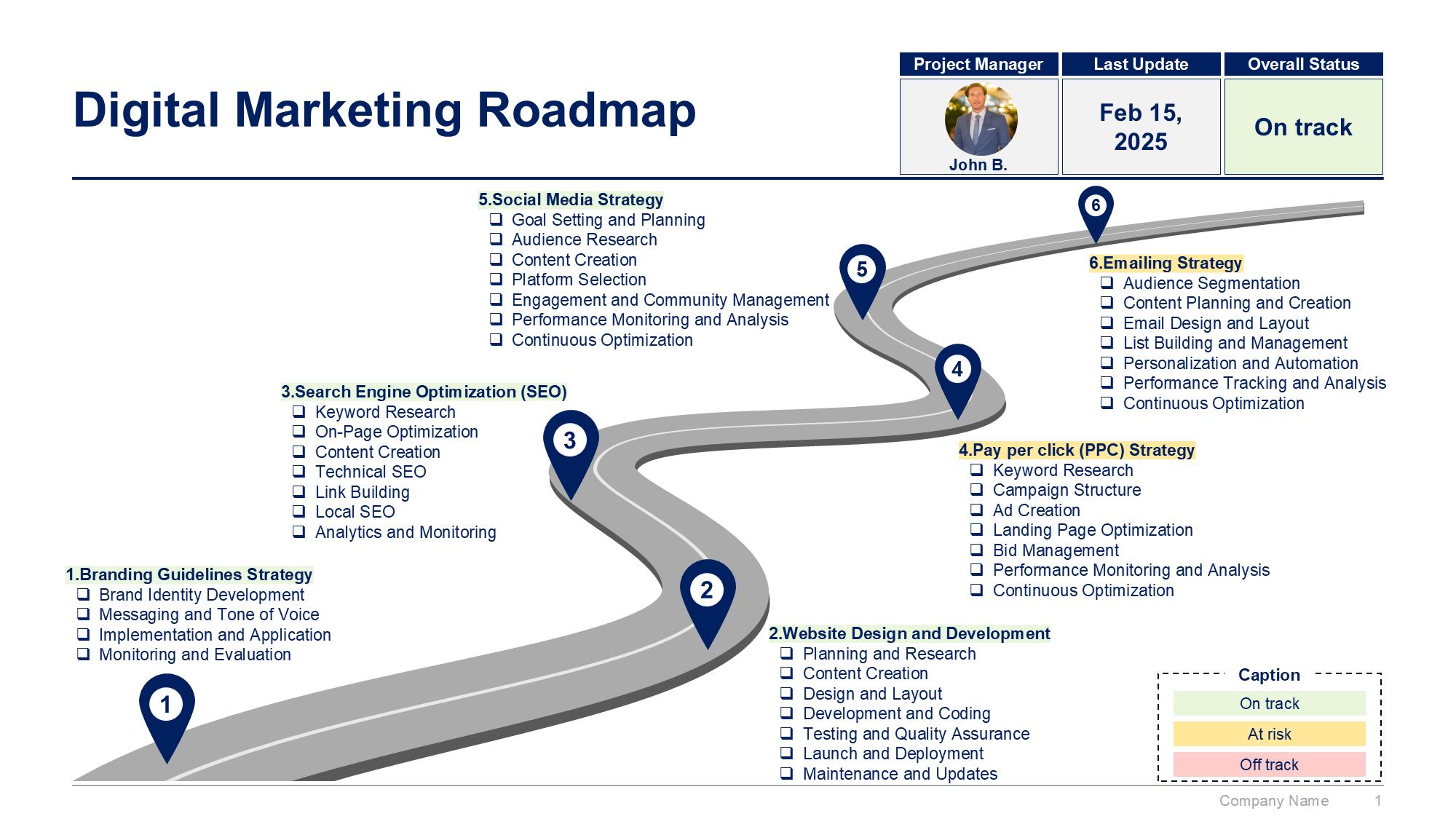
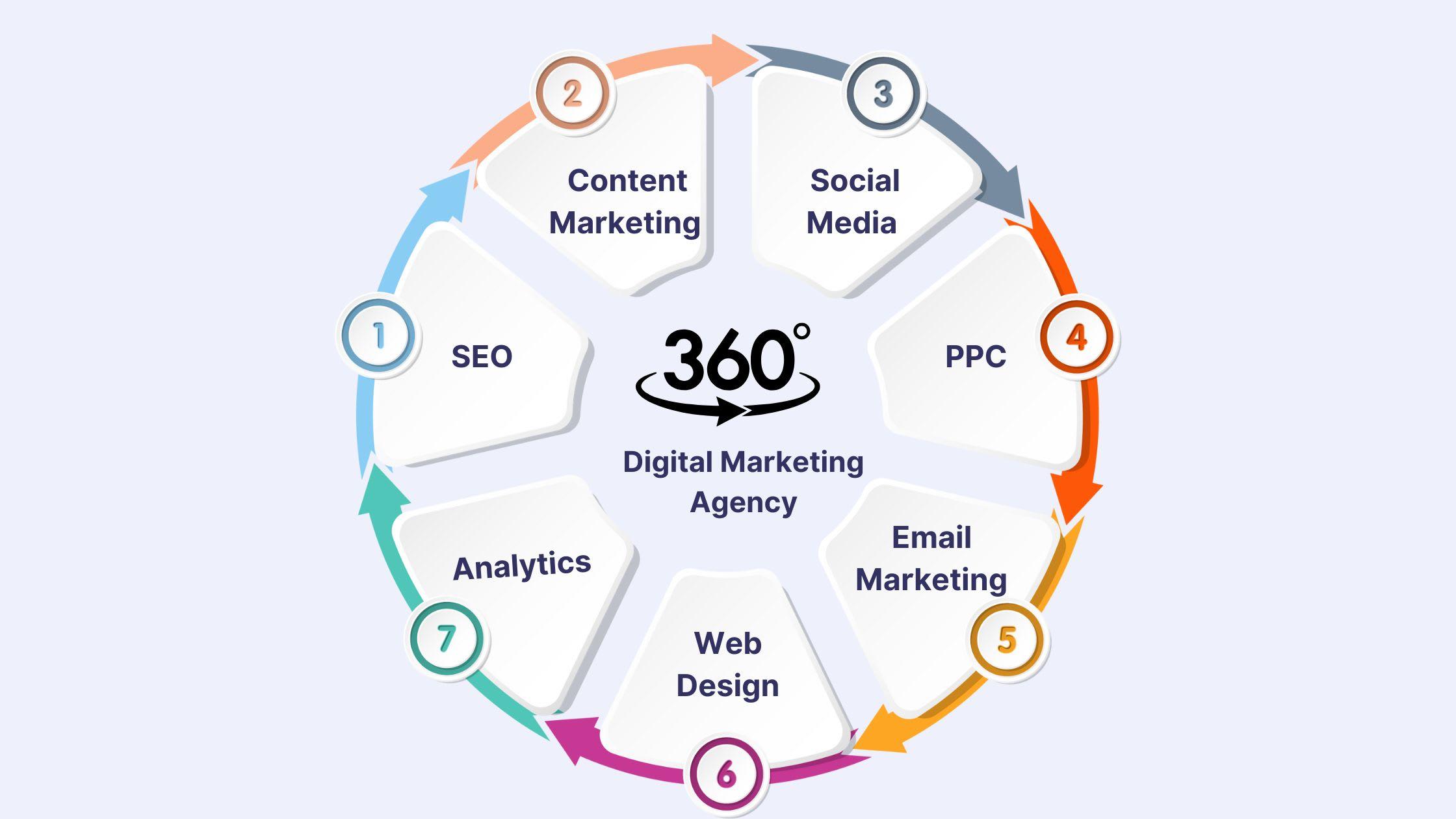
Digital marketing is an umbrella term covering several specialised activities.
Understanding these services helps business owners evaluate whether an agency is recommending work that matches their objectives.
| Service | Primary purpose | Suitable business requirement |
|---|---|---|
| SEO | Improve relevant organic search visibility | Long-term customer discovery |
| PPC advertising | Reach targeted audiences through paid campaigns | Demand capture and market testing |
| Website development | Establish or improve digital infrastructure | Customer experience and enquiries |
| Social media marketing | Support brand communication and engagement | Audience awareness and interaction |
| Content marketing | Educate customers and support decisions | Research-driven buying journeys |
| Digital PR | Improve relevant online exposure | Brand visibility and credibility |
| Email marketing | Communicate with prospects and customers | Lead nurturing and retention |
| Conversion optimisation | Improve website enquiry or purchase journeys | Better use of existing traffic |
| Local SEO | Improve visibility in relevant local searches | Location-based customer acquisition |
| Analytics and tracking | Measure customer interactions and outcomes | Performance evaluation |
You do not necessarily need every service.
A reliable agency should help determine which activities deserve priority rather than selling every available service without considering your business requirements.
4. Prepare a Business Brief Before Meeting an Agency

An effective agency proposal requires accurate information about your business.
Providing a structured brief can help agencies recommend more relevant strategies.
Information you should prepare
Company information: Business name, website, operating locations and industry.
Products and services: Your main offerings and commercially important categories.
Target customers: Customer industries, locations, business sizes or consumer segments.
Business objectives: Enquiries, sales, market expansion, online visibility or customer retention.
Existing marketing activities: Current SEO, advertising, social media and outreach activities.
Customer acquisition challenges: Problems you currently face in attracting and converting customers.
Budget: Your realistic monthly investment capacity.
Internal resources: Sales team, developers, content specialists and other available staff.
Growth expectations: Business priorities and desired implementation milestones.
Why a business brief is useful
It allows different agencies to respond to the same requirements.
This makes their proposals easier to compare and reduces the possibility of selecting an agency based solely on presentation quality.
5. Determine Whether Your Business Is Ready for Digital Marketing
Digital marketing cannot solve every business problem.
Before investing in customer acquisition, examine whether your company is ready to handle additional demand.
Check your operational readiness
-
Can your business fulfil additional orders?
-
Are your products and services clearly defined?
-
Do you have competitive and commercially sustainable pricing?
-
Is someone responsible for responding to enquiries?
-
Can your sales team explain your offerings effectively?
-
Do you have the resources to deliver work on time?
-
Are relevant licences and business requirements in place?
-
Can your website and systems support customer enquiries?
Example
A business spends heavily on Google Ads and generates genuine enquiries.
However, its sales team takes several days to respond.
Potential customers contact competitors and complete purchases elsewhere.
The advertising campaign may be attracting suitable customers, but the business is not adequately prepared to convert those opportunities.
Preparing internal processes before hiring an agency can help the company make better use of its marketing investment.
6. Check Whether the Agency Understands Your Business Model

An agency should not approach every business using the same strategy.
An SEO campaign for an eCommerce website differs from a campaign for a B2B manufacturing company.
A local dental clinic has different digital requirements from an international software development company.
What should the agency understand?
Your revenue model.
Your commercially important services.
Your ideal customer profile.
Your sales cycle.
Your geographic coverage.
Your customer acquisition challenges.
Your competitors.
Your operational capabilities.
Warning sign
An agency immediately recommends a package containing:
-
A fixed number of keywords.
-
A fixed number of backlinks.
-
A fixed number of blog articles.
-
A fixed number of social media posts.
However, it has not asked meaningful questions about your business.
Standard packages are not necessarily inappropriate for every company, but the agency should explain how the selected package addresses your particular requirements.
7. Review the Agency's Website and Digital Presence

A digital marketing agency's own website can provide useful information about its positioning, communication and capabilities.
Review the following areas
-
Clarity of service descriptions.
-
Technical usability.
-
Website navigation.
-
Relevant case studies.
-
Genuine client testimonials.
-
Leadership and team information.
-
Industry expertise.
-
Useful educational content.
-
Professional communication.
-
Transparent contact information.
Important consideration
An attractive website does not automatically prove marketing expertise.
Similarly, an agency does not need to rank first on Google for every competitive marketing keyword to be capable of serving clients.
Use its website as one piece of evidence alongside relevant work experience, technical understanding and proposal quality.
8. Ask for Relevant Case Studies, Not Just Client Logos
Many digital marketing agencies display familiar company logos on their websites.
These may indicate previous or existing commercial relationships, but they do not explain what work was performed.
A useful case study should explain
The original business challenge.
The client's starting position.
The work completed.
The implementation period.
The metrics used.
The measurable outcomes.
Relevant limitations or contributing factors.
Compare these examples
Weak case study:
"We increased client traffic by 500%."
More informative case study:
"We identified technical indexing problems, improved priority service pages, revised internal linking and developed supporting content. Over the measurement period, relevant organic clicks increased from the documented baseline."
The second example provides greater context for understanding the work.
Questions to ask
-
What services did you provide to this client?
-
How long did the engagement last?
-
What was the starting performance?
-
Which results can be independently verified?
-
Were the improvements related to commercially relevant pages?
-
Did the campaign contribute to customer enquiries or other agreed business objectives?
Historical results can demonstrate experience, but they do not guarantee identical outcomes for your business.
9. Evaluate the Agency's Experience in Your Industry
Industry experience can be valuable because different markets have different customer requirements.
B2B marketing
Requires attention to longer sales cycles, multiple decision-makers, technical information and qualified business enquiries.
Healthcare marketing
Requires accurate information, appropriate professional review and compliance with relevant healthcare communication requirements.
Legal and compliance marketing
Requires careful handling of regulatory information, jurisdiction-specific requirements and potentially consequential customer decisions.
eCommerce marketing
Requires product discovery, category architecture, inventory management, campaign measurement and conversion optimisation.
Real estate marketing
Requires accurate property information, location relevance, lead qualification and applicable regulatory compliance.
SaaS marketing
Requires product education, demonstrations, trial acquisition, onboarding and subscription economics.
Is industry-specific experience mandatory?
Not always.
An agency with strong research capabilities and relevant technical experience may adapt successfully to a new industry.
The important question is whether it can demonstrate a credible process for understanding your customers and market.
10. Understand Who Will Actually Work on Your Account

The person presenting the proposal may not be responsible for implementing your campaigns.
Some agencies have dedicated sales teams, account managers and execution specialists.
This is a normal organisational model, but business owners should understand how their account will be managed.
Ask about the team structure
Who will develop the strategy?
Who will manage technical SEO?
Who will write and review content?
Who will manage paid campaigns?
Who will coordinate website development?
Who will prepare reports?
Who will communicate with your company?
Who will take responsibility for escalations?
Understand the proposed responsibilities
| Role | Typical responsibility |
|---|---|
| Account manager | Communication and coordination |
| SEO strategist | Organic search strategy and priorities |
| Technical SEO specialist | Technical analysis and recommendations |
| Content specialist | Research, writing and optimisation |
| Paid marketing specialist | Campaign management and optimisation |
| Developer | Website implementation |
| Designer | Visual assets and user interface improvements |
| Analyst | Measurement and performance evaluation |
Not every business requires a separate specialist for every role.
However, the agency should have access to the capabilities necessary to deliver the agreed scope.
11. Determine Whether Work Is Completed In-House or Outsourced
Some digital marketing agencies outsource selected activities to freelancers or external specialists.
Outsourcing is not automatically a problem.
It can provide access to additional expertise and execution capacity.
However, unclear accountability can create difficulties.
Questions to ask
Which activities are managed internally?
Which activities are outsourced?
Who reviews the quality of outsourced work?
How is confidential business information protected?
Who is responsible when work requires revision?
Will the same specialists continue working on the account?
The agency should remain accountable for work it agrees to deliver, regardless of its staffing model.
12. Request an Initial Assessment Before Accepting a Proposal
An agency should understand the existing condition of your digital assets before recommending significant changes.
Depending on the project, an initial assessment may include:
-
Website structure.
-
Search visibility.
-
Commercial landing pages.
-
Relevant competitors.
-
Existing advertising campaigns.
-
Technical SEO issues.
-
Content quality.
-
Conversion tracking.
-
Customer enquiry processes.
-
Online reputation.
Does every agency need to provide a free audit?
No.
A detailed technical or strategic audit requires time and expertise.
Some agencies provide a preliminary assessment without charge, while others offer paid discovery or consulting engagements.
Both approaches can be reasonable.
The important consideration is whether the proposed recommendations are based on sufficient evidence rather than assumptions.
13. Ask for a Strategy, Not Just a Monthly Activity Package
A strategy explains how proposed activities are intended to support business objectives.
An activity package explains what the agency intends to deliver.
Both are useful, but they are not interchangeable.
Activity-focused proposal
-
Four blog articles.
-
Ten backlinks.
-
Twenty-five keywords.
-
Eight social media posts.
-
One monthly report.
Strategy-focused proposal
-
Resolve indexing issues affecting important service pages.
-
Improve landing pages for commercially relevant searches.
-
Develop content addressing customer purchasing questions.
-
Establish enquiry tracking.
-
Test relevant advertising opportunities.
-
Review customer feedback to refine targeting.
The second proposal provides greater context about why the activities matter.
What a good strategy should include
A documented starting position.
Defined target audiences.
Relevant business objectives.
Priority marketing channels.
Implementation requirements.
Measurement methods.
Responsibilities.
Review milestones.
Known risks and dependencies.
14. Understand What SEO Can and Cannot Deliver
SEO is one of the most frequently misunderstood digital marketing services.
It helps improve a website's ability to attract relevant organic search visitors, but it does not provide complete control over search engine rankings.
SEO may support
Relevant search visibility.
Website discoverability.
Commercial landing page performance.
Organic customer enquiries.
Content accessibility.
Technical website improvements.
Long-term customer discovery.
SEO cannot reliably guarantee
A first-position Google ranking.
A fixed number of monthly customers.
Immediate traffic growth.
Permanent ranking positions.
Specific revenue outcomes.
Immunity from search engine changes.
Be cautious of unrealistic SEO guarantees
Agencies claiming to guarantee first-page rankings within a fixed number of days should explain precisely what they mean.
Some low-competition keywords may be relatively easy to rank for but have limited commercial value.
Your objective should be to reach relevant customers, not simply accumulate ranking screenshots.
15. Understand How Paid Advertising Works Before Approving a Budget
Paid advertising can provide access to targeted audiences, but generating traffic does not automatically generate profitable customers.
Important advertising costs
Agency management fees.
Advertising media expenditure.
Creative production.
Landing page development.
Tracking and analytics.
Applicable taxes and platform charges.
Example
An agency quotes ₹30,000 per month for Google Ads management.
The business owner assumes the amount includes advertising expenditure.
However, the agency expects an additional ₹50,000 in media spend.
The actual monthly commitment becomes ₹80,000 before applicable taxes or additional services.
Questions to ask before launching campaigns
-
Is advertising expenditure included in the proposal?
-
Who owns the advertising account?
-
How will targeting be determined?
-
Which landing pages will be used?
-
What actions will be measured?
-
How will irrelevant enquiries be identified?
-
What happens if the campaign is underperforming?
-
Are there additional creative or tracking costs?
Ensure the commercial arrangement is clear before approving a campaign.
16. Determine Whether Website Improvements Are Required
A digital marketing agency may recommend SEO or paid advertising even when the website has important limitations.
Sending additional traffic to a website that does not adequately explain your products or services may reduce the value of marketing expenditure.
Common website problems
Slow or unreliable pages.
Poor mobile usability.
Unclear service descriptions.
Missing product specifications.
Broken enquiry forms.
Complicated navigation.
Weak calls to action.
Limited credibility information.
Technical indexing issues.
Incomplete analytics.
Should every business redesign its website?
No.
Some websites require targeted improvements rather than a complete rebuild.
A professional agency should explain whether problems can be resolved through existing website updates or whether a larger development project is justified.
Avoid approving a redesign solely because an agency wants to sell development services.
17. Ask How the Agency Will Protect Your Website's Existing SEO Performance
If your business already has a website, changes must be carefully managed.
Unnecessary URL changes, removed content or poorly planned migrations can affect existing search visibility.
Areas requiring attention
Existing ranking URLs.
Redirects.
Canonical tags.
Internal links.
XML sitemaps.
Robots directives.
Metadata.
Important content.
Structured data.
Analytics and conversion tracking.
Before approving a redesign or migration
Request a migration strategy.
Confirm that important pages will be reviewed.
Ensure redirects are planned where necessary.
Maintain appropriate website backups.
Clarify testing and rollback procedures.
Review search performance after implementation.
The agency should recognise the importance of protecting useful existing digital assets while introducing improvements.
18. Understand the Agency's Content Creation Process
Content is an important part of many digital marketing strategies.
However, publishing articles and service pages should not become a volume-based activity without quality standards.
Ask how content is developed
Who researches the topic?
How are customer requirements identified?
Who writes the content?
How are factual claims verified?
How are existing pages reviewed for overlap?
Who approves specialist information?
How are revisions handled?
How is content performance evaluated?
Important considerations for AI-generated content
AI tools can support research, drafting, editing and content development.
Their use does not automatically make content suitable or unsuitable.
Businesses should evaluate whether the final content is:
-
Accurate.
-
Original.
-
Relevant.
-
Useful.
-
Appropriately reviewed.
-
Consistent with the company's actual expertise and services.
For healthcare, legal, financial and regulatory subjects, suitable expert review is particularly important.
19. Understand the Agency's Approach to Search Engine Guidelines
Business owners should avoid strategies designed primarily to manipulate search engine rankings.
Short-term improvements achieved through prohibited practices may introduce long-term risks.
Practices to question
Buying large quantities of links intended to manipulate rankings.
Creating numerous near-identical location pages without genuine customer value.
Publishing large amounts of low-value content primarily to influence rankings.
Keyword stuffing.
Hidden text.
Misleading redirects.
Cloaking.
Fake business locations.
Using inaccurate or fabricated testimonials.
What a responsible agency should prioritise
Helpful content.
Clear website structure.
Accurate business information.
Relevant customer experiences.
Appropriate technical implementation.
Legitimate brand exposure.
Search engine policy compliance.
Google provides public documentation explaining its search policies and recommended practices. Business owners can use these resources to understand the principles behind an agency's recommendations.
-
Google Search Essentials: https://developers.google.com/search/docs/essentials
-
Google Search spam policies: https://developers.google.com/search/docs/essentials/spam-policies
-
Helpful, reliable, people-first content: https://developers.google.com/search/docs/fundamentals/creating-helpful-content
Following search engine guidelines does not guarantee rankings, but it helps businesses avoid unnecessary risks associated with manipulative practices.
20. Understand How the Agency Defines a Lead
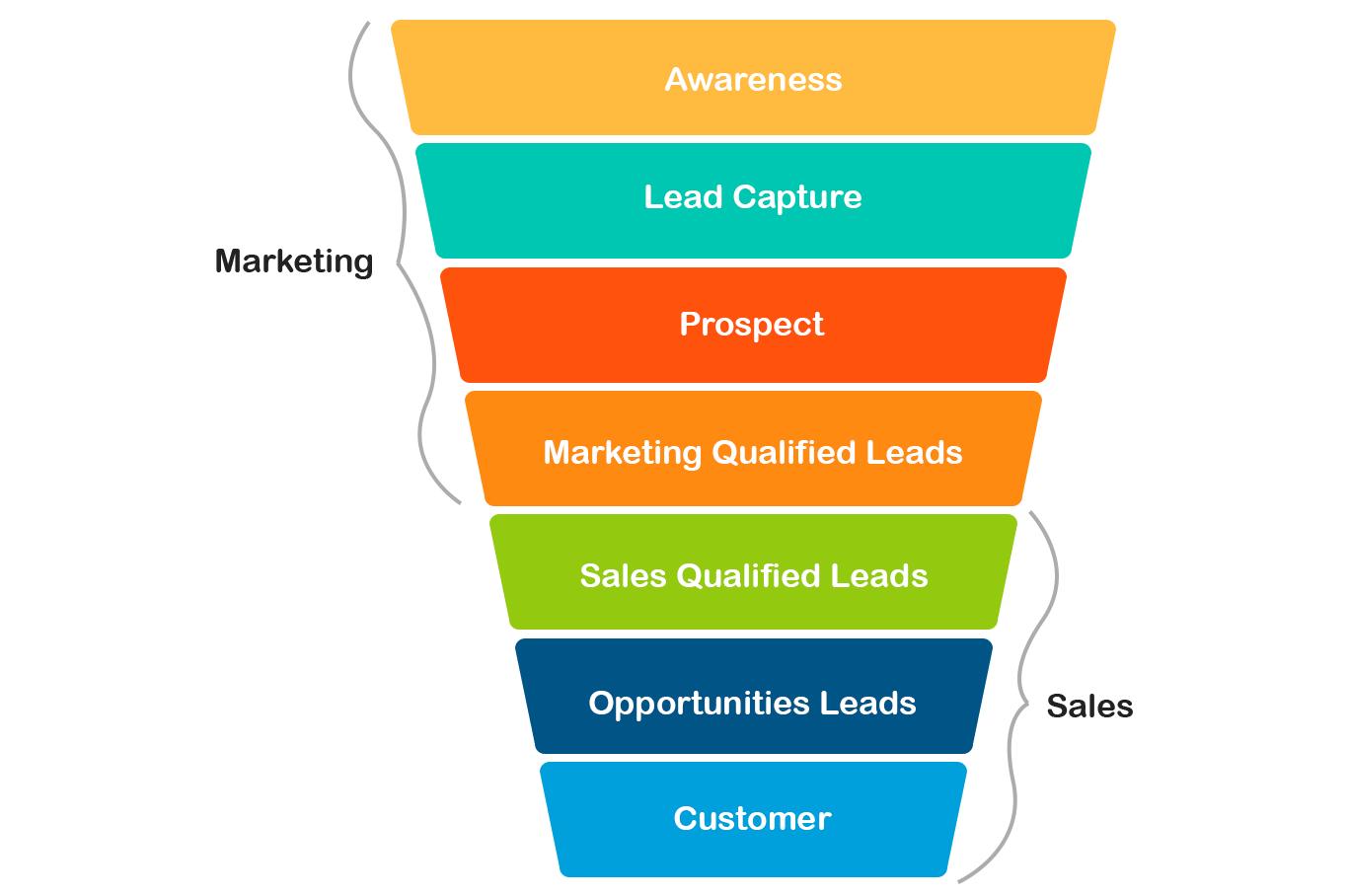
Not every form submission, phone call or WhatsApp message represents a genuine business opportunity.
Before hiring an agency for lead generation, agree on how leads will be classified.
Types of leads
| Lead category | Meaning |
|---|---|
| Raw enquiry | Someone contacts the business |
| Invalid enquiry | Spam, duplicate or unrelated request |
| Genuine enquiry | A real customer requirement |
| Qualified lead | Prospect meets agreed customer criteria |
| Sales opportunity | A potential commercial engagement |
| Converted customer | Prospect completes a purchase or signs an agreement |
Example
A digital marketing campaign generates 100 enquiries.
After reviewing them, the company finds:
-
15 spam or duplicate submissions.
-
25 enquiries outside its service scope.
-
60 genuine relevant enquiries.
-
30 qualified business prospects.
-
6 converted customers.
Reporting only 100 leads provides an incomplete understanding of performance.
The agency and business should agree on definitions before campaigns begin.
21. Understand Who Is Responsible for Converting Leads into Customers
Digital marketing and sales are connected but separate business functions.
Agency responsibilities may include
Attracting relevant audiences.
Improving marketing campaigns.
Developing landing pages.
Supporting enquiry generation.
Measuring marketing performance.
Reviewing available lead quality data.
Business responsibilities may include
Responding to enquiries.
Qualifying prospects.
Understanding customer requirements.
Preparing proposals.
Negotiating commercial terms.
Closing sales.
Delivering products and services.
Some agencies may also provide sales development or outsourced sales services, but these responsibilities should be explicitly included in the agreement.
Why this distinction matters
If the agency is responsible for generating qualified enquiries but your sales team does not follow up effectively, the campaign may not achieve its commercial potential.
Agree on responsibilities before judging whether the agency is meeting its commitments.
22. Understand Digital Marketing Pricing Models
Digital marketing agencies use different pricing structures.
Understanding these models helps business owners compare proposals more accurately.
Monthly retainer
A fixed recurring fee for agreed services.
Suitable for ongoing SEO, content marketing, campaign management and strategic support.
Project-based pricing
A fixed amount for a defined project such as a website development engagement, SEO audit or migration.
Hourly consulting
Payment based on consulting or implementation time.
Suitable for specialist guidance or temporary support.
Percentage of advertising expenditure
Management fees calculated partly or entirely as a percentage of media spend.
Performance-based pricing
Fees connected to agreed performance measures, such as qualified leads or customer acquisition.
Hybrid pricing
A combination of fixed fees and variable performance-based payments.
Comparison
| Pricing model | Advantage | Consideration |
|---|---|---|
| Monthly retainer | Predictable recurring expenditure | Deliverables should be clearly defined |
| Project-based | Defined project cost | Scope changes may cost extra |
| Hourly | Flexible specialist support | Total expenditure can vary |
| Percentage of ad spend | Scales with campaign expenditure | Incentives should be evaluated |
| Performance-based | Connects fees to agreed outcomes | Attribution and lead definitions are essential |
| Hybrid | Combines predictable and variable costs | Requires clear commercial terms |
Choose a pricing model that reflects your project complexity, objectives and ability to measure performance.
23. Calculate the Total Cost Before Hiring
Agency fees may represent only one part of your digital marketing expenditure.
Possible additional costs
Website development.
Advertising expenditure.
Content production.
Photography and video production.
Hosting and domain renewals.
Premium software.
CRM subscriptions.
Tracking tools.
Third-party outreach.
Internal staff resources.
Applicable taxes.
Illustrative monthly budget
| Expense | Monthly amount |
|---|---|
| Agency management fee | ₹40,000 |
| Advertising expenditure | ₹35,000 |
| Additional content production | ₹10,000 |
| Website maintenance | ₹5,000 |
| CRM and marketing tools | ₹5,000 |
| Total | ₹95,000 |
These are hypothetical figures, not a standard market quotation.
Depending on the engagement, some activities may already be included in the agency fee.
Request a complete cost breakdown before signing an agreement.
24. Do Not Choose an Agency Solely Because It Is Affordable
Budget is an important consideration, particularly for startups and small businesses.
However, choosing an agency only because it offers the lowest monthly fee can create problems.
Possible risks of unsuitable low-cost packages
Limited specialist involvement.
Generic marketing strategies.
Poor-quality content.
Insufficient technical work.
Weak campaign monitoring.
Unclear reporting.
Additional charges for essential activities.
Repeated website rework.
Does an expensive agency guarantee better results?
No.
Higher fees do not automatically indicate better execution, expertise or commercial outcomes.
Compare agencies based on:
Relevant experience.
Scope of work.
Team capabilities.
Implementation responsibilities.
Quality assurance.
Communication.
Measurement.
Total investment.
The best financial decision is not necessarily the cheapest or most expensive agency. It is the agency that offers an appropriate combination of relevant capabilities, transparent costs and realistic deliverables.
25. Learn How to Evaluate the Potential Return on Your Investment
Before approving a digital marketing budget, understand the customer acquisition economics of your business.
Hypothetical example
A business plans to invest ₹80,000 per month in digital marketing.
Its average initial customer revenue is ₹50,000.
Its contribution margin before customer acquisition costs is 40%.
This means each acquired customer generates approximately ₹20,000 in contribution before acquisition expenditure.
Possible scenarios
| Scenario | New customers | Customer revenue | Customer contribution | Contribution after marketing expenditure |
|---|---|---|---|---|
| Low performance | 2 | ₹1,00,000 | ₹40,000 | -₹40,000 |
| Break-even on measured spend | 4 | ₹2,00,000 | ₹80,000 | ₹0 |
| Moderate performance | 6 | ₹3,00,000 | ₹1,20,000 | ₹40,000 |
| Higher performance | 10 | ₹5,00,000 | ₹2,00,000 | ₹1,20,000 |
This simplified example assumes that the acquired customers are attributable to the measured marketing activity.
Additional fixed costs, sales expenses, taxes, payment delays and other costs are excluded.
Questions to consider
How many customers would justify the investment?
What is the acceptable customer acquisition cost?
What is the average contribution per customer?
How long does the sales process take?
Do customers make repeat purchases?
Can the business fulfil additional demand?
Understanding these numbers helps business owners evaluate marketing proposals more realistically.
26. Set Realistic Expectations About Results
Different marketing channels require different implementation and evaluation periods.
Indicative planning horizons
| Activity | Typical evaluation approach |
|---|---|
| Website assessment | Review during initial discovery |
| Conversion tracking | Verify after implementation |
| Website improvements | Assess according to development scope |
| Paid advertising | Review early campaign data and refine over time |
| Technical SEO | Monitor implementation and affected pages |
| Organic search growth | Evaluate over an appropriate multi-month period |
| Content marketing | Review relevance, discovery and longer-term contribution |
| B2B customer acquisition | Account for qualification and sales cycle duration |
These are planning considerations rather than guaranteed result timelines.
What should be visible early?
A clear strategy.
Defined priorities.
Completed discovery work.
Tracking implementation.
Evidence of agreed deliverables.
Identification of technical or commercial problems.
Transparent communication.
Even when business results require time, you should be able to understand what the agency is doing and why.
27. Agree on Key Performance Indicators Before Signing
Key performance indicators, commonly called KPIs, help determine whether marketing activities are progressing toward agreed objectives.
Appropriate KPIs by business type
| Business type | Potential primary KPIs |
|---|---|
| B2B service company | Qualified enquiries and sales opportunities |
| Manufacturing company | Distributor, procurement and quotation enquiries |
| eCommerce business | Sales, conversion rate and contribution after acquisition costs |
| Local service business | Relevant calls, bookings and enquiries |
| SaaS company | Qualified demonstrations, trials and customer acquisition |
| Healthcare business | Appropriate appointment or service enquiries |
| Startup | Validated customer interest and acquisition economics |
Supporting performance metrics
Organic search clicks.
Commercial keyword visibility.
Landing page performance.
Advertising cost.
Website conversion rate.
Cost per qualified lead.
Lead-to-customer conversion rate.
Important distinction
An agency should not be assessed using metrics that have no connection with its agreed responsibilities.
Choose a combination of implementation indicators, channel performance and business outcomes.
28. Understand What Information Your Monthly Report Should Contain
Business owners should know what type of reporting they will receive before hiring an agency.
A professional report should help you understand performance rather than simply present numbers.
A useful report may include
Business objectives: Which priorities the agency is addressing.
Completed work: Activities and deliverables implemented during the reporting period.
Search performance: Relevant page and query improvements or declines.
Advertising performance: Expenditure, relevant actions and acquisition data.
Website performance: Important customer interactions and conversion measurements.
Lead quality: Available information about genuine and qualified enquiries.
Challenges: Problems affecting implementation or outcomes.
Upcoming priorities: The agency's proposed next actions.
Reporting frequency
Monthly reports are common, while weekly updates may be appropriate for projects involving frequent implementation or active advertising campaigns.
Agree on a schedule that supports decision-making without creating unnecessary administrative work.
29. Ensure Your Business Owns Its Digital Assets
One of the most important considerations before hiring an agency is ownership.
Your business should maintain appropriate control of its essential digital assets.
Important assets
-
Domain name.
-
Website hosting.
-
Website administration.
-
Google Search Console.
-
Google Analytics.
-
Google Business Profile.
-
Google Ads account.
-
Meta advertising assets.
-
Social media accounts.
-
CRM systems.
-
Website content.
-
Creative assets.
-
Relevant source code and development documentation.
Why ownership matters
Imagine hiring an agency that creates your advertising account, manages your website and controls your analytics.
After ending the engagement, you discover that these assets are registered under the agency's accounts and you cannot access essential business information.
This can make future marketing and website management unnecessarily difficult.
What should the agreement clarify?
Administrative access.
Account ownership.
Intellectual property rights.
Third-party software licensing.
Data access.
Asset transfer procedures.
Responsibilities after termination.
The exact ownership of custom development work and licensed assets should be addressed explicitly in the contract.
30. Review Data Security and Confidentiality
Digital marketing agencies may require access to sensitive business systems and customer information.
Business owners should understand how that access will be managed.
Questions to ask
How will website credentials be protected?
Will employees receive individual access permissions?
Does the agency use multi-factor authentication?
How will customer information be handled?
Will external contractors access business data?
What happens when a team member leaves?
How will access be removed after the contract ends?
How will security incidents be communicated?
Recommended practices
Provide only the access necessary for the agreed work.
Avoid sharing passwords through unsecured channels.
Maintain company-controlled administrative accounts.
Review permissions periodically.
Ensure appropriate confidentiality and applicable data protection requirements are addressed.
31. Read the Contract Carefully Before Approving the Engagement
A digital marketing proposal explains the intended work.
The contract establishes the commercial relationship.
Business owners should understand both documents.
Important contract terms
| Contract area | What to verify |
|---|---|
| Scope of work | Services and deliverables included |
| Exclusions | Activities not covered by the fee |
| Payment terms | Amounts, dates and applicable taxes |
| Contract duration | Initial and renewal periods |
| Notice period | Requirements for termination |
| Additional work | Approval and pricing of scope changes |
| Deliverable ownership | Rights to content, design and development |
| Confidentiality | Protection of business information |
| Responsibilities | Agency and client obligations |
| Performance expectations | Agreed targets and limitations |
| Reporting | Frequency and required information |
| Handover | Access, documentation and asset transfer |
| Dispute resolution | Procedures for resolving disagreements |
Be careful with verbal promises
If an important deliverable or commercial commitment has been discussed verbally, request that it be reflected in the written agreement.
Do not assume that every statement made during a sales meeting will automatically form part of the contractual scope.
For substantial or complex agreements, professional legal review may be appropriate.
32. Understand Lock-In Periods and Cancellation Terms
Some agencies require a minimum engagement period.
This may reflect the time needed for planning, website improvements and campaign implementation.
A minimum term is not automatically unreasonable.
However, business owners should understand the implications.
Check the following
Minimum contract duration.
Notice period.
Early termination charges.
Refund policies.
Pending invoice obligations.
Handover fees, if any.
Treatment of unfinished work.
Access to business assets after termination.
Renewal conditions.
Example
A business signs a twelve-month agreement without reviewing the termination clause.
After four months, serious implementation and communication problems arise.
The company discovers that ending the agreement may create substantial financial obligations.
Understanding contract conditions before signing helps prevent avoidable disputes.
33. Determine How Much Time Your Internal Team Must Contribute
Hiring a digital marketing agency does not necessarily eliminate internal marketing responsibilities.
The agency may require information, approvals and technical support.
Client-side responsibilities may include
Providing product information.
Sharing approved brand guidelines.
Reviewing technical or regulatory content.
Approving advertising creatives.
Providing website access.
Coordinating internal development teams.
Sharing customer feedback.
Recording sales outcomes.
Approving important changes.
Why this matters
An agency may prepare useful recommendations, but implementation can remain incomplete if client approvals or technical support are unavailable.
Define responsibilities and approval timelines before the engagement begins.
34. Ask How Communication and Escalation Will Work
Poor communication can create difficulties even when an agency has strong technical capabilities.
Establish communication expectations
Who is the primary contact?
Which communication channels will be used?
How frequently will meetings occur?
How will urgent issues be handled?
How will delays be communicated?
Who approves major changes?
Who handles unresolved concerns?
Good communication does not mean constant messaging
An agency should communicate meaningful progress, decisions and problems.
Business owners should have sufficient visibility into the work without requiring daily explanations for every minor activity.
A structured communication process helps both teams focus on implementation.
35. Compare Multiple Agencies Using the Same Requirements
Speaking with several agencies can help business owners understand different approaches, pricing structures and capabilities.
However, comparing unrelated proposals can be misleading.
Example
Agency A quotes ₹25,000 per month for SEO.
Agency B quotes ₹40,000 per month for SEO, content production and development support.
Agency C quotes ₹60,000 per month for SEO and paid advertising management, excluding media spend.
Comparing only the monthly fees does not reveal which proposal provides the best fit.
Compare the same evaluation criteria
| Evaluation factor | Agency A | Agency B | Agency C |
|---|---|---|---|
| Understanding of business | Evaluate | Evaluate | Evaluate |
| Relevant experience | Evaluate | Evaluate | Evaluate |
| Proposed strategy | Evaluate | Evaluate | Evaluate |
| Technical capabilities | Evaluate | Evaluate | Evaluate |
| Content quality assurance | Evaluate | Evaluate | Evaluate |
| Implementation responsibility | Evaluate | Evaluate | Evaluate |
| Tracking and reporting | Evaluate | Evaluate | Evaluate |
| Total monthly investment | Compare | Compare | Compare |
| Contract conditions | Compare | Compare | Compare |
| Communication process | Evaluate | Evaluate | Evaluate |
| Digital asset ownership | Verify | Verify | Verify |
Use this comparison to identify meaningful differences rather than automatically selecting the lowest bidder.
36. Questions Every Business Owner Should Ask Before Hiring a Digital Marketing Agency
Use these questions during your initial agency meetings.
Questions about strategy
-
What do you understand about our business model?
-
Who do you believe our ideal customers are?
-
Which marketing channels would you prioritise and why?
-
What are the most important weaknesses in our existing digital presence?
-
How will your strategy differ from our competitors' approaches?
-
What would you recommend doing first?
Questions about experience
-
Have you worked with businesses involving similar customer acquisition requirements?
-
Can you explain relevant case studies?
-
Which specialists will work on our account?
-
Will any work be outsourced?
-
How do you review the quality of completed work?
Questions about execution
-
What will be included in the first month?
-
Who will implement technical recommendations?
-
How will content be researched and approved?
-
Will website development be included?
-
How will you coordinate with our internal team?
-
What happens when tasks are delayed?
Questions about performance
-
Which KPIs should we agree on?
-
How will you measure genuine enquiries?
-
How will lead quality be evaluated?
-
What performance limitations should we understand?
-
How will you respond to underperforming campaigns?
-
What can reasonably be assessed during the first 90 days?
Questions about pricing and contracts
-
What is included in your monthly fee?
-
Are advertising costs separate?
-
Which activities may incur additional charges?
-
Is there a minimum contract duration?
-
What are the termination and handover conditions?
-
Who owns the digital assets and content?
-
How will confidential business information be protected?
The answers should help you evaluate the agency's capabilities, transparency and suitability.
37. Red Flags to Watch for Before Hiring a Digital Marketing Agency
Certain behaviours deserve closer investigation.
Guaranteed Google rankings
No agency controls Google's ranking systems.
Guaranteed revenue without understanding the business
Customer acquisition depends on multiple commercial and operational factors.
No questions about target customers
The agency recommends services before understanding the intended audience.
Unclear pricing
Important activities or costs are not explained.
No documented scope
The agency expects payment without clearly defining what will be delivered.
Unverified performance claims
Impressive percentages are presented without baselines, dates or context.
Pressure to sign immediately
The agency discourages reasonable due diligence.
No clear ownership policy
Important business assets would remain under exclusive agency control.
Unclear implementation responsibilities
Nobody can explain who will complete necessary website changes.
Manipulative SEO practices
The agency recommends tactics primarily intended to influence rankings through prohibited methods.
Unclear team structure
Business owners cannot determine who will manage or execute the work.
One strategy for every client
The agency cannot explain how its approach reflects different business requirements.
An individual warning sign may require clarification rather than immediate rejection.
Repeated concerns involving transparency, misleading claims and accountability should receive particular attention.
38. A Digital Marketing Agency Hiring Scorecard
Use this scorecard to assess potential agencies before making a decision.
Rate each category from 1 to 5.
| Evaluation area | Maximum score |
|---|---|
| Business understanding | 5 |
| Relevant industry experience | 5 |
| Strategy quality | 5 |
| Technical capabilities | 5 |
| Team expertise | 5 |
| Content quality standards | 5 |
| Pricing transparency | 5 |
| Implementation clarity | 5 |
| Measurement capabilities | 5 |
| Communication process | 5 |
| Contract transparency | 5 |
| Digital asset ownership | 5 |
| Maximum total | 60 |
Illustrative interpretation
50–60: Strong alignment across many evaluation areas.
40–49: Potentially suitable, with some areas requiring clarification.
30–39: Significant gaps should be investigated before proceeding.
Below 30: Consider alternative options unless concerns can be adequately resolved.
This is a practical decision-support framework, not a validated industry benchmark.
Do not allow a high overall score to compensate for serious concerns such as misleading claims, inappropriate security practices or unclear ownership.
39. What Should Happen During the First 90 Days After Hiring?
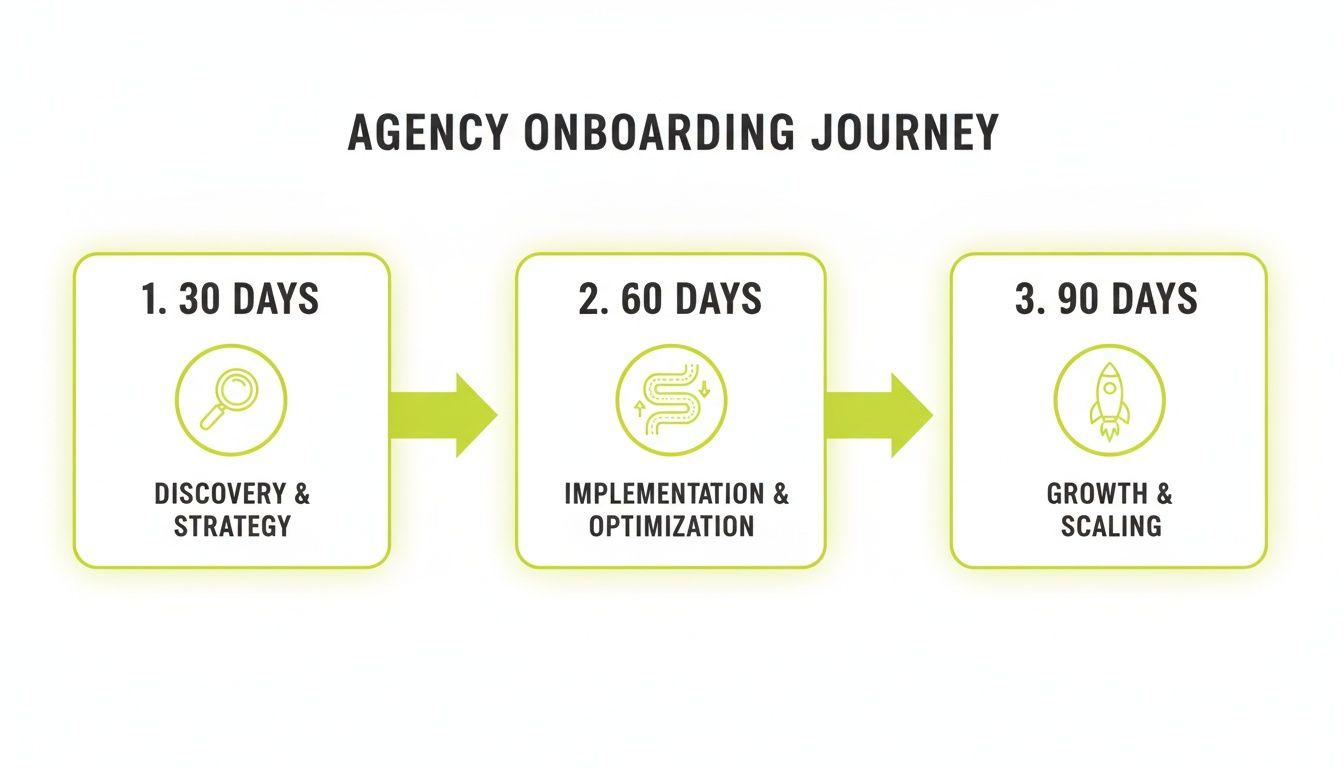
Understanding the proposed onboarding and implementation process can help you evaluate whether an agency is adequately prepared.
Days 1–30: Discovery and planning
The agency should establish a baseline and clarify priorities.
Potential activities include:
-
Business and customer discovery.
-
Website assessment.
-
Keyword and competitor research.
-
Analytics review.
-
Existing campaign assessment.
-
Technical issue identification.
-
Lead tracking review.
-
Strategy development.
Expected deliverable: A documented strategy, baseline and implementation plan.
Days 31–60: Priority implementation
The agency should begin implementing agreed improvements.
Potential activities include:
-
Technical SEO recommendations.
-
Commercial page optimisation.
-
Content development.
-
Website and landing page improvements.
-
Conversion tracking.
-
Relevant advertising campaigns.
-
Internal linking improvements.
Expected deliverable: Evidence of completed and ongoing priority work.
Days 61–90: Evaluation and refinement
The agency should review early performance and implementation progress.
Potential activities include:
-
Search performance analysis.
-
Advertising review.
-
Lead quality assessment.
-
Landing page evaluation.
-
Sales feedback.
-
Identification of remaining technical issues.
-
Refinement of the next phase.
Expected deliverable: A transparent performance assessment and revised roadmap.
The exact milestones depend on the agreed scope, website condition, available resources and complexity of the business.
Ninety days should not be treated as a universal deadline for generating substantial revenue or achieving specific organic search rankings.
40. Should You Hire a Digital Marketing Agency or Build an In-House Team?
Before hiring externally, consider whether your business would benefit from an internal team.
| Factor | Digital marketing agency | In-house team |
|---|---|---|
| Specialist access | May provide multiple disciplines | Depends on recruitment |
| Management | External coordination | Direct internal supervision |
| Business familiarity | Requires onboarding | Often develops deeper ongoing knowledge |
| Cost structure | Contract or service fees | Salaries, tools and management expenses |
| Flexibility | Depends on scope and contract | Depends on staffing capacity |
| Execution capacity | May scale across specialists | Depends on team size |
| Accountability | Defined through agreement | Managed through internal processes |
A hybrid approach
Some businesses retain an internal marketing manager and work with external specialists for SEO, development, advertising or content.
This approach can combine internal business understanding with external technical expertise.
The appropriate model depends on your company's size, budget, requirements and management capabilities.
41. How to Make Your Final Hiring Decision
Before signing the agreement, confirm that the proposed partnership addresses your business requirements.
Final pre-hiring checklist
-
Our business objectives are clearly defined.
-
The agency understands our customer segments.
-
The proposed services are relevant to our requirements.
-
We have reviewed suitable case studies.
-
We understand who will work on our account.
-
The strategy is documented.
-
Deliverables and exclusions are clear.
-
Technical implementation responsibilities are defined.
-
Content quality standards are agreed.
-
Advertising costs are clearly separated where applicable.
-
Total investment is financially manageable.
-
Performance indicators are agreed.
-
Lead qualification criteria are defined.
-
Reporting requirements are clear.
-
Our business retains appropriate digital asset control.
-
Data protection responsibilities are addressed.
-
Contract duration and termination terms are understood.
-
The initial implementation roadmap is documented.
-
Internal approvals and responsibilities are assigned.
-
We understand the risks and limitations of the proposed strategy.
If important questions remain unanswered, resolve them before committing to the engagement.
42. How SEOspade Helps Businesses Choose an Appropriate Digital Marketing Strategy
Every business has different customer acquisition requirements.
A startup establishing its first website needs a different approach from an established manufacturer entering new markets.
Similarly, a professional services company seeking qualified enquiries may require a different strategy from an eCommerce business looking to improve online sales.
At SEOspade, our services are designed to address different stages of digital business development.
Search engine optimisation services
Support relevant organic search visibility through technical SEO, on-page optimisation, keyword research, content development and appropriate off-page activities.
Website design and development
Develop scalable, professional websites that clearly communicate business offerings and support customer enquiry journeys.
Content writing services
Create relevant service pages, product information, educational articles and customer-focused resources.
Paid marketing and lead generation
Develop and manage appropriate advertising strategies based on the intended audience, available budget and agreed commercial objectives.
Social media marketing
Support brand communication, customer engagement and relevant digital visibility.
Digital PR and guest posting
Identify appropriate opportunities for online brand exposure and relevant editorial visibility.
Technical SEO consulting
Assess website architecture, indexing, migration requirements, internal linking and technical implementation priorities.
Business-focused performance measurement
Establish suitable indicators to help businesses understand digital marketing activities and their potential contribution to customer acquisition.
The appropriate combination of services depends on your existing digital presence, customer acquisition challenges, industry, operational capabilities and business objectives.
Our aim is to help businesses develop marketing strategies that are understandable, measurable and connected to their commercial requirements.
Conclusion: Hire a Digital Marketing Partner, Not Just a Service Provider
Hiring a digital marketing agency should be a considered business decision.
The right agency for your company is not necessarily the one offering the largest number of services, the lowest monthly fee or the most impressive ranking promises.
It is the agency that understands your customers, business model, commercial objectives and practical requirements.
Before signing an agreement, make sure you understand the proposed strategy, what work will be completed, who will be responsible for implementation and how performance will be measured.
Evaluate relevant experience.
Review the complete investment.
Ask meaningful questions.
Understand the contractual commitments.
Protect your digital assets.
Prepare your internal team to manage the partnership effectively.
Digital marketing cannot guarantee business success, but an appropriate strategy supported by consistent execution can help businesses develop stronger digital capabilities and more organised customer acquisition systems.
Do not hire a digital marketing agency simply because you want more website traffic. Hire an agency because you understand the business problem you want to solve and have identified a partner capable of helping you address it.
If you are planning to hire a digital marketing agency and are unsure which services your business requires, connect with SEOspade to discuss your website, existing digital presence, target customers and business growth objectives.