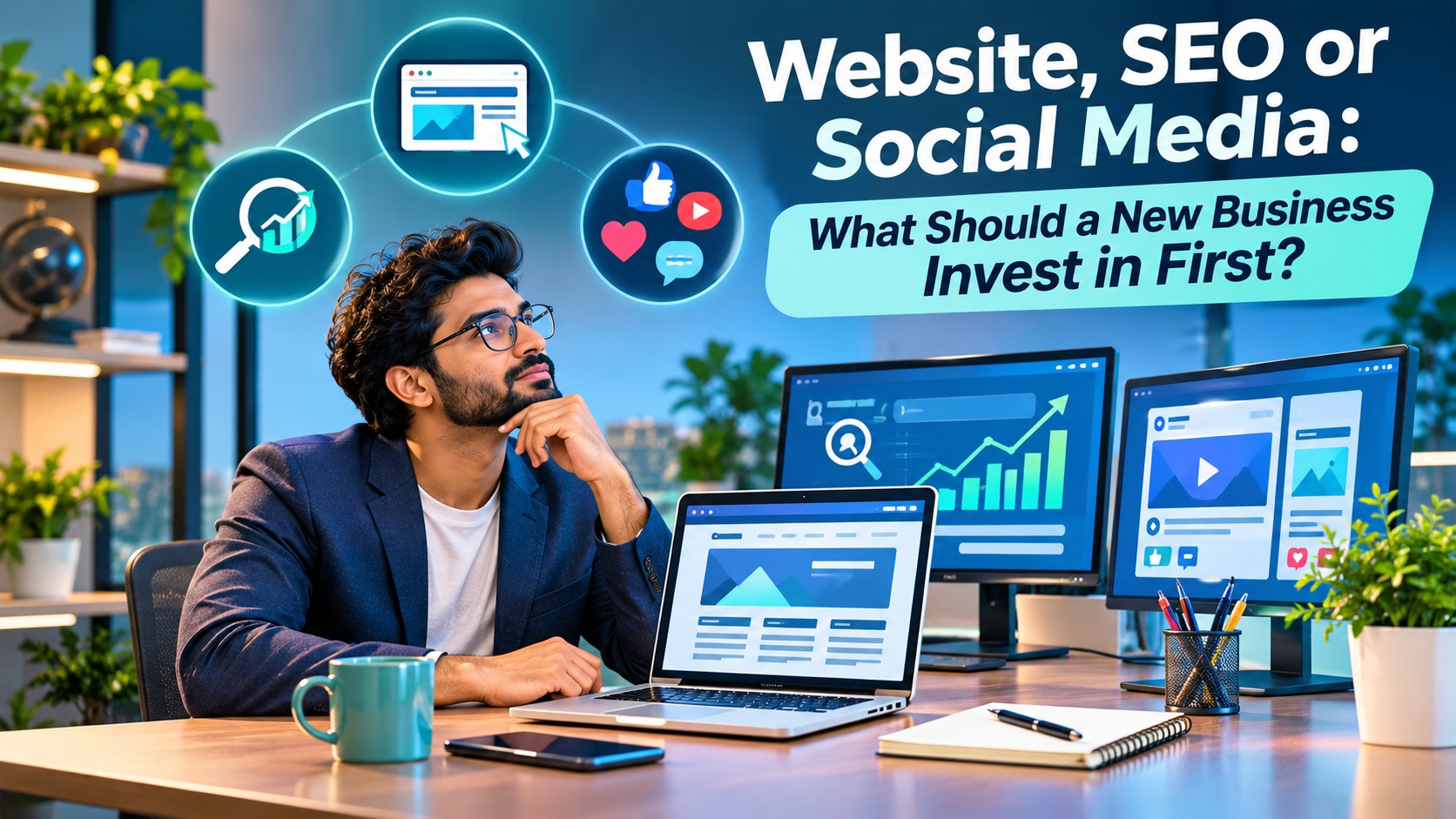
Starting a business involves many expenses. You may already be spending money on registration, office space, equipment, employees, inventory or product development. When it comes to marketing, you face another decision: Should you build a website, invest in SEO or start promoting your business on social media?
All three can help your business grow, but they serve different purposes. Spending on the wrong activity at the wrong time can leave you with an attractive website that nobody visits, social media followers who never buy or SEO traffic that does not generate enquiries.
This guide will help you decide what to prioritise based on your business type, budget, customer behaviour and immediate goals. It also includes practical cost examples, decision frameworks, a 90-day action plan and common mistakes to avoid.
1. Why This Decision Matters More Than Most New Business Owners Realise
When a business is new, every marketing expense competes with other important needs. You might have ₹20,000, ₹50,000 or ₹1 lakh available for marketing, but you cannot afford to spend it without understanding what it should achieve.
Consider three examples.
A local plumbing company needs nearby customers who have immediate service requirements. A fashion startup needs people to discover and become interested in its products. A B2B machinery supplier needs purchasing managers to understand its technical capabilities and request quotations.
All three businesses need customers, but their buying journeys are different.
A plumbing customer may search Google and call a provider within minutes. Someone buying clothing may discover a product through Instagram, compare styles and purchase later. A factory purchasing manager may review technical specifications and contact several suppliers before making a decision.
That is why the best first marketing investment depends on how your customers discover businesses, evaluate their options and make purchasing decisions.
A website, SEO and social media are not three versions of the same service. Each has a different role.
2. What Does a Website, SEO and Social Media Actually Do?
Website — Your digital business location
A website explains your offerings, provides useful information, establishes credibility and gives visitors a way to contact or buy from you. It is an asset your business can control, subject to your hosting and platform arrangements.
SEO — Helping relevant customers find you
Search engine optimisation improves your website's ability to be discovered through relevant organic searches. It involves technical improvements, useful content, website structure and search relevance.
Social media — Building awareness and relationships
Social media helps introduce your brand, demonstrate products, answer questions and engage with audiences. Some businesses also use it to generate direct enquiries and sales.
A website provides the destination. SEO can help people discover that destination. Social media creates additional opportunities for people to become familiar with your business.
These activities can support one another, but you do not necessarily need to invest heavily in all three from day one.
3. Should a New Business Invest in a Website First?
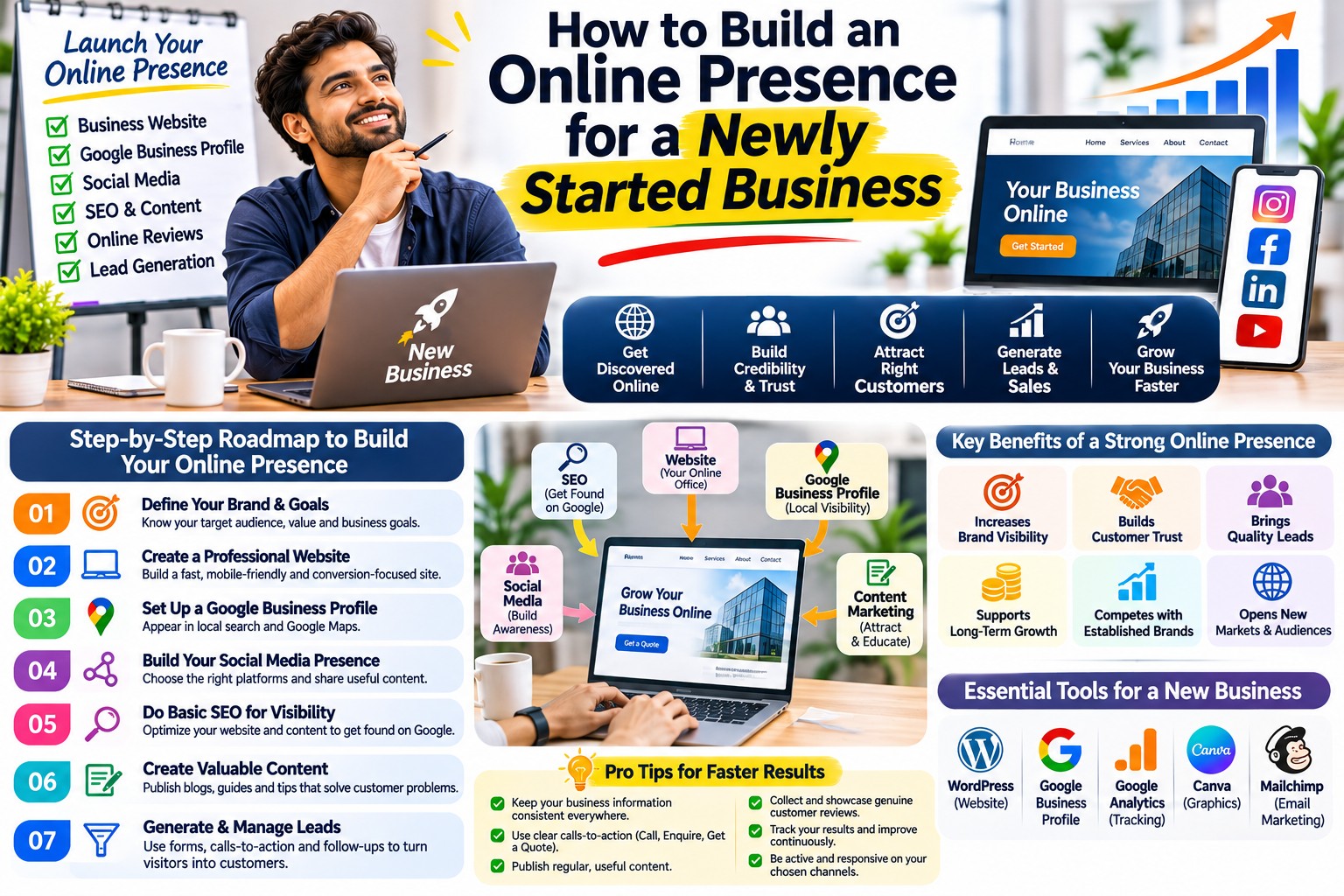
For many businesses, a website is a sensible first investment because it provides a central place for potential customers to understand the company.
However, this does not mean every startup needs a large, expensive website before it can make its first sale.
Why a website matters
Imagine someone sees your company mentioned on LinkedIn.
They are interested in your service, but they have never heard of your business before.
They search for your company name and want to know:
-
What services do you provide?
-
Who do you work with?
-
Where are you located?
-
How much does your service cost?
-
Can they see examples of your work?
-
How can they contact you?
A useful website can answer these questions.
Without one, potential customers may struggle to verify your business or understand your offering.
What should your first website include?
For a new service-based business, start with the pages that help customers make decisions.
|
Page |
Purpose |
|---|---|
|
Homepage |
Explain the business and its main offering |
|
About Us |
Introduce the company and relevant experience |
|
Service pages |
Describe individual services in detail |
|
Contact Us |
Make enquiries straightforward |
|
Portfolio or case studies |
Show genuine examples, if available |
|
Privacy policy |
Explain relevant data practices |
An e-commerce business may additionally need product pages, shopping cart functionality, checkout, delivery information and return policies.
Avoid spending on unnecessary features
A new business may not need elaborate animations, dozens of generic pages or expensive custom functionality.
Start by answering the customer's most important questions.
For example, a new interior design company may benefit more from clear service descriptions, genuine project photographs and a simple consultation form than from an elaborate animated homepage.
When should a website be your first priority?
Prioritise a website when customers need detailed information before purchasing, your services require quotations or consultations, your business targets professional buyers, or you want to build organic search visibility.
If you already have a functioning website, however, redesigning it may not be the best use of your first marketing budget. You might benefit more from improving the existing pages and generating relevant traffic.
4. When Should SEO Be Your First Major Marketing Investment?
SEO becomes particularly valuable when your potential customers already search Google for the products or services you provide.
For example, someone searching for "commercial RO plant manufacturer" or "GST registration consultant in Delhi" may have a clear business requirement.
If your website appears for relevant searches and provides useful information, you have an opportunity to attract those potential customers.
What does SEO involve?
SEO is not simply adding keywords to a website.
A practical SEO strategy includes several areas.
Keyword research: Identify the actual terms customers use, distinguish informational searches from commercial searches and select relevant opportunities.
Technical SEO: Ensure search engines can access and understand important pages. This includes crawling, indexing, canonical URLs, XML sitemaps, internal linking and technical website issues.
On-page SEO: Improve page titles, headings, descriptions, structure and content relevance.
Content development: Create genuinely helpful service pages, product information and articles that answer customer questions.
Local SEO: Improve visibility for relevant local searches when your business serves specific locations.
Performance measurement: Use appropriate tools to understand organic search visibility, landing page performance and enquiries.
Example: A new B2B manufacturer
Suppose your company manufactures packaging machines.
You may want to reach buyers searching for:
-
Automatic packaging machine manufacturer.
-
Industrial packaging equipment supplier.
-
Pouch packing machine manufacturer.
-
Packaging machine supplier in India.
A useful SEO strategy would start by researching these searches and building relevant product or category pages.
Each page should explain the equipment, applications, specifications, suitable industries and enquiry process.
This approach is more commercially relevant than publishing unrelated articles simply to increase website traffic.
When should you prioritise SEO?
SEO deserves early investment when:
-
Customers actively search for your offerings.
-
Your products or services have identifiable search demand.
-
You want to build a longer-term acquisition channel.
-
Your website is ready to support enquiries.
-
You can invest consistently and review progress over time.
When should SEO not be your only immediate priority?
If your business needs enquiries this week, organic SEO alone may not meet that requirement.
Similarly, if you are introducing a completely new product category that customers do not yet know exists, search demand may be limited.
In such cases, direct outreach, partnerships, product demonstrations or paid campaigns may help you validate demand while developing your organic presence.
5. When Should Social Media Be Your First Marketing Priority?
Social media can be especially useful when customers discover products through visuals, recommendations, demonstrations and ongoing engagement.
For some businesses, people may not search for a product until they have seen it.
For example, a new fashion label may attract its first interested customers through Instagram videos or creator collaborations.
A bakery may use photographs and short videos to show its products and attract local attention.
A software business may demonstrate how its product solves a problem.
Organic social media versus paid social media
These are two different investments.
Organic social media involves creating and sharing content through your business accounts. It may include product demonstrations, educational posts, videos, customer stories and updates.
Paid social media involves paying platforms to distribute advertisements to selected audiences.
Creating an account may be free, but producing useful content takes time, skills and resources. Paid promotion introduces advertising costs as well.
What should you publish?
Your content should match what customers need to understand before buying.
For a clothing brand, this may include fabric details, sizing, styling ideas, product videos and customer experiences.
For a consultancy, it may include explanations of common business problems, practical advice and evidence of relevant experience.
For a manufacturing business, it may include product demonstrations, facility information, equipment applications and technical explanations.
When is social media the better first choice?
Consider prioritising it when your customers spend time discovering products through social platforms, your offering benefits from visual demonstrations, you can produce useful content consistently or you want to test how people respond to a new brand.
When should you avoid making it your only channel?
Social media is less useful as a standalone strategy if your customers primarily search for specialist suppliers or if you have no clear way to convert attention into enquiries.
For example, a manufacturer selling specialised industrial machinery may not benefit much from collecting thousands of unrelated followers.
The goal should be reaching relevant people, not merely growing follower counts.
6. Website vs SEO vs Social Media: Detailed Comparison
|
Factor |
Website |
SEO |
Social media |
|---|---|---|---|
|
Main purpose |
Explain offerings and convert visitors |
Attract relevant organic search visitors |
Build awareness and engagement |
|
Initial requirement |
Domain, hosting/platform and content |
Suitable website or web presence |
Relevant social account and content |
|
Typical investment |
Setup plus maintenance |
Ongoing work |
Content, management and optional advertising |
|
Speed of initial activity |
Can launch quickly |
Work can begin quickly; organic growth varies |
Can start publishing quickly |
|
Customer discovery |
Limited without promotion |
Based on relevant search demand |
Based on platform distribution and audience interest |
|
Control |
Relatively high |
Search rankings are not controlled |
Platform algorithms and policies affect reach |
|
Lead generation |
Depends on traffic and conversion experience |
Depends on relevant searches and website performance |
Depends on audience, offer and follow-up |
|
Long-term value |
Business-controlled digital asset |
Can build sustained organic visibility |
Can build brand familiarity and community |
|
Main risk |
Website exists but receives no visitors |
Investment without relevant commercial outcomes |
Engagement without qualified customers |
The important distinction: A website is primarily infrastructure and a conversion destination. SEO and social media are marketing activities that can bring attention to your business.
They should not be compared as though they are identical purchases.
7. How Much Should a New Business Budget for Each Option?
Marketing costs vary significantly by website complexity, service provider, competition, content requirements and whether you manage the work internally.
The following figures are hypothetical examples for planning purposes in India, not verified market averages.
|
Investment |
Illustrative planning range |
Main variables |
|---|---|---|
|
Basic business website |
₹15,000–₹50,000 one-time |
Pages, design, functionality, content |
|
Custom or advanced website |
₹50,000–₹2,00,000+ |
Integrations, complexity, design |
|
Ongoing SEO |
₹15,000–₹60,000+ monthly |
Competition, website size, scope |
|
Social media management |
₹10,000–₹40,000+ monthly |
Platforms, posts, videos, creative work |
|
Paid social advertising |
Variable additional spend |
Targeting, competition, campaign objectives |
These ranges exclude or may not include domain renewals, hosting, paid advertising, specialist content, development changes, video production and other expenses.
Why the cheapest option is not always the best
Suppose an agency offers SEO for ₹5,000 per month but cannot explain which pages it will improve, what work is included or how progress will be measured.
A low fee does not automatically make that investment worthwhile.
Similarly, a ₹1 lakh website may not be necessary for a company that only needs five well-designed service pages.
Evaluate the work required, not just the quoted price.
8. Decide What to Invest in First Based on Your Situation
Find your best starting point
Select your business situation to see a practical recommendation.
YOUR RECOMMENDED APPROACH
Establish a reliable digital foundation
Prioritise an easy-to-use website or landing page, accurate local business information and local search visibility.
Build only the pages and features needed to explain your offer and capture customer interest. You can begin appropriate outreach or social activity in parallel.
Track qualified enquiries and sales outcomes rather than only clicks, impressions or engagement.
For eligible businesses, a Google Business Profile can help customers discover you in Search and Maps.
Copy recommendationThis framework is a starting point. Your available budget, margins, sales cycle and customer research should guide the final decision.
9. Why Spending on All Three at Once Can Be a Mistake
A common approach is to hire a website developer, an SEO agency and a social media manager immediately after starting a business.
That can work if you have a clear plan and sufficient resources.
But for a new business with limited funds, it can create several problems.
You may spend heavily on marketing before confirming that customers want your offering. You may also have multiple providers producing work without a shared objective.
For example, your social media manager may promote one service, your SEO team may target a different audience and your website may not clearly explain either offering.
The result is activity without coordination.
A better approach
First, identify your main commercial objective.
Then determine which channel is most likely to reach customers who have that requirement.
Invest in a reliable way to capture enquiries.
Once you understand what works, expand into other channels.
This does not mean waiting until one channel is completely successful before using another. It means prioritising investments instead of spreading your resources without a plan.
10. What Should You Do if Your Marketing Budget Is Only ₹10,000–₹20,000?
A small budget does not prevent you from starting, but it does require careful choices.
If you have no website, you might begin with a simple website or landing page using a suitable platform, rather than commissioning a large custom project.
If your business is eligible for Google Business Profile, completing an accurate listing may be a useful early activity.
You can also use your own time for customer research, direct outreach and useful social media content.
An illustrative ₹20,000 initial budget
|
Activity |
Example allocation |
|---|---|
|
Basic website or landing page setup |
₹12,000 |
|
Essential content and visuals |
₹3,000 |
|
Initial promotion or advertising test |
₹5,000 |
|
Total |
₹20,000 |
This example assumes a very limited website scope and is not a guarantee that these services will be available at these prices.
If you already have a usable website, you may be better off investing in improving its most important pages and testing a suitable acquisition channel.
What should you avoid?
Avoid paying for hundreds of generic backlinks, large quantities of low-value blog content, purchased followers or unnecessary website features.
Focus on activities that address a genuine business need.
11. What Should You Do With a ₹50,000 Monthly Marketing Budget?
A larger budget provides more flexibility, but you should still avoid dividing it equally between channels without considering your business.
For example, a service business with an existing website and clear search demand might use the following illustrative allocation:
Example monthly allocation — ₹50,000
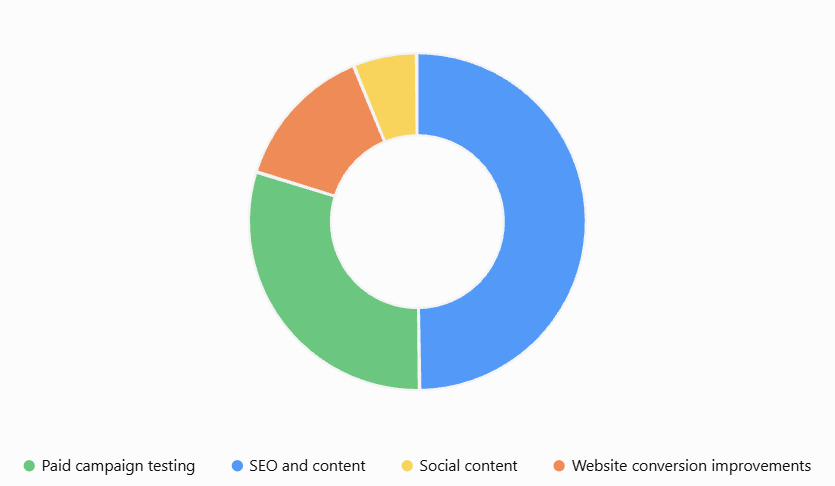
For a consumer product brand, a different allocation may make more sense.
You might invest more in product photography, video production, social content, customer experience and paid campaign testing.
For a new B2B manufacturing business, detailed product pages, search visibility and targeted professional outreach may deserve a larger share.
The correct budget is the one that fits your customer acquisition strategy and commercial economics.
12. What Should a New Business Do During the First 90 Days?
A practical marketing plan should focus on establishing the foundation, testing demand and improving based on evidence.
01
MONTH
Days 1–30: Understand customers and establish your foundation
Identify the target audience, review competitors, define your offer and build or improve essential website pages. Set up appropriate analytics and enquiry tracking. Create relevant business profiles and test the contact process.
02
MONTH
Days 31–60: Begin customer acquisition
Improve the most important service or product pages. Start relevant SEO work, publish genuinely useful content and establish a manageable social media routine. Test targeted outreach or advertising where appropriate.
03
MONTH
Days 61–90: Measure and refine
Review which channels attract relevant visitors and qualified enquiries. Identify conversion problems, improve weak pages, evaluate campaign costs and decide which activities deserve more investment.
The purpose of the first 90 days is to establish a working process and learn from actual customer behaviour. It is not a promise that SEO rankings, revenue or customer acquisition will reach a particular level within three months.
13. How Do You Know Whether Your Investment Is Working?
Different channels require different measurements.
A website should be evaluated for usability, enquiry completion and its ability to help visitors understand your offering.
SEO should be evaluated using relevant search visibility, organic traffic quality, important landing pages and conversions.
Social media should be evaluated based on the audience reached, meaningful engagement, relevant website visits and enquiries or sales where measurable.
Example: Comparing marketing performance
|
Metric |
Website |
SEO |
Social media |
|---|---|---|---|
|
Main activity |
Improve enquiry experience |
Improve relevant search visibility |
Reach and engage target audience |
|
Useful performance measure |
Enquiry conversion rate |
Organic qualified leads |
Relevant enquiries and engagement |
|
Supporting measure |
Form completion and mobile usability |
Clicks, queries and landing pages |
Reach, profile visits and clicks |
|
Commercial measure |
Customers acquired through website |
Customers influenced by organic search |
Customers influenced by social activity |
Avoid treating all website visitors as potential customers.
Similarly, do not assume that a social media follower or a high keyword ranking automatically creates commercial value.
Track qualified enquiries
Suppose your website receives 100 enquiries.
If 70 are spam or irrelevant, reporting 100 leads gives a misleading picture.
Agree on what qualifies as a genuine lead and track the outcome through your sales process.
14. Common Mistakes New Businesses Should Avoid
Building an expensive website without understanding customers. The website may look attractive but fail to answer important buying questions.
Expecting SEO to produce immediate sales. Organic search visibility requires work and is influenced by competition and search demand.
Choosing social media because competitors use it. Your customers may discover suppliers through different channels.
Paying for followers and engagement. Artificial numbers do not establish genuine demand.
Creating duplicate service or location pages. Every important page should have a distinct purpose and provide useful information.
Ignoring mobile usability. Customers should be able to browse, understand your offer and contact you from a phone.
Running advertisements without conversion tracking. Clicks alone do not tell you whether campaigns generate customers.
Changing strategy too frequently. Make adjustments based on sufficient evidence rather than reacting to every small fluctuation.
Hiring providers without clear responsibilities. Your website developer, SEO specialist and social media manager should understand how their work supports the business.
Measuring only traffic and impressions. Track qualified enquiries, customers and commercial outcomes whenever possible.
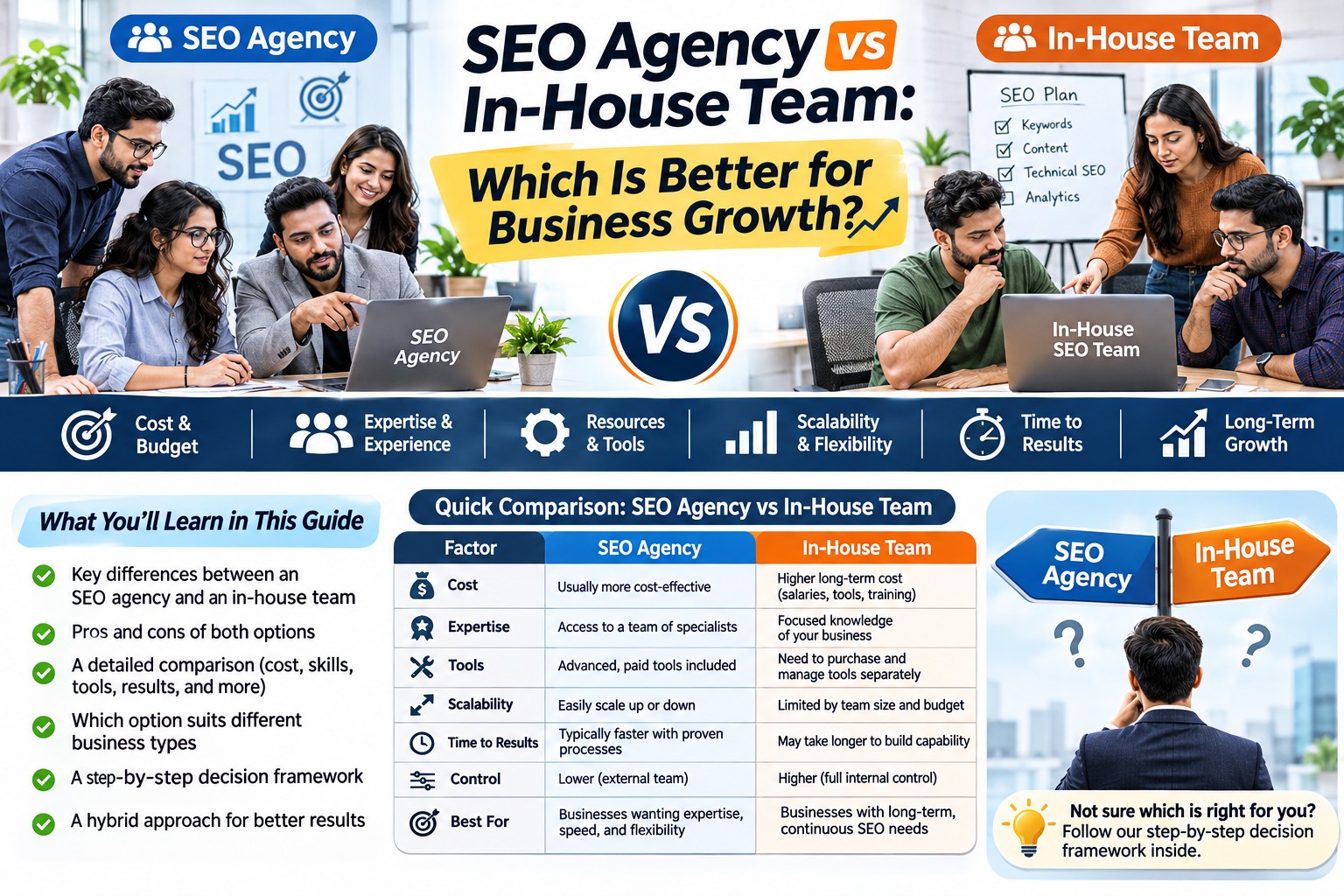
15. Should You Hire One Digital Marketing Agency for All Three Services?
A single agency may offer website development, SEO and social media marketing.
This can simplify communication and help align different activities around one strategy.
For example, the website team can build service pages with SEO requirements in mind, while the social media team can direct relevant visitors to those pages.
However, offering all three services does not automatically mean an agency has equal expertise in each.
Before hiring, ask who will perform the work, what is included in the fee, which services are handled internally and how performance will be measured.
If you already have a capable website developer or internal marketing team, you may only need specialist support in one area.
The objective is not to purchase the largest package. It is to obtain the expertise and capacity your business needs.
16. What Should You Invest in First? Recommendations by Business Type
|
Business type |
First priority |
Next investment |
|---|---|---|
|
Local clinic or service provider |
Clear website/contact presence and eligible local listing |
Local SEO and suitable promotion |
|
B2B manufacturing company |
Detailed product website |
Commercial-intent SEO and targeted outreach |
|
New fashion or lifestyle brand |
Product purchasing destination and visuals |
Social media discovery and suitable paid campaigns |
|
Accounting or legal consultancy |
Trustworthy service website |
Relevant search visibility and professional outreach |
|
SaaS startup |
Product explanation, demo or signup experience |
Content, search or demand-generation tests |
|
New restaurant or café |
Accurate local information and menus |
Local discovery and visual social content |
|
Real estate service business |
Credible listings and enquiry process |
Local search, content and targeted campaigns |
|
Online retailer |
Reliable store and product pages |
Product discovery, SEO and advertising |
These are broad starting points. A business with strong existing traffic but weak conversions may need website improvements before investing in more visitors.
17. The Most Practical Recommendation for a Newly Started Business
For many service-based businesses, the sensible sequence is:
Build a credible, functional website → improve relevant search visibility → use social media where it reaches your customers.
But that sequence is not universal.
A new product brand may use social media early to discover whether people are interested in its offering. A local business may receive its first enquiries through local listings. A B2B consultancy may begin targeted outreach while its website and SEO are being developed.
The most important question is not which channel is popular.
It is:
Where can you reach the right customer, give them enough confidence to consider your business and make it easy for them to take the next step?
That question should guide your first investment.
Conclusion: Invest in What Your Customers Need First
A website, SEO and social media can all contribute to business growth, but their value depends on when and how you use them.
A website helps customers understand and evaluate your business. SEO helps relevant people discover your website through search. Social media can introduce your brand, build familiarity and create additional opportunities for engagement.
For many new businesses, a clear website provides a useful foundation. From there, SEO and social media investments should follow customer behaviour and commercial priorities.
You do not need to build everything at once.
Start with what helps potential customers find you, trust you and contact you. Track the results, learn from customer feedback and expand your marketing activities as the business develops.
Need Help Deciding Where to Invest Your Marketing Budget?
At SEOspade, we help businesses plan and improve their online presence through website design and development, SEO, content marketing, social media management and paid advertising.
Whether you are launching your first website or deciding how to attract customers online, the starting point should be your business objectives and the needs of your target audience.
Visit SEOspade to explore the services that may be suitable for your business.