Starting a business takes money, planning and effort. You may have already spent several months arranging your products, developing your services, registering your company, building a website, hiring employees or preparing your office.
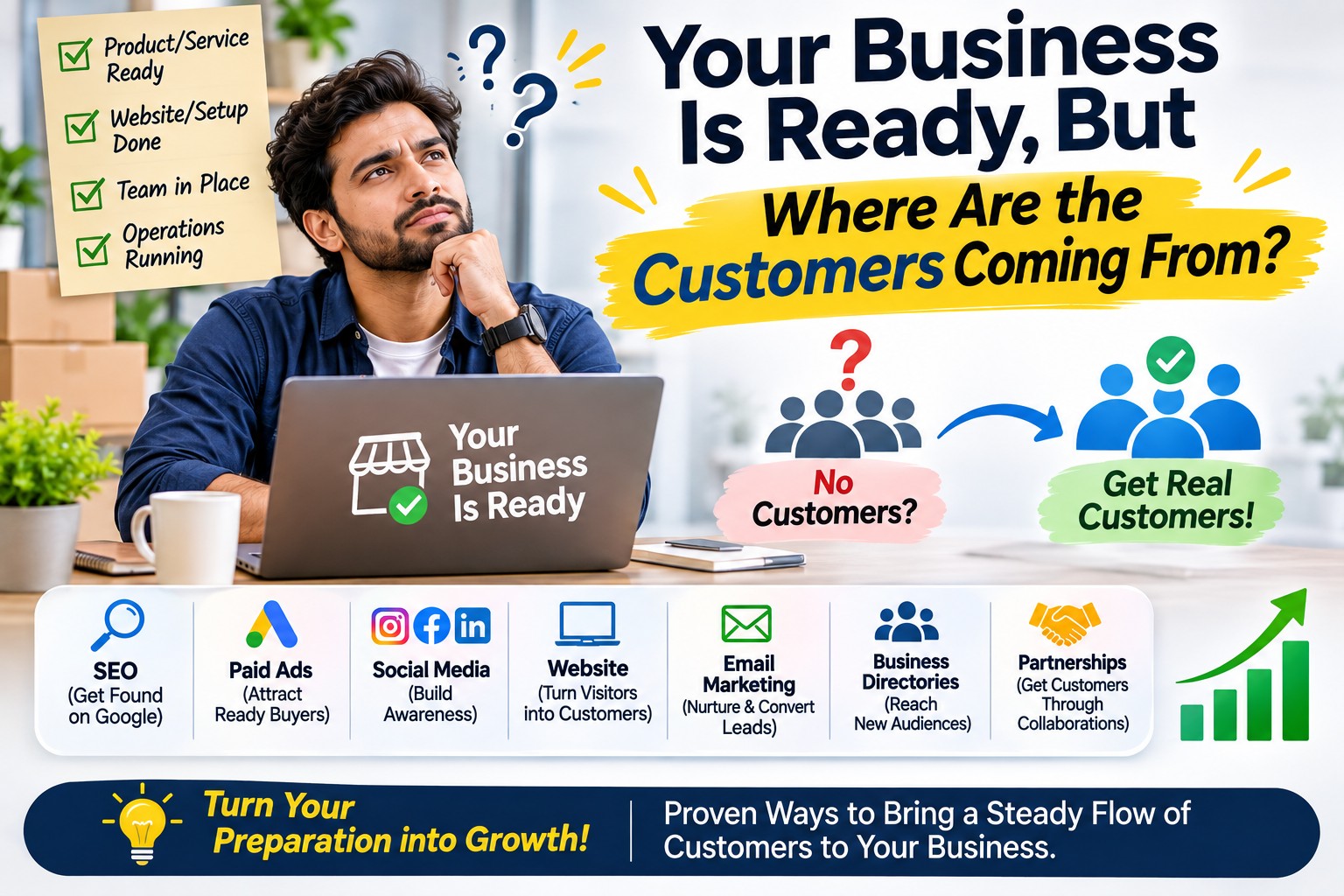
Now your business is ready to serve customers.
But there is one important problem.
Where will your first business enquiries come from?
You might have a professional website, a company profile and a list of services. Your team may be capable of delivering excellent work. Yet your phone is not ringing, your email inbox is quiet and nobody is requesting quotations.
Meanwhile, your competitors seem to be everywhere. They appear on Google, publish social media posts, run advertisements and regularly announce new projects.
You may start wondering whether you need to spend ₹30,000, ₹50,000 or even ₹1 lakh every month on marketing just to attract customers.
For a newly started business, that can be a difficult decision.
You may still be paying for office rent, salaries, equipment, software, website development and other operating expenses. Spending heavily on advertisements without knowing whether they will generate sales could put additional pressure on your finances.
Fortunately, paid advertising is not the only way to attract customers.
Many businesses can begin generating enquiries through direct customer research, professional networking, useful website content, local visibility, relevant business partnerships and carefully planned outreach.
These methods are not completely free. They require time, research, communication skills and sometimes modest spending. But they allow you to start testing demand before committing a large advertising budget.
The biggest challenge is knowing where to begin.
Should you focus on Google? Contact businesses on LinkedIn? Create a website? Join industry groups? Publish blog articles? Ask your existing contacts for introductions?
The right answer depends on what you sell, who needs it and how your customers normally choose a supplier or service provider.
This guide explains how to identify your first potential customers, create a compelling offer, approach prospects professionally, build trust without a large portfolio, turn interest into enquiries and create a repeatable customer acquisition process.
The objective is not to attract thousands of random visitors. It is to help you find people who have a genuine reason to consider your business.
1. Understand Why Your New Business Is Not Receiving Enquiries

Before choosing a marketing channel, identify what is preventing customers from contacting you.
A lack of enquiries does not always mean there is no demand for your product or service.
Sometimes customers need what you offer but do not know your business exists.
In other situations, people discover your company but do not understand why they should contact you.
There are several common reasons.
Nobody knows your business exists
An established company may already have repeat customers, referrals, search visibility and a recognised brand.
A new company usually has none of these advantages.
Even if your service is excellent, potential customers cannot consider you if they have never encountered your business.
What to do: Identify where your customers look for suppliers, service providers and solutions. Then create a plan to become visible in those places.
You have not identified a specific customer group
Suppose you provide website development services.
You might say that your customers are "all businesses that need websites."
Technically, many businesses could use your service.
But targeting everyone makes it difficult to decide whom to contact, what message to send and what information to publish.
What to do: Begin with a smaller, clearly defined group such as manufacturers needing product websites, local service providers needing enquiry forms or established businesses planning website redesigns.
Your offer does not explain the customer's benefit
Consider this statement:
"We provide complete digital solutions."
It sounds professional but gives little useful information.
A business owner may not understand what problem you solve.
A clearer explanation would be:
"We develop business websites that clearly present services, explain company capabilities and make it easier for potential customers to request quotations."
What to do: Describe your service in terms of the customer's requirement and the work you actually provide.
Your business lacks visible credibility
Potential customers may hesitate to contact a company they have never heard of.
They may want to know who runs the business, where it operates, what services it offers and whether it has relevant experience.
What to do: Provide accurate company information, genuine professional experience, clear contact details and examples that you have permission to share.
You are waiting for customers instead of creating opportunities
Launching a website does not automatically produce enquiries.
Posting occasionally on social media does not guarantee that the right people will see your business.
What to do: Combine discoverability with active, relevant customer outreach.
You do not have a reliable enquiry process
Some businesses attract interested visitors but lose them because the contact form does not work, phone calls go unanswered or quotation requests are forgotten.
What to do: Test your contact methods and establish a clear process for handling every enquiry.
2. Define What Your First Business Enquiry Should Look Like

Not every message is a useful sales opportunity.
A genuine business enquiry normally comes from someone who wants to know whether your company can help with a specific requirement.
Examples include:
-
A manufacturer requesting a quotation for packaging materials.
-
A startup founder asking about website development.
-
A property owner requesting a solar installation estimate.
-
A company looking for commercial cleaning services.
-
A business owner asking for an SEO consultation.
-
A procurement manager requesting technical product specifications.
A person asking for a job, requesting an unrelated service or submitting spam is not necessarily a potential customer.
Understand the difference between enquiries, qualified leads and customers
| Stage | Meaning | Example |
|---|---|---|
| Website visitor | Someone visits your website | A person views your service page |
| Enquiry | Someone contacts your business | They request a quotation |
| Qualified lead | The requirement matches your offering | They need your service in your coverage area |
| Sales opportunity | A relevant requirement is being discussed | You prepare a proposal |
| Customer | The prospect agrees to purchase | They approve the project and commercial terms |
Your first goal should be to generate relevant conversations, not simply increase the number of messages you receive.
Create a basic lead qualification checklist
Ask whether the prospect has a genuine requirement, whether your business can deliver it, whether the location is suitable, whether the timeline is realistic and whether there is reasonable commercial alignment.
For B2B projects, you may also need to understand who makes the final purchasing decision.
Do not make qualification unnecessarily complicated. At the beginning, a few well-chosen questions are often enough.
3. Identify Your Ideal First Customers Before Spending Money on Marketing

One of the most important decisions for a new business is choosing which customers to approach first.
You do not need to serve every possible customer immediately.
You need to identify a group that is likely to understand your offering and has a realistic reason to consider it.
Step 1: List your products or services
Suppose you have started a digital agency.
Your services may include SEO, website development, social media management, content writing and paid advertising.
Instead of promoting everything equally, identify the services that your team can deliver confidently and profitably.
Step 2: Identify the problems those services solve
For website development, potential customer problems include:
-
The business has no website.
-
Its existing website is outdated.
-
Customers cannot find clear product information.
-
The website is difficult to use on mobile devices.
-
Enquiry forms are missing or unreliable.
-
The business is launching a new service or product line.
Step 3: Identify businesses experiencing those problems
A newly established manufacturer may need a product catalogue website.
A local consultancy may need a professional website that explains its services.
An established company may need a redesign because its current site no longer represents its offerings.
Step 4: Understand the decision-maker
For a small business, the founder may approve the project.
For a larger organisation, the marketing manager, IT team, procurement department or management team may be involved.
Knowing the likely decision-maker helps you choose an appropriate contact method.
Step 5: Create a practical customer profile
Example: B2B website development
| Factor | Target customer |
|---|---|
| Business type | Small and medium manufacturers |
| Main requirement | Professional product and company website |
| Common problem | Outdated website or limited product information |
| Decision-maker | Founder, director or marketing manager |
| Service area | Locations the agency can serve |
| First offer | Website requirements discussion |
| Useful evidence | Relevant work examples and development process |
Use this profile to guide prospect research, messaging and website content.
4. Find Customers Who May Need Your Services Right Now

Not every potential customer is ready to buy.
Some businesses may have no current requirement. Others may be planning a purchase several months later.
A useful early-stage strategy is to look for signs that a company may have an upcoming need.
Newly established businesses
New companies often need websites, branding, accounting support, software, equipment, office services and other professional solutions.
You may identify relevant businesses through public announcements, professional networks or appropriate business directories.
Do not assume that every new company needs your service or has the budget to purchase it.
Businesses expanding operations
A company opening a new office, warehouse, factory or branch may need additional services.
Depending on your offering, this could create opportunities for office interiors, equipment, technology, facility services or marketing.
Businesses launching new products
A product launch may create requirements for packaging, website updates, photography, distribution support or marketing.
Businesses reviewing existing suppliers
Some companies may be considering a change because their requirements have evolved.
However, do not invent claims that a business is unhappy with its current provider.
Public requests for quotations
Some organisations publish supplier requirements, tenders or requests for proposals.
These can be useful when your business meets the stated qualifications and requirements.
How to prioritise opportunities
Create three groups:
High relevance: The business has a publicly stated requirement that matches your service.
Potential relevance: The business shows a reasonable signal of possible need, but the requirement is unconfirmed.
Low relevance: The business belongs to your target industry but has no identifiable reason to consider your service now.
Spend most of your early outreach time on high-relevance opportunities.
5. Create a Clear Offer Before Asking Anyone to Contact You

A good offer does not necessarily mean offering the lowest price.
It means making the service understandable and helping the customer decide whether the next step is worthwhile.
Explain exactly what you provide
Instead of saying:
"We provide the best business solutions."
Explain the service, intended customer and process.
For example:
"We design and develop websites for manufacturing businesses, including company information, product catalogues, enquiry forms and mobile-friendly layouts."
Explain who the service is suitable for
A commercial cleaning company could explain whether it serves offices, warehouses, retail spaces or other facilities.
A software company could identify the types of businesses and workflows its product supports.
This helps customers evaluate suitability.
Offer a small, useful next step
Examples include:
-
Request a quotation.
-
Schedule a requirements discussion.
-
Request a product catalogue.
-
Book a site assessment.
-
Arrange a demonstration.
-
Discuss a website redesign.
-
Ask about available service packages.
Avoid unrealistic guarantees
Do not promise that a website will automatically generate hundreds of leads or that an SEO campaign will guarantee first-page rankings.
A credible offer explains what the customer will receive, what information is needed and what happens next.
6. Build Enough Trust for Someone to Contact a New Business
One of the biggest challenges for a new business is credibility.
Customers may prefer an established provider because they believe it carries less risk.
You cannot manufacture a history your company does not have.
But you can make the information you do have easier to verify.
Show who is behind the business
Include accurate founder, team or management information where appropriate.
Explain relevant professional experience.
If the founder previously worked on projects at another company, describe that experience accurately rather than presenting those projects as completed by the new business.
Explain your working process
Customers often want to know how the service will be delivered.
For a website project, you might explain:
-
Requirements discussion.
-
Project scope and quotation.
-
Design planning.
-
Development.
-
Testing and revisions.
-
Launch and handover.
This reduces uncertainty.
Provide genuine examples
If you have completed projects, show examples with permission.
If you have no clients yet, consider providing a clearly labelled demonstration, sample design, product specification or explanation of your capabilities.
Be transparent about pricing
You do not need to publish a fixed price for every customised service.
But you can explain what affects costs and how quotations are prepared.
Make your business contactable
Provide accurate contact information, business email and relevant company details.
Do not use fabricated reviews, false certifications or unsupported claims.
7. Create a Simple Website That Supports Enquiries
A new business does not necessarily need a large, expensive website.
It needs a website that helps potential customers understand the offering and contact the company.
Essential pages
Homepage: Introduce the business, core services, intended customers and next steps.
About page: Explain who runs the company, its capabilities and relevant background.
Service or product pages: Provide detailed information about each important offering.
Contact page: Make it easy to ask questions or request a quotation.
Relevant policies: Provide appropriate privacy and other required information.
What should appear on a service page?
A useful service page should answer:
-
What exactly is the service?
-
Who is it suitable for?
-
What problems does it address?
-
What is included?
-
How does the process work?
-
What affects pricing?
-
What information must the customer provide?
-
How can the customer enquire?
Improve the contact form
A website development enquiry form might ask for the customer's name, business email, website if available, project type and a short description.
Do not ask for unnecessary information.
Test the website yourself
Open the website on a mobile phone.
Try submitting an enquiry.
Check that emails are delivered and that the person responsible for sales receives the message.
A technically attractive website is not useful if customers cannot contact you.
8. Start With Relevant People in Your Existing Professional Network
Your professional network can provide useful early conversations.
This may include former colleagues, suppliers, business associates, industry contacts and people who know your professional work.
The objective is not to pressure friends or relatives to purchase.
Instead, make relevant contacts aware of your new business.
How to introduce your business
Keep the message short and specific.
Example:
"Hi, I've recently started a company providing website design and development services for small and growing businesses. We focus on professional business websites, service pages and enquiry-friendly layouts. If you come across a business planning a new website or redesign, I'd be happy to discuss its requirements."
Why this works better than a generic announcement
The recipient understands what you provide and which situations may be relevant.
What to avoid
Do not repeatedly ask people for referrals.
Do not send unrelated promotions.
Do not assume that every contact is a potential buyer.
Use this channel to begin relevant conversations while developing independent customer acquisition methods.
9. Research Potential B2B Customers and Build a Qualified Prospect List
For B2B services, targeted prospect research can be a useful low-advertising-cost activity.
Suppose your company provides industrial packaging, commercial cleaning, website development or specialised consulting.
Your customers may be identifiable organisations.
Where to research prospects
Depending on your industry, useful sources may include public company websites, industry association directories, professional networking platforms, trade event exhibitor lists and publicly available procurement opportunities.
Use these sources responsibly and respect their terms.
What to record
Create a spreadsheet containing:
| Field | Purpose |
|---|---|
| Company name | Identify the organisation |
| Industry | Confirm relevance |
| Website | Understand the business |
| Location | Confirm service coverage |
| Possible requirement | Explain why the prospect may be suitable |
| Public business contact | Choose an appropriate contact route |
| Contact date | Track outreach |
| Response | Record feedback |
| Next action | Avoid missed follow-ups |
Research before contacting
Spend a few minutes understanding what the company does.
Look for a genuine connection between its activities and your offering.
A short list of relevant prospects can be more useful than a large list of unrelated companies.
Avoid invasive data collection
Do not collect private personal details or use questionable contact databases.
Follow applicable privacy, communication and anti-spam requirements.
10. Write Outreach Messages That Encourage Genuine Conversations
Many business owners struggle with outreach because they do not know what to say.
A common mistake is to send a long message listing every service.
For example:
"We are a leading company providing SEO, SMO, PPC, website development, app development, branding, content writing and all digital services."
This tells the prospect very little about why they should respond.
Use a four-part message
Part 1: Introduce yourself.
Explain your business briefly.
Part 2: Establish relevance.
Mention the verified reason you believe your offering may be relevant.
Part 3: Explain the potential value.
Describe what you can help with.
Part 4: Suggest a low-pressure next step.
Ask whether the requirement is currently relevant.
Example: Website development
"Hello, I came across your company while researching businesses in your industry. I noticed your website has limited information about some of your product categories. We help businesses develop clearer product and enquiry pages. If website improvements are currently a priority, I'd be happy to discuss a few practical suggestions."
Only use the observation if you have actually checked the website.
Example: B2B supplier
"Hello, we manufacture custom packaging materials for businesses requiring specific sizes and specifications. If your procurement team is reviewing suppliers for upcoming requirements, we can share our product details and discuss suitable options."
Example: Professional consultancy
"Hello, we provide compliance consulting services for businesses in your sector. If your team is planning a new facility or reviewing related requirements, we would be happy to understand the project and explain which services we can provide."
How often should you follow up?
There is no universal schedule.
A reasonable follow-up may be appropriate when a prospect has shown interest or when professional contact is otherwise permitted.
Respect opt-outs and do not continue contacting someone who has declined.
11. Use LinkedIn to Reach Relevant Decision-Makers
LinkedIn may be useful for businesses selling to other businesses.
But it works best when you approach it as a professional relationship channel rather than a place to send unlimited sales messages.
Optimise your personal profile
Explain your role, expertise and business offering.
A founder's professional profile may help potential customers understand the person behind a new company.
Improve your company page
Add accurate business information, website details and a clear description of services.
Identify relevant roles
Depending on your offering, useful contacts may include founders, directors, marketing managers, operations managers, procurement professionals and facility managers.
Start with a short connection message
Example:
"Hi, I work with growing businesses on website development and digital visibility. I came across your profile and would be glad to connect."
Share useful content
A digital agency might publish practical website improvement advice.
A manufacturer might explain technical product specifications.
A consultant might discuss common questions customers should consider before starting a project.
Avoid immediate aggressive selling
Not every connection needs your service.
Build familiarity and begin commercial conversations when there is a genuine reason.
12. Use Business Partnerships to Reach Customers You Cannot Easily Find Yourself
Complementary businesses often serve similar customers.
This creates opportunities for appropriate partnerships.
Example: Website development company
Potential partners include branding designers, business consultants, IT service providers and software companies.
A business consultant may work with founders who need websites.
A website development company may work with businesses that need accounting software or branding.
Example: Commercial interior company
Potential partners include architects, office furniture suppliers, commercial property consultants and relocation companies.
Example: Industrial equipment supplier
Potential partners may include equipment installers, maintenance providers, engineering consultants and relevant distributors.
How to begin a partnership
Explain who your customers are and how your services complement each other.
Discuss what a suitable introduction would look like.
Agree on how enquiries will be handled.
Be transparent about commercial arrangements where relevant.
Never exchange customer information without appropriate permission.
13. Use Local Visibility to Help Nearby Customers Discover Your Business
For businesses that serve customers in person, local discovery can be valuable.
A customer searching for an office cleaning provider, repair service or local consultant may prefer a nearby business.
Set up Google Business Profile if eligible
Provide accurate business information, appropriate categories, contact details and service-area information.
Maintain consistency
Ensure your business name, contact information and website details are accurate wherever they appear.
Use genuine photographs
Show your premises, equipment, products or completed work where appropriate.
Request authentic reviews
Ask real customers to provide honest feedback.
Do not buy reviews or offer rewards for positive ratings.
Consider relevant local directories
Evaluate directories based on whether they serve real customers in your market.
Do not assume that listing your business on hundreds of directories will generate enquiries.
Understand the limitations
Local search visibility is not guaranteed, and some business models are not eligible for Google Business Profile.
14. Use SEO to Build a Future Source of Business Enquiries
SEO can help your business become visible when customers search for relevant services.
But a new website may take time to attract meaningful organic traffic.
For that reason, SEO should complement early outreach rather than replace it immediately.
Focus on your most important services
If you offer five services, prioritise the ones most closely connected to customer demand and business profitability.
Use commercial-intent keywords naturally
For example, a website development business may target searches connected to hiring a developer or commissioning a business website.
Do not repeat the same phrase unnaturally throughout the page.
Create helpful service content
Explain the offering, requirements, process, cost factors and common customer questions.
Improve technical foundations
Check indexing, internal links, mobile usability, page performance and enquiry functionality.
Avoid duplicate location pages
Do not create dozens of nearly identical pages with only city names changed.
Measure actual opportunities
Organic traffic and rankings can be useful indicators, but qualified enquiries and sales outcomes are more commercially meaningful.
For a detailed Google-specific strategy, SEOspade can link this section to its separate guide, How Can Small Businesses Generate Consistent Leads Through Google?
15. Publish Content That Answers Questions Customers Ask Before Purchasing
Your customers may need information before they are ready to request a quotation.
Useful content can help them understand their requirements and evaluate providers.
Example: Website development company
Potential topics include:
-
What should a business prepare before hiring a website developer?
-
What affects the cost of developing a business website?
-
How should a company evaluate website development proposals?
-
What information should a manufacturing website include?
Example: Solar installation business
Potential topics include:
-
What should homeowners check before installing rooftop solar?
-
What affects rooftop solar installation costs?
-
What questions should customers ask an installer?
-
How should a business compare solar installation proposals?
Example: Industrial manufacturer
Potential topics include:
-
How to choose suitable packaging material for a product.
-
Which specifications should buyers provide when requesting quotations?
-
How to compare suppliers for a particular component.
-
Common mistakes when ordering custom industrial products.
Make each article genuinely useful
Include practical explanations, decision criteria, examples and common mistakes.
Where appropriate, link readers to the relevant service page.
Do not publish large volumes of repetitive content merely to increase website page count.
16. Participate in Relevant Business Communities Without Spamming
Industry communities can provide useful information about customer problems.
These may include professional groups, local business associations, industry forums and other relevant communities.
Listen before promoting
Observe what members discuss.
Look for recurring questions and practical difficulties.
Answer questions properly
If someone asks how to evaluate a service provider, explain the important considerations.
If your company can help and the community permits it, disclose your connection and offer a relevant next step.
Respect community rules
Avoid repeated promotional posts, misleading recommendations and unwanted private messages.
A useful reputation develops through consistent, relevant contributions.
17. Use Your First Customer Conversations to Improve Your Offer
Early conversations are valuable even when they do not immediately result in sales.
They reveal what potential customers actually care about.
Record common questions
Do prospects ask about price, delivery time, experience, technical specifications or support?
These questions can help you improve your website and proposals.
Identify objections
If several prospects say your service is outside their budget, review whether you are targeting the right customer segment or explaining the scope clearly.
If customers do not understand your offering, simplify the explanation.
If they need capabilities you do not provide, decide whether those requirements fit your business strategy.
Do not change your entire business after one rejection
Look for repeated patterns rather than reacting to every individual comment.
Use feedback responsibly
A prospect's opinion is useful information, but it does not automatically represent the whole market.
18. Build a Sales Process That Converts Enquiries Into Customers
Marketing creates opportunities.
Your sales process determines whether those opportunities are handled properly.
Respond within a realistic timeframe
Assign someone to monitor enquiries.
Explain your business hours and response expectations where appropriate.
Understand the requirement before quoting
Ask relevant questions.
For a website project, this may include the number of pages, required functionality, content availability and timeline.
For a manufacturing order, it may include specifications, quantity, delivery location and technical requirements.
Explain the quotation
A proposal should make the scope, deliverables, assumptions, exclusions, timeline and commercial terms understandable.
Provide a clear next step
Tell the prospect whether you will arrange a call, send a revised quotation, prepare a demonstration or request further information.
Follow up professionally
Agree on a suitable follow-up time when possible.
Avoid repeated unwanted messages.
Record why opportunities do not proceed
Where known, reasons may include price, timing, missing features, internal approval delays or choosing another supplier.
This information can help improve future marketing and sales.
19. Track Your First Enquiries in a Simple Spreadsheet
You do not need an expensive CRM immediately.
A well-maintained spreadsheet can be enough for a small number of early enquiries.
Suggested fields
| Field | Example |
|---|---|
| Date | 12 November |
| Company | ABC Industries |
| Contact source | |
| Requirement | Product catalogue website |
| Qualification | Relevant |
| Stage | Proposal preparation |
| Estimated value | ₹45,000 |
| Next action | Send quotation |
| Follow-up date | 15 November |
| Final outcome | Pending |
Illustrative example.
Review the spreadsheet every week
Ask:
-
How many enquiries arrived?
-
Which channels produced them?
-
How many matched your services?
-
How many requested proposals?
-
How many became customers?
-
What prevented other opportunities from proceeding?
These answers are more useful than counting website visits or social media followers alone.
20. Calculate the Real Cost of Generating Enquiries Without Ads
Low-cost marketing still involves resources.
Suppose you spend time researching prospects, improving your website and conducting outreach.
You may not pay for advertisement clicks, but the work has a cost.
Example monthly allocation
| Activity | Illustrative budget |
|---|---|
| Prospect research and basic tools | ₹1,000 |
| Website improvements | ₹2,000 |
| Content preparation | ₹2,000 |
| Networking and communication | ₹1,000 |
| Contingency | ₹1,000 |
| Total | ₹7,000 |
These figures are hypothetical planning assumptions, not current supplier quotations.
Include your time
If you spend 30 hours on outreach and research, that time has an opportunity cost.
If employees perform the work, their relevant labour costs should be considered.
Calculate cost per qualified enquiry
Suppose the direct marketing expense is ₹7,000 and the business receives seven qualified enquiries.
Direct expense per qualified enquiry = ₹7,000 ÷ 7 = ₹1,000.
A fuller calculation would also include relevant labour and other acquisition costs.
Compare costs with sales outcomes
If none of the seven enquiries becomes a customer, investigate why.
If two become profitable customers, evaluate the revenue, margins and total acquisition costs.
The cheapest enquiry source is not necessarily the most profitable one.
21. A Detailed 30-Day Action Plan for Getting Your First Enquiries
A new business needs a plan that is practical enough to follow alongside daily operations.
Week 1: Understand the market and prepare your offer
Day 1: List your services and identify the one you want to promote first.
Day 2: Define the target customer and the problem your service solves.
Day 3: Research competing providers and how they explain their services.
Day 4: Prepare a clear service description and first-step offer.
Day 5: Review your website and contact information.
Day 6: Prepare a simple company introduction and genuine supporting material.
Day 7: Test your enquiry process and finalise the prospect research criteria.
End-of-week outcome: You know whom to approach, what to offer and how prospects can contact you.
Week 2: Find and qualify potential customers
Day 8: Research relevant businesses in your target market.
Day 9: Identify potential requirements and appropriate business contact channels.
Day 10: Review your prospect list and remove irrelevant entries.
Day 11: Prepare personalised outreach messages.
Day 12: Contact a small, carefully selected group.
Day 13: Continue relevant outreach and participate in suitable professional discussions.
Day 14: Review responses and refine your messages.
End-of-week outcome: You have started relevant market conversations and gathered initial feedback.
Week 3: Build relationships and handle enquiries
Day 15: Review prospects who expressed interest.
Day 16: Conduct requirements discussions where appropriate.
Day 17: Prepare quotations or proposals for suitable opportunities.
Day 18: Identify potential complementary business partners.
Day 19: Contact appropriate partners and discuss mutual relevance.
Day 20: Improve your website using questions raised by prospects.
Day 21: Review enquiry quality and pending follow-ups.
End-of-week outcome: You have a clearer understanding of customer requirements and potential sales opportunities.
Week 4: Improve what works
Day 22: Review which customer segments responded.
Day 23: Identify which messages or channels produced useful conversations.
Day 24: Improve your offer and supporting materials.
Day 25: Follow up with interested prospects who welcome further contact.
Day 26: Publish or improve one useful customer-facing resource.
Day 27: Review relevant local and organic search opportunities.
Day 28: Calculate direct marketing expenditure and time spent.
Day 29: Review qualified enquiries, proposals and sales outcomes.
Day 30: Create next month's plan based on the evidence.
End-of-month outcome: You have a documented acquisition process and know which activities deserve further testing.
This plan does not guarantee that enquiries will arrive within thirty days. It gives you a structured way to create opportunities and learn from actual customer responses.
22. What to Do If You Receive No Enquiries After 30 Days
If you have completed the initial activities and still have no enquiries, do not automatically assume you need a larger advertising budget.
Investigate where the process is failing.
Problem: Nobody responds to outreach
Review whether your prospects are relevant, whether your message explains a genuine benefit and whether you are using appropriate contact channels.
Problem: People respond but do not need the service
Your customer targeting may be too broad.
Focus on organisations with clearer indications of need.
Problem: Prospects ask questions but do not request quotations
They may not understand the service, may be comparing options or may not be ready to purchase.
Review common questions and clarify the next step.
Problem: Prospects request quotations but do not proceed
Investigate pricing, scope, credibility, timing and purchasing requirements.
Problem: Your website receives visits but no enquiries
Review visitor intent, service information, trust signals and contact functionality.
Problem: You receive irrelevant enquiries
Make your service scope, customer suitability and geographic coverage clearer.
The appropriate solution depends on the actual bottleneck.
Increasing outreach volume or advertising spend without diagnosing the problem may simply create more waste.
23. A 90-Day Roadmap for Building a Repeatable Enquiry Process
The first month should focus on validating your target customer and creating initial conversations.
The following months should help you refine and repeat the activities that show promise.
Month 1: Validate
Define the customer segment, prepare the offer, research prospects, begin outreach and track responses.
Month 2: Improve
Refine messaging, strengthen website content, develop suitable partnerships and improve sales follow-up.
Begin reviewing early organic search information where available.
Month 3: Systemise
Document the activities that produce qualified opportunities.
Assign responsibilities, set realistic weekly activity targets and review acquisition costs.
Consider modest paid testing only when you have a clear offer, reliable tracking and enough budget to evaluate the results.
What should you measure?
| Metric | Why it matters |
|---|---|
| Relevant prospects researched | Measures targeting activity |
| Appropriate outreach attempts | Shows acquisition effort |
| Responses | Indicates initial engagement |
| Qualified enquiries | Shows relevant interest |
| Proposals requested | Indicates commercial opportunity |
| Customers acquired | Shows sales outcomes |
| Acquisition cost | Helps assess efficiency |
| Reasons for lost opportunities | Identifies improvements |
Do not set arbitrary enquiry guarantees without understanding market demand and your actual conversion data.
24. Which Low-Cost Lead Generation Methods Suit Different Businesses?
Different businesses need different approaches.
B2B service companies
Examples include website development, business consulting and commercial facility services.
Useful starting activities may include targeted prospect research, professional networking, relevant outreach, partnerships and service-focused website content.
Manufacturing businesses
Useful activities may include product specification pages, supplier directories with genuine buyer activity, industry associations, relevant trade events and procurement research.
Local service providers
Useful activities may include an eligible Google Business Profile, accurate local information, relevant professional relationships and clear service-area pages.
Professional consultancies
Useful activities may include expertise-led content, professional networking, referral relationships and detailed explanations of service processes.
E-commerce businesses
Useful activities may include product page improvements, relevant organic discovery, genuine customer feedback and appropriate partnerships.
High-value project businesses
Businesses offering large projects may benefit from fewer, more carefully qualified prospects and detailed requirements discussions rather than trying to generate high enquiry volumes.
The best starting channel is the one that gives you access to suitable customers at a cost and effort your business can sustain.
25. When Should a New Business Start Paying for Advertising?
Advertising may become useful when you have enough information to make a controlled investment.
Before spending, ask:
Do we understand our ideal customer?
If not, advertising may attract irrelevant visitors.
Is our offer clear?
If customers cannot understand what you provide, paid traffic may not solve the problem.
Can our website capture enquiries?
If contact forms are broken or landing pages are confusing, fix them first.
Can we respond to leads?
Advertising can waste money when the sales process cannot handle enquiries.
Do we understand customer value?
You need some idea of revenue, margins and acceptable acquisition costs.
Can we afford to test without guaranteed returns?
Advertising involves uncertainty. Do not spend money needed for essential operations.
A small, carefully measured campaign may be useful later, but it should support a functioning customer acquisition process rather than substitute for one.
26. Common Mistakes New Businesses Should Avoid
Trying to market every service at once. This can dilute your message and make targeting difficult.
Contacting irrelevant prospects. Large contact lists do not automatically produce suitable customers.
Sending generic messages. Prospects need a reason to believe your service is relevant.
Making unsupported claims. False guarantees and invented achievements damage credibility.
Ignoring website usability. Interested prospects may leave before contacting you.
Expecting instant SEO results. Organic visibility takes time and remains uncertain.
Using fake testimonials or reviews. Misleading credibility signals can harm customer trust.
Joining professional groups only to advertise. This can lead to poor engagement and reputational problems.
Failing to qualify enquiries. Time may be wasted on unsuitable opportunities.
Sending quotations without understanding requirements. Proposals may not match what customers need.
Not following up appropriately. Genuine opportunities may be forgotten.
Failing to measure results. You cannot identify which activities deserve more attention.
Spending heavily before validating demand. Advertising may amplify weaknesses in your offer or targeting.
Confusing marketing activity with business progress. Sending messages and publishing posts are activities; qualified enquiries and customers are outcomes.
27. A Practical Checklist Before Spending Heavily on Advertising
-
I know which customer group I want to serve first.
-
I understand the problems my service solves.
-
I can explain my offering clearly.
-
I have identified a relevant first-step offer.
-
My business has accurate online information.
-
My website or official business page is accessible.
-
Customers can contact me easily.
-
I can provide genuine examples or relevant experience.
-
I know where suitable prospects can be found.
-
I have researched potential customers.
-
I use relevant and respectful outreach messages.
-
I have identified potential complementary partners.
-
I respond to enquiries professionally.
-
I ask appropriate qualification questions.
-
I prepare quotations based on actual requirements.
-
I record enquiries and follow-up dates.
-
I track which enquiries become customers.
-
I review marketing performance weekly.
-
I understand the direct costs and time involved.
- I have a plan for improving unsuccessful activities.
Conclusion: Your First Business Enquiries Start With a Clear Plan, Not a Large Advertising Budget
When you start a business, it is easy to believe that attracting customers requires expensive advertising.
Advertising can be useful, but it is not the only way to create business opportunities.
Your first priority should be understanding who needs your services, why they might choose your business and how you can begin a relevant conversation.
Start with a specific customer group.
Prepare an offer that clearly explains what you provide.
Make your business information easy to verify.
Research potential customers, communicate professionally, develop complementary partnerships and build useful website content.
Most importantly, record what happens.
If prospects respond but do not buy, understand why.
If nobody responds, review your targeting and message.
If visitors reach your website but do not enquire, investigate the customer experience.
The objective is not to perform more marketing activities for the sake of appearing busy.
It is to develop a process that connects your business with people who have genuine requirements.
Your first business enquiries do not have to begin with a large advertising campaign. They can begin with a clear offer, the right customers and a practical plan for reaching them.
Need Help Turning Your New Business Into an Enquiry-Generating Website?
At SEOspade, we help startups, small businesses and growing companies improve their online presence through SEO, website design and development, content writing, social media marketing and lead generation services.
If your business is ready but you are struggling to attract enquiries, we can help you evaluate your website, search visibility, customer targeting and digital marketing opportunities.
Our approach begins with understanding your business requirements and identifying activities that are appropriate for your goals and available budget.
Explore SEOspade's services to discuss a practical digital growth plan for your business.