For many chartered accountant firms in India, business growth has traditionally depended on professional relationships, existing clients, networking and recommendations.
These relationships remain extremely valuable. However, relying primarily on established networks can limit a firm's ability to reach new companies, corporate decision-makers and emerging business opportunities.
Consider a manufacturing company preparing to expand its operations.
Its management may need assistance with tax planning, financial reporting, internal controls, regulatory compliance and business restructuring.
Instead of depending entirely on personal recommendations, the company's CFO or managing director may begin researching these requirements on Google.
They may search for information about corporate taxation, GST compliance, financial due diligence, international taxation or outsourced accounting.
During this research, they may discover professional accounting firms, read their published resources and evaluate their areas of practice.
If your CA firm has considerable professional expertise but limited online visibility, these businesses may never discover your firm.
The challenge is not necessarily your professional capabilities. It may be the accessibility of accurate information about those capabilities.
Google can help CA firms become discoverable to businesses actively researching professional services, provided their digital activities remain consistent with applicable ICAI ethical and professional requirements.
This guide explains how chartered accountant firms can establish a professional digital presence, improve organic search visibility and create opportunities to engage with suitable corporate clients.
1. Why CA Firms Should Develop a Strong Presence on Google

Many established CA firms have years of professional experience, qualified partners and expertise across taxation, accounting, assurance and business advisory.
However, their digital presence may not reflect the full extent of their professional capabilities.
Common limitations include:
-
Outdated business websites.
-
Limited information about areas of practice.
-
Dependence on existing professional networks.
-
Poor visibility for relevant corporate searches.
-
Lack of useful technical and regulatory resources.
-
Incomplete office and contact information.
-
Limited understanding of website-generated enquiries.
-
Difficulty reaching businesses outside existing networks.
A professional digital presence can help address these limitations.
Potential corporate clients may use Google to identify relevant information, understand their obligations and discover firms offering permitted professional services.
A well-maintained website can support that research process.
The objective is not aggressive client solicitation. It is to make accurate and professionally appropriate information accessible to businesses seeking it.
2. What Are High-Value Corporate Clients for a CA Firm?

A high-value corporate client is not necessarily the company paying the highest professional fees.
A suitable corporate engagement may offer a combination of commercial sustainability, professional relevance, long-term requirements and alignment with the firm's capabilities.
Potential corporate client segments
| Client segment | Potential professional requirements |
|---|---|
| Manufacturing companies | Taxation, cost management, accounting and financial reporting |
| Established private limited companies | Corporate compliance, financial advisory and assurance |
| Funded startups | Financial reporting, due diligence and taxation |
| Export-oriented businesses | International taxation, GST and cross-border compliance |
| Foreign subsidiaries | Indian regulatory requirements and financial reporting |
| Real estate companies | Project accounting, tax compliance and financial management |
| Healthcare companies | Accounting, taxation and financial controls |
| SaaS companies | Revenue accounting, international transactions and financial reporting |
| Family-owned businesses | Succession planning, restructuring and financial advisory |
| Large distributors | GST, inventory accounting and financial controls |
| Growing SMEs | Outsourced accounting and financial management |
The suitability of any engagement depends on professional competence, independence, regulatory eligibility, conflicts of interest and applicable ethical requirements.
A firm should not accept an unsuitable engagement simply because it has significant commercial value.
3. Understand How Corporate Decision-Makers Search on Google
Corporate customers rarely begin every search with a specific CA firm's name.
They may begin by researching a business problem, regulatory requirement or financial decision.
Example corporate search journey
A manufacturing company planning to establish a subsidiary may search for:
Initial research: Tax implications of establishing a subsidiary in India.
Requirement assessment: Financial reporting requirements for subsidiary companies.
Professional evaluation: Corporate taxation and accounting advisory.
Firm discovery: Chartered accountant firms with relevant areas of practice.
Due diligence: Firm information, partner qualifications, office locations and professional capabilities.
Engagement decision: Assessment of competence, independence, scope and commercial terms.
Each stage represents a different information requirement.
CA firms should develop useful website resources that support appropriate stages of this journey.
4. What CA Firms Must Know About ICAI's Digital Marketing Guidelines in 2026
Unlike ordinary commercial businesses, practising chartered accountants operate within a specific professional and ethical framework.
Their websites, communications and promotional activities must comply with the Chartered Accountants Act, applicable regulations and ICAI's Code of Ethics.
What changed in April 2026?
ICAI's revised 13th edition of the Code of Ethics, effective from 1 April 2026, introduces greater flexibility in professional visibility.
The updated framework distinguishes between exclusive professional services and non-exclusive services.
Certain non-exclusive services, including accounting and consultancy, may have greater scope for push-based communication. Exclusive professional services continue to follow applicable pull-based requirements.
What does this mean for CA firms?
CA firms should classify their services before deciding how they will be presented or promoted online.
A digital strategy appropriate for an accounting consultancy activity may not automatically be appropriate for a statutory audit engagement.
Important compliance considerations
-
Avoid misleading professional claims.
-
Do not use prohibited solicitation methods.
-
Maintain professional independence.
-
Protect confidential client information.
-
Avoid unsupported comparative superiority claims.
-
Review permissions relating to client names and assignments.
-
Assess advertising eligibility separately for each service.
-
Ensure website content receives professional compliance approval.
-
Review current ICAI guidelines before implementing paid campaigns.
The 2026 reforms do not provide unrestricted permission to advertise every professional service.
Official reference: ICAI Press Release dated 12 December 2025 — Council approval of revised advertisement and website guidelines: https://www.icai.org/post/23580
Firms should consult the complete applicable Code of Ethics and subsequent ICAI directions before implementation.
5. Why Generic Keywords May Not Help CA Firms Reach Suitable Corporate Clients
A common SEO mistake is focusing exclusively on broad keywords such as:
-
CA near me.
-
Chartered accountant.
-
CA services.
-
Income tax return filing.
-
GST registration.
-
Tax filing services.
These searches may generate visibility, but their audiences can include individuals, students, small businesses and people seeking basic compliance assistance.
A CA firm interested in larger corporate assignments should also develop information around more specific business requirements.
Generic search intent versus corporate search intent
| Generic search | Corporate-focused search |
|---|---|
| Tax filing | Corporate income tax compliance |
| GST services | GST reconciliation for manufacturing companies |
| Accounting services | Outsourced accounting for established companies |
| Income tax | Corporate tax planning considerations |
| Business registration | Tax implications of corporate restructuring |
| Financial accounting | Ind AS financial reporting requirements |
| Tax consultant | International taxation and transfer pricing |
| Business finance | Financial due diligence during acquisitions |
| GST return | GST compliance for multi-state businesses |
| Bookkeeping | Accounting and reporting for foreign subsidiaries |
Corporate-focused searches may have lower search volumes than generic keywords, but they may represent more specialised business requirements.
Keyword selection should reflect professional relevance rather than traffic volume alone.
6. Develop a Website That Reflects Your Firm's Professional Capabilities
Many CA websites contain only basic information about the firm and a general list of services.
Potential corporate clients may require more detailed information when evaluating professional suitability.
Recommended website architecture
Homepage
-
About the firm.
-
Permitted partner and team information.
-
Areas of professional practice.
-
Corporate taxation.
-
GST and indirect taxation.
-
Accounting and financial reporting.
-
International taxation.
-
Management consultancy.
-
Business advisory.
-
Permitted audit and assurance information.
-
Relevant industries.
-
Knowledge resources.
-
Office locations.
-
Professional contact information.
All sections must remain within applicable professional website guidelines.
Why website architecture matters
A structured website helps visitors understand relevant information without searching through unrelated sections.
It also helps search engines understand how different pages relate to one another.
For example, a corporate taxation section could contain resources addressing corporate income tax, tax assessments, cross-border transactions and other relevant requirements.
Each page should have a distinct purpose.
Creating dozens of nearly identical service pages is unlikely to improve the usefulness of the website.
7. Create Dedicated Pages for Relevant Areas of Practice
A single page listing every accounting, taxation and advisory service may not adequately answer specialised corporate questions.
Where professionally permitted, CA firms can develop dedicated informational pages explaining distinct areas of practice.
Potential website content categories
| Category | Potential page focus |
|---|---|
| Corporate taxation | Corporate tax obligations |
| International taxation | Cross-border taxation requirements |
| Transfer pricing | Documentation and compliance considerations |
| GST compliance | Corporate indirect tax obligations |
| Financial reporting | Financial statement preparation and reporting |
| Ind AS | Indian Accounting Standards |
| Financial due diligence | Financial assessment during transactions |
| Business valuation | Relevant valuation requirements and eligibility |
| Outsourced accounting | Accounting process management |
| Virtual CFO | Financial management and reporting support |
| Business restructuring | Financial and taxation implications |
| Internal controls | Financial control frameworks |
| FEMA compliance | Foreign exchange regulatory considerations |
| Management consultancy | Permitted business advisory activities |
These are potential information architecture categories, not blanket authorisation to market every listed service.
The firm must verify professional eligibility and applicable promotional restrictions before publication.
8. Build an Industry-Specific Content Strategy
Corporate decision-makers frequently have requirements unique to their industries.
A manufacturing company may require assistance with inventory accounting, input tax credit and financial controls.
A SaaS company may have questions about subscription revenue, international transactions and accounting standards.
A foreign subsidiary may require information about Indian taxation and regulatory compliance.
Industry-focused content opportunities
| Industry | Potential information requirements |
|---|---|
| Manufacturing | Inventory accounting, GST reconciliation and cost management |
| Real estate | Project accounting and taxation |
| SaaS and technology | Revenue recognition and cross-border transactions |
| Healthcare | Financial reporting and taxation considerations |
| Exporters | GST refunds and international taxation |
| Retail | Multi-location accounting and indirect taxation |
| Logistics | GST and operational accounting |
| Renewable energy | Financial reporting and project-related taxation |
| Foreign subsidiaries | Transfer pricing and Indian compliance |
| Family businesses | Succession and restructuring considerations |
Industry-specific resources should provide genuinely distinct information.
Avoid creating multiple industry pages by changing only the industry name while repeating the same generic content.
9. Target Problem-Solving Searches From Corporate Decision-Makers
A CFO, finance manager or business founder may search for solutions before contacting a professional.
Useful educational content can make a CA firm's website discoverable during that research.
Corporate taxation topics
-
What Should Companies Review Before Finalising Their Annual Tax Provision?
-
How Can Companies Prepare for an Income Tax Scrutiny Assessment?
-
What Are the Tax Implications of Restructuring a Business Group?
-
How Should Growing Companies Evaluate Advance Tax Obligations?
-
What Financial Records Should Companies Maintain for Tax Assessments?
GST and indirect taxation topics
-
What Should Manufacturers Do When GSTR-2B Does Not Match Purchase Records?
-
How Can Companies Identify Input Tax Credit Reconciliation Issues?
-
What Should Multi-State Businesses Review Before GST Compliance Audits?
-
Why Do Exporters Face Delays in GST Refund Applications?
-
How Should Businesses Review GST Compliance During Expansion?
Financial reporting topics
-
How Can Growing Companies Prepare for Their First Ind AS Transition?
-
What Should Companies Review Before Consolidating Financial Statements?
-
How Can SaaS Companies Evaluate Revenue Recognition Requirements?
-
What Causes Differences Between Management Accounts and Statutory Financial Statements?
-
How Should Companies Prepare Financial Information Before Seeking Investment?
International taxation topics
-
What Should Indian Companies Review Before Making Payments to Foreign Vendors?
-
When Do Related-Party Transactions Require Transfer Pricing Documentation?
-
What Tax Considerations Apply When Establishing a Foreign Subsidiary?
-
How Can Foreign Companies Prepare for Indian Tax Compliance?
-
What Financial Records Are Relevant for Cross-Border Related-Party Transactions?
Financial advisory topics
-
How Can Businesses Prepare for Financial Due Diligence Before an Acquisition?
-
When Should a Growing Company Consider Outsourced CFO Support?
-
What Financial Controls Should Businesses Establish Before Rapid Expansion?
-
How Can Companies Identify Weaknesses in Their Financial Reporting Processes?
-
What Should Founders Review Before Restructuring Their Company's Finances?
Each article should address a distinct question, reference relevant official materials and undergo appropriate professional review.
Financial and regulatory topics should not be published solely to target search keywords.
10. Demonstrate Professional Expertise Through Accurate Educational Content
Accounting, taxation and financial information can influence significant business decisions.
Consequently, CA websites should prioritise accuracy, clarity and professional accountability.
Google's quality evaluation framework places particular importance on trust for content that can materially affect people's financial circumstances.
Recommended content quality practices
-
Identify qualified authors or reviewers where permitted.
-
Reference relevant government and regulatory sources.
-
Explain the applicability of rules.
-
Include publication and review dates.
-
Update content when requirements change.
-
Distinguish general information from individual professional advice.
-
Explain important exceptions and limitations.
-
Correct outdated information.
-
Avoid unsupported financial claims.
-
Maintain a documented professional review process.
A qualified professional should review technical content before publication.
AI-assisted writing can support drafting, but it should not replace professional verification.
11. Strengthen Technical SEO for Your CA Firm's Website
A website may contain useful information but remain difficult for search engines to discover or index.
Technical SEO helps address these underlying issues.
Important technical SEO activities
| SEO area | Purpose |
|---|---|
| Crawlability | Help search engines discover relevant pages |
| Indexability | Ensure appropriate pages are eligible for indexing |
| XML sitemap | Communicate important website URLs |
| Robots.txt | Manage crawler access appropriately |
| Canonical tags | Identify preferred URLs where duplication exists |
| Internal linking | Connect related informational resources |
| Mobile usability | Improve access across devices |
| Website performance | Improve loading and interaction experience |
| HTTPS | Support secure website communication |
| Structured data | Describe eligible website information accurately |
| Redirect management | Preserve navigational continuity |
| Broken link management | Prevent unnecessary access difficulties |
Technical SEO should be reviewed regularly rather than treated as a one-time activity.
A website with strong technical foundations is easier to maintain as new resources and areas of practice are introduced.
12. Avoid Keyword Cannibalisation Across Your CA Website
Keyword cannibalisation can occur when multiple website pages compete for substantially the same search intent without providing meaningful distinctions.
This may make it harder to establish a clear preferred page.
Example of unnecessary overlapping pages
-
Corporate Tax Consultant.
-
Corporate Tax Consultancy Services.
-
Corporate Tax Advisory Firm.
-
Corporate Tax Consulting Company.
-
Corporate Tax Advisory Services.
Depending on their actual content and search results, these phrases may represent substantially similar requirements.
Creating five pages could introduce unnecessary duplication.
Recommended approach
Develop one clearly structured corporate taxation page covering the relevant shared intent.
Create separate educational resources only when they address genuinely distinct questions.
Example of a suitable content cluster
Main page: Corporate Taxation
Supporting resources:
-
Corporate advance tax obligations.
-
Preparing for income tax assessments.
-
Tax implications of business restructuring.
-
Corporate tax provision considerations.
-
Tax compliance during international expansion.
Each supporting resource should address a specific information requirement and connect naturally to the relevant main topic.
13. Improve Geographic Discoverability Without Creating Doorway Pages
CA firms with genuine offices or appropriately served geographic markets may benefit from accurate geographic information.
However, creating large numbers of nearly identical city pages can introduce duplication and potentially problematic doorway page patterns.
Location information may include
Genuine office addresses.
Accurate professional contact information.
Partner information where permitted.
Office-specific information.
Relevant areas of practice.
Actual geographic coverage.
Avoid practices such as
Creating fictitious office locations.
Publishing hundreds of duplicated city pages.
Using virtual addresses to misrepresent physical presence.
Claiming nationwide office networks without evidence.
Replacing city names in otherwise identical content.
Using promotional location claims prohibited by ICAI.
Any Google Business Profile or third-party directory listing should also be assessed against applicable professional rules and platform requirements.
The objective is accurate discoverability, not artificial geographic expansion.
14. Build Professional Credibility Without Misleading Promotional Claims
Corporate clients may want to understand whether a CA firm has the appropriate expertise and infrastructure for their requirements.
However, financial professionals must communicate credibility within professional ethical boundaries.
Information to consider, subject to applicable rules
Firm history.
Permitted professional qualifications.
Areas of practice.
Professional partner information.
Factual office details.
Relevant knowledge resources.
Professional publications.
Permitted network affiliations.
Appropriate descriptions of industry experience.
Practices that require caution
Unsupported claims of being the best or leading CA firm.
Guaranteed tax savings.
Guaranteed regulatory approvals.
Misleading comparisons with competitors.
Unapproved testimonials.
Client logos or assignment disclosures that are not permitted.
Unverified awards and rankings.
Aggressive promotional offers.
The revised 2026 guidelines provide greater flexibility for certain disclosures and non-exclusive services, but each use must satisfy its applicable conditions.
Obtaining client consent alone does not automatically make every promotional disclosure permissible.
15. Develop a Corporate Knowledge Centre Instead of a Generic Blog
Many professional websites publish short regulatory updates without a clear content structure.
A corporate knowledge centre can provide a more organised experience.
Recommended knowledge centre categories
Corporate Taxation
Tax provisions, assessments and business taxation considerations.
GST and Indirect Taxation
Reconciliation, compliance processes and regulatory updates.
International Taxation
Cross-border transactions and transfer pricing.
Financial Reporting
Accounting standards, reporting obligations and financial statements.
Corporate Finance
Financial due diligence, financial controls and business planning.
Business Advisory
Growth-related financial and operational considerations.
Regulatory Updates
Relevant developments from official authorities.
Organise related resources into clearly defined categories.
Include links to applicable official notifications and review older resources when regulations change.
This approach supports long-term professional knowledge sharing rather than relying on a high volume of generic SEO articles.
16. Use Google Search Console to Understand Corporate Search Demand
Google Search Console provides information about how a website performs in Google Search.
CA firms can use this information to understand which resources are discoverable and which queries are generating relevant visibility.
Information to review
-
Organic search impressions.
-
Website clicks from Google.
-
Search queries.
-
Page-level search performance.
-
Indexing information.
-
Search click-through rates.
-
Geographic performance where available.
-
Changes in visibility over time.
Example analysis
| Search query | Monthly impressions | Clicks | Potential relevance |
|---|---|---|---|
| Corporate tax assessment documents | 1,200 | 72 | Corporate taxation research |
| Transfer pricing documentation India | 900 | 45 | International taxation research |
| GST reconciliation for manufacturers | 650 | 39 | Manufacturing compliance |
| Financial due diligence checklist | 1,500 | 90 | Corporate finance research |
| Accounting for foreign subsidiaries | 500 | 30 | International business requirements |
These figures are hypothetical and do not represent verified search volumes or actual client performance.
The objective is to understand relevant information demand rather than simply increase total website clicks.
17. Measure Organic Search Performance Based on Corporate Relevance
A website generating 50,000 monthly visitors may not necessarily support a CA firm's corporate practice more effectively than a website generating 5,000 relevant visitors.
The commercial and professional relevance of those visitors matters.
Illustrative website comparison
| Metric | Website A | Website B |
|---|---|---|
| Monthly organic visitors | 30,000 | 5,000 |
| Relevant corporate enquiries | 18 | 50 |
| Professionally suitable opportunities | 6 | 20 |
| Accepted engagements | 2 | 6 |
These are hypothetical figures.
Website B receives considerably less traffic but generates more suitable corporate opportunities.
Useful performance indicators
Relevant non-branded search visibility.
Engagement with technical resources.
Corporate enquiries.
Suitably qualified enquiries.
Professional eligibility of opportunities.
Accepted engagements.
Acquisition-related operating costs.
Long-term engagement suitability.
Do not evaluate performance using traffic and keyword rankings alone.
18. Create a Professional Enquiry Management Process
A potential corporate client may contact a CA firm after reviewing relevant information.
The firm should establish a confidential and organised process for responding to such enquiries.
Where permitted, website contact facilities can collect limited information needed to establish the nature of the requirement.
Initial information may include
Company name.
Contact person.
Business email address.
Industry.
General nature of the professional requirement.
Preferred method of communication.
The initial enquiry should not require unnecessary sensitive financial information.
Information to avoid collecting through unsecured forms
Income tax returns.
Bank statements.
Confidential contracts.
Financial statements.
PAN or Aadhaar information without a genuine requirement and appropriate safeguards.
Sensitive employee or customer records.
Detailed transaction information.
Confidential documents should be collected only through suitable secure processes when required.
19. Introduce a CRM System for Corporate Enquiry Management
As a firm's online discoverability improves, it may receive enquiries from different businesses and locations.
Informal management through personal inboxes and phone records can create difficulties.
A suitable CRM or secure professional enquiry management system can help organise these interactions.
Recommended enquiry workflow
-
Receive an enquiry initiated by the prospective client.
-
Record essential information securely.
-
Assign an appropriate professional reviewer.
-
Understand the nature and scope of the requirement.
-
Perform conflict and independence checks.
-
Evaluate professional competence and eligibility.
-
Conduct appropriate discussions.
-
Establish engagement terms where suitable.
-
Accept or decline the engagement.
-
Maintain appropriate records.
Professional acceptance procedures should take priority over conventional sales conversion objectives.
20. Define What a Suitable Corporate Enquiry Looks Like
Not every corporate enquiry should become a professional engagement.
A CA firm should assess suitability using clearly defined criteria.
| Qualification factor | Assessment |
|---|---|
| Professional requirement | Is the requested work clearly understood? |
| Competence | Does the firm have suitable expertise? |
| Independence | Can applicable independence requirements be met? |
| Conflict of interest | Are there existing conflicting engagements? |
| Regulatory eligibility | Is the firm permitted to undertake the assignment? |
| Client acceptance | Can required due diligence be completed? |
| Resource availability | Does the firm have suitable capacity? |
| Commercial sustainability | Can the assignment be delivered appropriately? |
| Professional risk | Are the engagement risks acceptable? |
This approach helps maintain professional standards while improving the relevance of the firm's digital visibility.
21. How CA Firms Can Evaluate the Financial Return From SEO
SEO requires expenditure on website development, technical improvements, content quality and ongoing management.
Firms should evaluate whether that investment supports their digital and operational objectives.
Hypothetical monthly performance example
| Metric | Illustrative value |
|---|---|
| Monthly SEO investment | ₹60,000 |
| Genuine corporate enquiries | 40 |
| Professionally suitable opportunities | 15 |
| Accepted corporate engagements | 3 |
| Average initial engagement revenue | ₹1,20,000 |
| Total initial engagement revenue | ₹3,60,000 |
Illustrative acquisition calculations
Cost per genuine enquiry:
₹60,000 ÷ 40 = ₹1,500.
Cost per suitable opportunity:
₹60,000 ÷ 15 = ₹4,000.
SEO expenditure per accepted engagement:
₹60,000 ÷ 3 = ₹20,000.
These figures are hypothetical internal planning calculations.
They do not represent guaranteed outcomes, recommended professional fees or an actual case study.
Consider contribution rather than revenue alone
Assuming a 40% contribution margin before the SEO expenditure:
| Financial measure | Amount |
|---|---|
| Initial engagement revenue | ₹3,60,000 |
| Contribution before SEO expenditure | ₹1,44,000 |
| SEO expenditure | ₹60,000 |
| Remaining contribution | ₹84,000 |
Additional overheads, taxes, administrative costs and other expenses may apply.
This is not a net profit calculation.
Firms should also consider engagement duration, professional risk, delivery capacity and long-term commercial sustainability.
22. Can CA Firms Use Google Ads to Reach Corporate Clients?
This requires careful consideration of the applicable service category and professional guidelines.
The revised ICAI framework effective from April 2026 allows greater flexibility for certain non-exclusive services.
However, that does not automatically authorise paid advertising for every service offered by a CA firm.
Before considering paid search advertising
Identify the service being presented.
Determine whether it is exclusive or non-exclusive.
Review the applicable advertising and website guidelines.
Obtain appropriate professional approval.
Review the proposed advertising text.
Review the destination landing page.
Assess whether the campaign could indirectly solicit restricted professional work.
Evaluate privacy and tracking requirements.
Document the approval process.
Google Ads should not be implemented simply because competing firms appear to be running advertisements.
Professional obligations remain applicable regardless of competitor behaviour.
Organic website improvements and accurate educational resources provide a useful starting point for firms developing their digital presence.
23. Avoid Risky Link-Building and Digital PR Practices
Backlinks and legitimate editorial references can help people discover useful professional resources.
However, CA firms must evaluate both search engine policies and professional ethics before pursuing digital publicity.
Appropriate opportunities may include
Permitted professional publications.
Useful technical articles.
Relevant educational resources.
Authoritative references to original research.
Professionally approved directory listings.
Relevant knowledge-sharing activities.
Avoid risky practices
Purchasing links intended to manipulate rankings.
Publishing misleading advertorials.
Mass-produced guest posting campaigns.
Fake awards or rankings.
Undisclosed promotional relationships.
Artificial search engine authority schemes.
Inaccurate firm listings.
Misleading comparisons with other professionals.
Paid placements, where otherwise permitted, should comply with relevant disclosure and search engine link qualification requirements.
Professional reputation should take priority over artificial SEO metrics.
24. SEO Strategy for Small, Mid-Sized and Established CA Firms
Different firms require different approaches.
Small CA firms
Prioritise a professional website, clearly defined areas of practice, technical foundations and regularly reviewed educational content.
Avoid attempting to target every corporate service simultaneously.
Mid-sized CA firms
Develop more comprehensive subject-based resources, structured service information, appropriate industry coverage and centralised enquiry management.
Focus on areas where genuine professional capabilities exist.
Established CA firms
Improve large website architecture, technical content governance, multi-office information, complex topic clusters and appropriate analytics.
Established firms may also need stronger coordination between partners, technical reviewers and digital implementation teams.
The depth of the website should reflect actual expertise and organisational capacity.
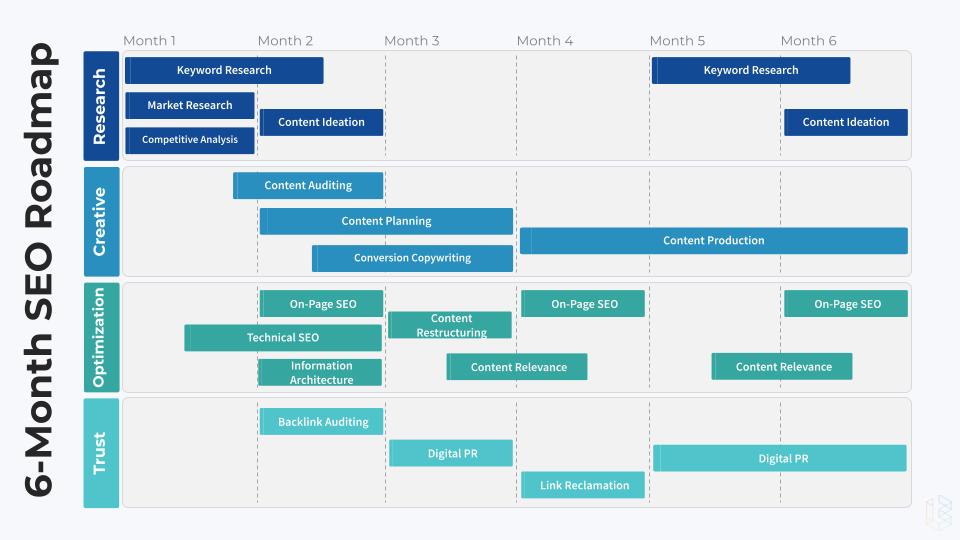
25. A Practical Six-Month SEO Roadmap for CA Firms
| Month | Main activities | Intended outcome |
|---|---|---|
| Month 1 | Website audit, professional compliance review and search research | Clear digital strategy |
| Month 2 | Website restructuring and technical SEO | Stronger website foundations |
| Month 3 | Develop approved practice-area information | Improved access to relevant professional information |
| Month 4 | Publish reviewed corporate educational resources | Broader relevant search visibility |
| Month 5 | Improve internal linking, content quality and enquiry processes | Better website usability and information discovery |
| Month 6 | Review organic performance and suitability of enquiries | Evidence-based planning for the next phase |
Timelines depend on existing website quality, competition, implementation speed and professional review requirements.
Organic rankings and corporate engagements cannot be guaranteed within a fixed period.
26. Recommended Monthly SEO Activities for a CA Firm
A structured monthly SEO programme may include:
| Activity | Recommended approach |
|---|---|
| Keyword research | Identify distinct corporate information requirements |
| Technical monitoring | Review crawling, indexing and website issues |
| Existing content updates | Correct outdated technical or regulatory information |
| Educational content | Publish professionally reviewed resources |
| Internal linking | Connect related subject areas |
| Website improvements | Address usability and accessibility issues |
| Search Console analysis | Evaluate relevant search queries and visibility |
| Competitor research | Identify information gaps without copying content |
| Enquiry analysis | Assess relevance and professional suitability |
| Compliance review | Review proposed changes under applicable guidelines |
| Monthly reporting | Communicate completed work and meaningful outcomes |
Content volume should depend on available professional review resources.
Four thoroughly researched and reviewed articles may provide greater value than dozens of repetitive AI-generated articles.
27. How Much Should CA Firms Invest in SEO?
There is no universal SEO budget suitable for every chartered accountant firm.
Investment depends on:
Existing website quality.
Number of practice areas.
Technical complexity.
Content requirements.
Professional review processes.
Competition.
Geographic coverage.
Development requirements.
Analytics and enquiry management.
Illustrative monthly planning budgets
| Firm requirements | Illustrative monthly SEO budget |
|---|---|
| Foundational SEO and limited content | ₹25,000–₹40,000 |
| Structured corporate-focused SEO | ₹40,000–₹75,000 |
| Advanced SEO for larger firms | ₹75,000–₹1,50,000+ |
These figures are illustrative digital marketing planning scenarios, not verified market averages or formal SEOspade quotations.
Website development, advertising expenditure, CRM implementation and specialist professional review may involve separate costs.
Select the scope based on requirements rather than simply choosing the lowest-priced package.
28. Common SEO Mistakes CA Firms Should Avoid
Mistake 1: Targeting only generic CA-related searches
Develop useful information for relevant corporate requirements.
Mistake 2: Ignoring ICAI guidelines
Professional compliance should be incorporated into the strategy from its beginning.
Mistake 3: Creating duplicate service pages
Consolidate pages that address the same fundamental search intent.
Mistake 4: Publishing outdated tax and compliance information
Establish a regulatory content review process.
Mistake 5: Publishing unreviewed AI-generated content
Require appropriate professional verification.
Mistake 6: Using unsupported superiority claims
Communicate factual professional information within applicable ethical restrictions.
Mistake 7: Creating fake office locations
Maintain accurate business and office information.
Mistake 8: Purchasing manipulative backlinks
Prioritise legitimate editorial visibility and useful professional resources.
Mistake 9: Evaluating SEO only through traffic
Measure relevance and suitable corporate opportunities.
Mistake 10: Collecting confidential financial data unnecessarily
Use proportionate and secure enquiry processes.
Mistake 11: Running advertising without professional approval
Review eligibility for each service and proposed communication.
Mistake 12: Accepting every digitally generated opportunity
Maintain professional independence, due diligence and appropriate engagement acceptance procedures.
29. Digital Readiness Checklist for Chartered Accountant Firms
CA firm partners can use the following checklist to identify improvement opportunities.
| Assessment area | Maximum score |
|---|---|
| Professional website infrastructure | 5 |
| ICAI website compliance review | 5 |
| Clearly structured practice areas | 5 |
| Accurate corporate information | 5 |
| Technical SEO foundation | 5 |
| Relevant keyword strategy | 5 |
| Professionally reviewed content | 5 |
| Regulatory content update process | 5 |
| Website usability | 5 |
| Secure enquiry management | 5 |
| Google Search Console monitoring | 5 |
| Corporate enquiry assessment | 5 |
| Data confidentiality | 5 |
| Digital asset ownership | 5 |
| Management and partner oversight | 5 |
| Maximum score | 75 |
Illustrative score interpretation
60–75: Strong foundations may exist. Focus on continuous improvement.
45–59: Several important capabilities are established, with further improvements required.
30–44: Meaningful technical, content or governance gaps require attention.
Below 30: Begin with website, compliance and digital infrastructure assessment.
This is a practical self-assessment framework, not an ICAI compliance certification or validated industry benchmark.
30. How to Choose an SEO Agency for Your CA Firm
A CA firm should not hire a digital marketing agency based only on ranking promises or lead generation commitments.
The agency must understand the differences between professional services marketing and ordinary commercial advertising.
Questions to ask before hiring
-
Does the agency understand the CA profession's ethical restrictions?
-
Can it develop a corporate-focused keyword strategy?
-
How will it prevent keyword cannibalisation?
-
Does it have technical SEO and website development capabilities?
-
How will technical content receive professional review?
-
What is its approach to backlink acquisition?
-
Will the firm retain ownership of its website and analytics accounts?
-
How will enquiries be measured securely?
-
Can it explain its implementation roadmap?
-
Does it avoid unrealistic ranking and revenue guarantees?
A suitable agency should coordinate with the firm's partners and designated compliance reviewers.
Final approval for professional content and promotional activities should remain with the CA firm.
31. How SEOspade Helps CA Firms Build a Stronger Digital Presence
At SEOspade, we understand that professional service businesses require a different digital strategy from ordinary consumer-focused businesses.
Chartered accountant firms need accurate information architecture, appropriate professional visibility, technical reliability and a carefully managed approach to corporate discovery.
Our digital services can help establish that infrastructure.
SEO strategy for CA firms
Develop search strategies focused on relevant corporate information requirements and genuine areas of professional expertise.
Technical SEO
Identify and address website architecture, indexing, page duplication, internal linking and technical performance issues.
Website design and development
Build professional, scalable websites that clearly organise permitted firm information and educational resources.
Corporate keyword research
Identify relevant searches associated with taxation, accounting, financial reporting, advisory and other applicable professional areas.
Content development support
Develop structured content plans and writing drafts that can undergo review and approval by qualified professionals.
Existing website content optimisation
Identify overlapping pages, outdated resources and opportunities to improve information quality.
Analytics and performance measurement
Help firms understand relevant organic visibility, website engagement and suitable enquiry opportunities.
Digital infrastructure and integrations
Support agreed website functionality, enquiry management and appropriate integrations with business systems.
Compliance-conscious implementation
Coordinate proposed website changes and digital activities with the firm's designated professional reviewers.
SEOspade provides digital marketing and technical implementation support. It does not provide ICAI compliance certification or substitute for the firm's professional and legal responsibilities.
Our objective is to help CA firms establish a professional, accessible and sustainable digital presence that reflects their genuine capabilities.
Conclusion: Make Your CA Firm Discoverable to Businesses That Need Your Expertise
The growth of a chartered accountant firm depends on its professional competence, integrity, reputation and ability to deliver suitable services.
These fundamental principles remain unchanged.
However, the way corporate decision-makers research financial and professional requirements continues to evolve.
A manufacturing company researching GST reconciliation, a foreign subsidiary evaluating taxation requirements or a founder preparing for financial due diligence may begin their research through Google.
Your firm's website should make relevant and professionally appropriate information accessible during that process.
A strong digital presence requires more than publishing keywords or increasing website traffic.
It requires:
-
A professional and technically reliable website.
-
Accurate information about genuine areas of practice.
-
Useful and professionally reviewed corporate resources.
-
Relevant organic search visibility.
-
Secure enquiry management.
-
Appropriate professional compliance.
-
Continuous measurement and improvement.
The objective is not unrestricted promotion of a CA firm. It is to make genuine professional expertise accessible to businesses actively seeking relevant information and professional assistance.
If your CA firm wants to improve its website, technical SEO, corporate search visibility and digital infrastructure, connect with SEOspade to discuss a digital strategy aligned with your professional capabilities and applicable ethical requirements.