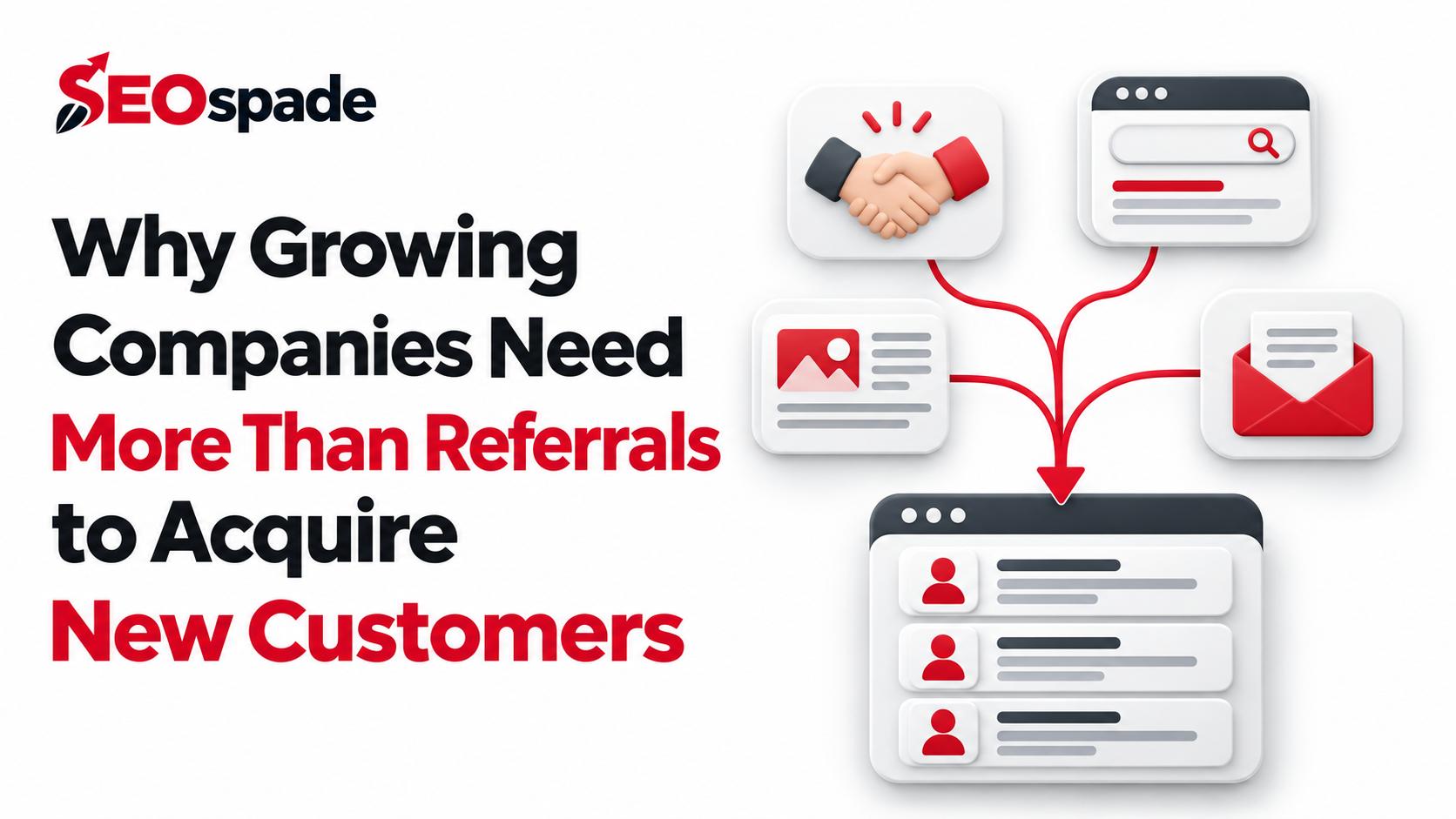
Many successful businesses have been built through personal relationships, customer recommendations and professional networks.
A satisfied customer recommends your company to another business owner. An existing client introduces you to a potential customer. A professional contact shares your number with someone looking for your services.
These referrals generate enquiries, build trust and help your business grow.
But consider an important question.
What happens to your business when those recommendations slow down?
While your company waits for its next referral, potential customers may already be searching on Google for exactly the products or services you provide.
They may be looking for a manufacturer, business consultant, technology partner, professional service provider or industrial supplier.
If your business is not appearing for those searches, your competitors may be receiving enquiries from customers who have never heard of your company.
Investing in Google does not mean abandoning referrals. It means developing an additional customer acquisition channel that allows potential customers to discover your business independently.
For established companies, this can be an important step towards more diversified and measurable business growth.
1. Why Customer Referrals Are Valuable for Businesses
Referrals remain one of the most valuable sources of customer acquisition for many businesses.
When someone recommends your company, the potential customer receives an initial level of confidence based on another person's experience.
This can make commercial conversations easier.
Benefits of referral-based customer acquisition
-
Existing customer trust supports new introductions.
-
Potential customers may be more comfortable initiating conversations.
-
Sales discussions may require less initial credibility building.
-
Customer acquisition expenditure may be relatively low.
-
Strong customer relationships can generate repeat recommendations.
-
Professional networks can introduce businesses to relevant opportunities.
Businesses should continue investing in customer satisfaction and professional relationships.
The problem is not receiving customers through referrals.
The problem arises when referrals become the only reliable way new customers discover your business.
2. The Difference Between Referral-Based Customers and Google-Generated Customers
Referral customers discover your company through recommendations.
Google-generated customers discover your company while independently searching for information, products, services or suppliers.
| Factor | Referral-based customers | Google-generated customers |
|---|---|---|
| Discovery method | Personal recommendations | Relevant online searches |
| Initial awareness | Introduced by an existing contact | May have no previous knowledge of your company |
| Market reach | Influenced by existing networks | Can extend beyond existing relationships |
| Enquiry timing | Depends on recommendations | Depends on search demand and visibility |
| Initial trust | Supported by the referring person | Established through credible business information |
| Growth potential | Influenced by network size | Influenced by market demand and search performance |
| Measurement | Referral source tracking | Search analytics and CRM tracking |
| Ongoing investment | Customer relationships and networking | SEO, content, website improvements or advertising |
Both channels have advantages.
A business combining referrals with relevant Google visibility may have more opportunities to attract customers than a business depending exclusively on either channel.
3. Why Referrals Alone May Not Support Your Future Growth Plans
A business may initially grow successfully through referrals.
However, its customer acquisition requirements can change as it expands.
Consider a company that starts with five employees and requires four new customers every month.
Its existing professional network generates approximately four customers.
Several years later, the company has 25 employees, higher operating expenses and greater delivery capacity.
It now requires 15 new customers every month, but its referral network generates only six.
| Business requirement | Early stage | Growth stage |
|---|---|---|
| Employees | 5 | 25 |
| Monthly new customer target | 4 | 15 |
| Customers acquired through referrals | 4 | 6 |
| Additional customers required | 0 | 9 |
These figures are hypothetical.
The business has expanded, but its traditional acquisition channel has not expanded at the same rate.
Google visibility may help address part of this additional customer acquisition requirement.
4. Your Potential Customers May Already Be Searching on Google
Many customers do not have a personal contact who can recommend a suitable supplier.
Instead, they search online.
For example, potential customers may search for:
-
Industrial equipment manufacturers in India.
-
Corporate compliance consultants.
-
Commercial solar installation companies.
-
Bulk corporate gifting suppliers.
-
Medical device manufacturers.
-
Custom software development companies.
-
Factory licensing consultants.
-
Packaging manufacturers in Delhi NCR.
-
Commercial construction companies.
-
Business website development services.
These searches represent different customer requirements and purchasing intentions.
Some users are researching available options. Others may be actively looking for a supplier.
If your company provides these products or services but has limited visibility for relevant searches, it may miss opportunities to participate in customer purchasing decisions.
5. Google Can Introduce Your Business to Customers Outside Your Network
Referral marketing is influenced by the people who already know your business.
Google Search provides an opportunity to reach customers who have no existing connection with your organisation.
Consider a manufacturing company
A manufacturer based in Delhi receives most enquiries from existing distributors and industry contacts.
However, a procurement manager in Gujarat is searching for a manufacturer offering the same products.
The procurement manager has never heard of the Delhi-based company.
Without relevant Google visibility, the manufacturer may remain undiscovered.
With useful product information and stronger organic search visibility, the company may become part of the procurement manager's supplier research.
This is one of the important differences between referral-based discovery and search-based discovery.
Google can help businesses become discoverable beyond their existing professional relationships.
6. Your Competitors May Be Receiving Enquiries While You Wait for Referrals
Imagine two companies operating in the same industry.
Company A depends primarily on referrals.
Company B receives referrals but also invests in SEO, website optimisation and Google search visibility.
| Customer acquisition activity | Company A | Company B |
|---|---|---|
| Existing customer recommendations | Yes | Yes |
| Professional networking | Yes | Yes |
| Non-branded Google visibility | Limited | Actively developed |
| Commercial website pages | Basic | Detailed |
| Customer-focused content | Limited | Regularly improved |
| Organic enquiry tracking | No | Yes |
| Search-based customer acquisition | Limited | Additional acquisition channel |
Company B is not necessarily better at delivering its products or services.
However, it has created additional opportunities for potential customers to discover its business.
Over time, these opportunities may contribute to a broader sales pipeline.
7. Even Referred Customers May Search for Your Business on Google
Google visibility is not only useful for attracting customers outside your network.
It can also support the customers you already receive through referrals.
Consider the following situation.
An existing client recommends your company to another business owner.
Before contacting you, the business owner searches for your company name on Google.
They may want to review:
-
Your company website.
-
Products and services.
-
Professional experience.
-
Office locations.
-
Customer feedback.
-
Manufacturing capabilities.
-
Certifications.
-
Relevant case studies.
-
Professional team information.
If your website is outdated, your business information is incomplete or your digital presence is difficult to find, the referred customer may have unanswered questions.
A credible and accurate online presence can reinforce the confidence established through a personal recommendation.
In this way, Google visibility and referral marketing can support each other.
8. Why Ranking for Your Company Name Is Not Enough
Many business owners believe their website performs well because it appears first when they search for their company name.
However, customers who search for your company name generally already know about your business.
To attract unfamiliar customers, businesses also need relevant non-branded search visibility.
Branded vs non-branded searches
| Business type | Branded search example | Non-branded search example |
|---|---|---|
| Manufacturing | ABC Industries Pvt Ltd | Industrial machinery manufacturer |
| Solar energy | XYZ Solar Company | Commercial rooftop solar installation |
| Corporate consultancy | ABC Consultants | Corporate compliance consultancy |
| Packaging | XYZ Packaging | Corrugated box manufacturers |
| Software development | ABC Technologies | Custom CRM development company |
| Corporate gifting | XYZ Gifts | Bulk corporate gifting suppliers |
Branded searches support existing awareness.
Non-branded searches can introduce your company to customers who have not previously encountered it.
Both are important, but they serve different purposes.
9. Why Google Search Can Be Valuable for B2B Customer Acquisition
B2B customers often conduct detailed research before contacting suppliers.
A corporate buyer may need to evaluate:
Technical specifications.
Manufacturing capacity.
Industry experience.
Quality standards.
Delivery capabilities.
Customisation options.
Commercial suitability.
Professional qualifications.
Google can help these buyers identify businesses offering relevant solutions.
A well-developed website can then provide the information necessary for further evaluation.
Example B2B purchasing journey
| Stage | Potential Google search |
|---|---|
| Identifying a problem | How to reduce electricity costs in factories |
| Researching a solution | Solar energy solutions for industrial buildings |
| Evaluating requirements | Commercial rooftop solar installation cost |
| Finding suppliers | Industrial solar EPC companies |
| Comparing providers | How to choose an industrial solar contractor |
| Initiating contact | Request a commercial solar installation quotation |
A company with useful information addressing these requirements may be discovered at multiple stages of the purchasing journey.
10. Should Your Business Invest in SEO or Google Ads?
Businesses can develop visibility on Google through organic SEO and paid search advertising.
Both approaches have different characteristics.
Search engine optimisation
SEO involves improving website accessibility, relevance, content and organic search discoverability.
It can help businesses become visible for relevant searches without paying a direct charge for each organic click.
However, SEO requires investment in implementation, content, technical improvements and ongoing maintenance.
Google Ads
Google Ads allows businesses to compete for relevant advertising placements.
It may help businesses test commercial demand or generate additional enquiries after campaigns are configured and approved.
However, advertising requires media expenditure and careful performance management.
| Factor | Google SEO | Google Ads |
|---|---|---|
| Visibility type | Organic | Paid |
| Initial results | Generally gradual | Can begin after campaign setup |
| Direct click expenditure | No organic click charge | Advertising charges apply |
| Long-term potential | Can support sustained discoverability | Primarily dependent on ongoing advertising |
| Investment requirements | SEO, content and website improvements | Media budget and campaign management |
| Suitable objective | Long-term organic customer discovery | Commercial demand testing and paid acquisition |
For businesses already receiving customers through referrals, SEO may provide an additional long-term discovery channel, while paid advertising can support selected commercial requirements.
Neither approach guarantees customer acquisition.
11. How Google SEO Helps Businesses Attract New Customers
An effective SEO strategy involves more than increasing website traffic.
It focuses on making relevant business information discoverable to suitable potential customers.
Technical SEO
Ensure important website pages can be accessed and understood by search engines.
Commercial keyword research
Identify how customers search for your products and services.
Product and service page optimisation
Develop useful information addressing genuine customer requirements.
Website architecture
Organise commercial pages and resources into a logical structure.
Customer-focused content
Answer relevant questions that arise during customer research.
Internal linking
Connect related products, services and educational resources.
Geographic visibility
Communicate genuine business locations and service coverage.
Legitimate online recognition
Develop relevant industry visibility through authentic professional and editorial opportunities.
These activities should work together to support customer discovery.
12. Start With the Products and Services That Generate the Most Business Value
Businesses do not need to target every available keyword.
Management should first identify which products and services are commercially important.
Evaluate your offerings based on:
-
Profitability.
-
Average customer value.
-
Repeat purchase potential.
-
Market demand.
-
Delivery capacity.
-
Competitive advantages.
-
Geographic coverage.
-
Sales cycle duration.
For example, a manufacturer may offer 50 products but generate most of its contribution from 10 specialised products.
The initial SEO strategy may prioritise those products rather than allocating equal resources across the entire catalogue.
Google visibility should be aligned with the company's commercial priorities.
13. Build Website Pages That Help Customers Make Decisions
A customer discovering your business through Google may know nothing about your company.
Unlike a referred customer, they may not have received an explanation of your capabilities from someone they trust.
Your website must provide sufficient information to support their evaluation.
Important commercial page elements
Clear product or service descriptions.
Relevant technical information.
Actual business capabilities.
Industries served.
Available product variants.
Genuine certifications.
Delivery and implementation information.
Relevant frequently asked questions.
Accurate contact details.
Quotation or consultation opportunities.
Avoid vague descriptions that provide little useful information.
Your website should help customers understand whether your company is suitable for their requirements.
14. Use Your Existing Customer Experience to Create Useful Content
Businesses receiving referrals often possess valuable industry knowledge.
Their employees regularly answer customer questions and solve practical problems.
This expertise can support the company's Google visibility strategy.
Examples of useful customer questions
How do I choose the right industrial supplier?
What documents are required before starting a project?
What should a company evaluate before purchasing equipment?
How long does implementation usually take?
Which technical specifications should buyers consider?
What information is required to obtain a quotation?
How can businesses compare available solutions?
These questions can be addressed through product pages, service pages, technical resources and educational articles.
The objective is to make existing business expertise accessible to potential customers.
Avoid publishing generic content simply to increase the number of indexed pages.
15. Google Visibility Can Support Expansion Into New Markets
Referral networks may be concentrated within particular cities, industries or professional communities.
Businesses planning geographic expansion may need additional discovery channels.
For example, a manufacturer serving customers primarily in Delhi NCR may want to expand into Gujarat, Maharashtra and Karnataka.
Google search research can help identify relevant customer requirements in those markets.
The business can then improve its website information to reflect genuine service coverage and delivery capabilities.
Important considerations
Create location-specific information only where it provides distinct customer value.
Maintain accurate business addresses.
Avoid fictitious offices.
Do not publish substantially identical pages for every city.
Ensure the business can genuinely serve the targeted market.
Google visibility should support real expansion capabilities rather than create misleading geographic claims.
16. How Local Businesses Can Benefit From Google Visibility
For businesses serving customers within specific locations, Google Maps and local search results may provide additional discovery opportunities.
An eligible business can maintain a Google Business Profile containing accurate information.
This may include:
Business name.
Actual address or eligible service area.
Business category.
Contact information.
Operating hours.
Website link.
Original photographs.
Relevant customer reviews.
Businesses should follow Google's eligibility and representation requirements.
Do not create fake business locations or purchase fabricated customer reviews.
For eligible local businesses, accurate local visibility can support both referred customers and customers independently searching for nearby services.
17. How Much Additional Business Could Google Generate?
The potential depends on search demand, competition, website quality, customer relevance and sales effectiveness.
Businesses can create planning scenarios using reasonable assumptions.
Illustrative monthly customer acquisition model
Suppose your company currently receives:
| Metric | Referrals only | Referrals + Google |
|---|---|---|
| Genuine referral enquiries | 30 | 30 |
| Genuine Google enquiries | 0 | 50 |
| Total genuine enquiries | 30 | 80 |
| Qualified referral leads | 20 | 20 |
| Qualified Google leads | 0 | 20 |
| Total qualified leads | 20 | 40 |
| Customers from referrals | 8 | 8 |
| Customers from Google | 0 | 4 |
| Total new customers | 8 | 12 |
| Average initial customer revenue | ₹75,000 | ₹75,000 |
| Total initial customer revenue | ₹6,00,000 | ₹9,00,000 |
In this hypothetical scenario, Google contributes four additional customers and ₹3,00,000 in initial monthly revenue.
That represents a 50% increase in new customers compared with the referral-only scenario.
These figures are illustrative, not a prediction or guaranteed outcome.
Actual results depend on the company's market and implementation quality.
18. What Happens When Referral Enquiries Decline?
A company relying entirely on referrals may experience acquisition difficulties when its network generates fewer recommendations.
Hypothetical comparison
| Scenario | Referral customers | Google customers | Total customers |
|---|---|---|---|
| Referral-only business: normal month | 10 | 0 | 10 |
| Referral-only business: weaker month | 6 | 0 | 6 |
| Diversified business: normal month | 10 | 5 | 15 |
| Diversified business: weaker referral month | 6 | 5 | 11 |
The referral-only business experiences a 40% decline in new customers.
The diversified business experiences approximately a 26.7% decline, assuming its Google-generated customer acquisition remains unchanged.
Google-generated enquiries can also fluctuate, so diversification does not eliminate business risk.
However, developing multiple acquisition channels may reduce dependence on any single source.
19. Calculate the Return From Investing in Google
Business owners should evaluate Google marketing expenditure against commercially meaningful outcomes.
Hypothetical monthly example
| Metric | Amount |
|---|---|
| SEO and website optimisation expenditure | ₹50,000 |
| Genuine Google-generated enquiries | 50 |
| Qualified leads | 20 |
| New customers | 4 |
| Average initial customer revenue | ₹75,000 |
| Total initial customer revenue | ₹3,00,000 |
Cost per genuine enquiry
₹50,000 ÷ 50 = ₹1,000.
Cost per qualified lead
₹50,000 ÷ 20 = ₹2,500.
Measured marketing expenditure per acquired customer
₹50,000 ÷ 4 = ₹12,500.
Contribution after marketing expenditure
Assuming a 40% contribution margin before marketing expenditure:
-
Initial customer revenue: ₹3,00,000.
-
Customer contribution: ₹1,20,000.
-
Marketing expenditure: ₹50,000.
-
Remaining contribution: ₹70,000.
The remaining contribution is not net profit. Additional sales costs, overheads and taxes may apply.
This example demonstrates why businesses should evaluate Google marketing using customer acquisition economics rather than rankings alone.
20. How Much Business Is Required to Recover Your Google Marketing Investment?
Suppose your company invests ₹60,000 every month in SEO and website improvements.
The average initial revenue from each new customer is ₹1,00,000.
Your contribution margin before marketing expenditure is 30%.
Each new customer therefore generates approximately ₹30,000 in contribution.
| Metric | Amount |
|---|---|
| Monthly marketing investment | ₹60,000 |
| Average initial customer revenue | ₹1,00,000 |
| Contribution margin | 30% |
| Contribution per customer | ₹30,000 |
| Additional customers required to cover measured marketing expenditure | 2 |
Under these hypothetical assumptions, two additional customers would cover the measured monthly marketing expenditure.
Actual break-even calculations should account for relevant acquisition costs, customer servicing expenses, sales cycles and revenue collection.
Businesses with high-value customers may not require large enquiry volumes to justify their investment.
21. Do Google-Generated Leads Convert as Easily as Referrals?
Not necessarily.
Referred customers may already have confidence in your company because someone they trust recommended it.
Google-generated customers may be comparing multiple businesses.
They may require additional information before making a decision.
Your sales team should be prepared to:
Respond promptly to genuine enquiries.
Understand customer requirements.
Explain relevant business capabilities.
Provide appropriate quotations.
Share useful product and service information.
Address customer concerns.
Maintain structured follow-up.
Record enquiry outcomes.
Google can introduce potential customers to your business, but your sales team remains responsible for developing those opportunities.
22. Why Your Website Needs to Be Connected With Your Sales Team
A business may generate relevant Google enquiries but lose opportunities because of weak internal processes.
For example:
A potential customer submits a website enquiry.
The enquiry reaches a general email address.
No employee is clearly responsible for responding.
The customer contacts another supplier.
Your business loses the opportunity despite having generated the enquiry successfully.
Recommended enquiry management process
Google discovery → Website visit → Customer enquiry → CRM entry → Sales assignment → Qualification → Quotation → Follow-up → Customer acquisition.
Every genuine enquiry should have a responsible employee and a recorded outcome.
Marketing and sales teams should regularly discuss lead relevance and customer feedback.
23. Track Referral Customers and Google Customers Separately
Businesses should understand how customers discover their company.
A customer may receive a referral, search for the company on Google and then submit a website enquiry.
Attributing that customer entirely to Google would overlook the original recommendation.
Similarly, attributing the customer entirely to the referral would overlook the role of online verification.
Recommended CRM information
| Information | Purpose |
|---|---|
| Initial discovery source | Understand how the customer first heard about the business |
| Website acquisition source | Understand the recorded digital visit |
| Referring customer or partner | Track genuine recommendations |
| Landing page | Identify relevant website content |
| Product or service requirement | Assess commercial relevance |
| Qualification status | Measure enquiry quality |
| Sales outcome | Track acquired customers |
| Revenue and contribution | Evaluate commercial performance |
Combine customer-provided source information with appropriate website analytics.
This provides a more complete understanding of how referrals and Google contribute to acquisition.
24. Important Google Performance Metrics for Business Owners
Business owners should receive reports that connect search visibility with commercial outcomes.
| Metric | Why it matters |
|---|---|
| Non-branded search impressions | Measures discovery opportunities beyond existing brand awareness |
| Relevant organic clicks | Indicates customer visits from organic search |
| Commercial page visibility | Shows whether important offerings are discoverable |
| Genuine enquiries | Measures actual customer interest |
| Qualified leads | Evaluates commercial relevance |
| Proposals submitted | Indicates sales pipeline activity |
| New customers | Measures acquisition outcomes |
| Customer acquisition expenditure | Helps evaluate acquisition economics |
| Customer contribution | Supports financial evaluation |
Use Google Search Console to understand organic search performance.
Use GA4 and appropriate event tracking to understand website interactions.
Use CRM records to evaluate genuine enquiries, qualification and customer acquisition.
A website contact click should not automatically be counted as a qualified lead.
25. Which Businesses Should Invest in Google Alongside Referrals?
Manufacturing companies
Manufacturers can develop detailed product information, technical specifications and industry-specific resources to support supplier discovery.
B2B service providers
Service companies can improve visibility for relevant business problems and commercial requirements.
Renewable energy companies
Solar and renewable energy businesses can communicate industrial and commercial installation capabilities.
Corporate gifting companies
Businesses can target relevant bulk purchasing, employee gifting and corporate event requirements.
Software development companies
Technology companies can develop visibility for specific business solutions and implementation needs.
Real estate businesses
Real estate companies can support customer discovery through accurate property information, genuine locations and appropriate regulatory disclosures.
Professional service firms
Consultants, chartered accountants, legal practitioners and other professionals can improve the accessibility of permitted business information, subject to applicable professional conduct and advertising restrictions.
Industrial suppliers
Suppliers can develop useful product pages, technical resources and quotation opportunities.
The strategy should reflect actual customer behaviour and industry requirements.
26. A Practical 30-Day Plan for Businesses Currently Depending on Referrals
The first month should focus on understanding existing capabilities and Google search opportunities.
Week 1: Understand current customer acquisition
Review referral sources.
Calculate monthly customer requirements.
Identify commercially important products and services.
Review existing website enquiries.
Week 2: Conduct a Google visibility assessment
Review existing organic search performance.
Identify relevant customer searches.
Evaluate search competitors.
Assess technical website limitations.
Week 3: Prepare website improvement requirements
Prioritise important commercial pages.
Review customer enquiry functionality.
Identify missing product and service information.
Establish analytics requirements.
Week 4: Develop the acquisition roadmap
Define SEO priorities.
Prepare a customer-focused content plan.
Establish enquiry qualification procedures.
Set implementation responsibilities.
Define appropriate performance indicators.
The first month should establish a clear strategy rather than promise immediate customer acquisition.
27. A Six-Month Google Customer Acquisition Roadmap
| Month | Implementation activities | Intended outcome |
|---|---|---|
| Month 1 | Website audit, customer acquisition assessment and keyword research | Identify relevant Google opportunities |
| Month 2 | Technical SEO, website structure and tracking improvements | Establish reliable acquisition foundations |
| Month 3 | Optimise commercially important product and service pages | Improve relevance for customer searches |
| Month 4 | Develop useful customer-focused and industry-specific content | Expand relevant search coverage |
| Month 5 | Improve internal linking, geographic visibility and legitimate brand recognition | Strengthen discoverability |
| Month 6 | Review organic performance, lead quality and customer acquisition economics | Refine the ongoing growth strategy |
The actual timeline depends on website condition, competition, market demand and implementation resources.
Six months is a planning framework, not a guarantee of rankings or enquiries.
28. How Much Should a Referral-Based Business Invest in Google?
The appropriate investment depends on the business's customer value, competitive environment and existing website capabilities.
Illustrative monthly planning budgets
| Activity | Foundational plan | Growth-focused plan |
|---|---|---|
| SEO and technical optimisation | ₹15,000 | ₹30,000 |
| Commercial content development | ₹10,000 | ₹20,000 |
| Website and conversion improvements | ₹5,000 | ₹10,000 |
| Analytics and performance reporting | ₹5,000 | ₹5,000 |
| Optional Google Ads budget | — | ₹25,000 |
| Total monthly investment | ₹35,000 | ₹90,000 |
These are hypothetical planning scenarios, not verified market averages or formal SEOspade quotations.
Complex website development, CRM implementation and specialised content requirements may involve additional investment.
Start with a budget aligned with realistic customer acquisition requirements and business economics.
29. Common Mistakes Businesses Make When Moving Beyond Referrals
Mistake 1: Stopping referral marketing completely
Existing customer relationships remain valuable and should continue receiving attention.
Mistake 2: Expecting Google to generate immediate customers
Organic visibility requires implementation and time.
Mistake 3: Investing in advertising before fixing the website
Customers may leave without making contact if important information is missing.
Mistake 4: Targeting irrelevant keywords
Commercial relevance matters more than traffic volume.
Mistake 5: Publishing generic content
Use genuine industry expertise to address customer requirements.
Mistake 6: Purchasing manipulative backlinks
Focus on legitimate recognition and useful website information.
Mistake 7: Creating fake business locations
Geographic information should reflect actual business operations.
Mistake 8: Ignoring lead quality
Measure qualified opportunities rather than counting every enquiry equally.
Mistake 9: Failing to train the sales team
Google-generated customers may require a different initial sales approach from referred customers.
Mistake 10: Measuring success only through rankings
Evaluate customer acquisition, commercial opportunities and contribution.
30. Signs Your Business Is Ready to Invest in Google
Your business may be ready to develop Google as an additional acquisition channel when:
You have satisfied existing customers.
Your products or services address genuine market demand.
Your company has capacity to serve additional customers.
You want to expand beyond existing professional networks.
Your competitors are visible for commercially important Google searches.
Your website generates limited non-branded enquiries.
Your customer acquisition targets are increasing.
Your business can manage and qualify additional enquiries.
You have a realistic marketing investment budget.
Management wants clearer customer acquisition measurement.
An established referral network can provide a strong foundation for digital expansion because the business already possesses customer experience and genuine commercial expertise.
31. How SEOspade Helps Referral-Based Businesses Generate Customers Through Google
At SEOspade, we help businesses develop additional customer acquisition opportunities through SEO, website development, content strategy and digital marketing.
Our objective is not to replace existing referral relationships.
It is to help businesses become discoverable to customers outside those relationships while strengthening their overall digital presence.
Google visibility audit
Assess existing organic search performance and commercially relevant visibility gaps.
Competitor SEO analysis
Identify relevant search competitors and missed customer discovery opportunities.
Commercial keyword research
Understand how potential customers search for products and services.
Technical SEO
Improve website accessibility, indexing, architecture and internal linking.
Website design and development
Improve existing website capabilities or develop new infrastructure where necessary.
Product and service page optimisation
Create useful commercial information that helps customers evaluate your business.
Customer-focused content development
Make genuine business expertise accessible through relevant online resources.
Google Ads and paid marketing
Develop suitable paid acquisition campaigns where they align with business requirements.
Lead generation and conversion optimisation
Improve website enquiry opportunities and customer interaction processes.
Analytics and CRM integration
Support measurement of genuine enquiries, qualified opportunities and customer acquisition outcomes.
Ongoing SEO management
Monitor relevant search performance, identify improvement opportunities and refine implementation priorities.
Our approach connects Google visibility with the company's broader customer acquisition objectives.
Conclusion: Keep Your Referrals, but Give New Customers Another Way to Find You
Customer referrals demonstrate that people trust your business enough to recommend it.
That is a valuable achievement.
However, your existing professional network represents only part of your potential market.
There may be customers in other cities, industries and business communities who need exactly what your company offers but have never heard of your brand.
Google provides an opportunity for those customers to discover your business independently.
By investing in relevant search visibility, useful website information and effective enquiry management, your company can develop an additional customer acquisition channel without abandoning the relationships that helped build it.
The objective is not to choose between referrals and Google.
It is to combine the trust of personal recommendations with the discovery opportunities of online search.
Your existing customers are already recommending your business. Now give potential customers who do not know them a way to find you.
If your business currently depends on referrals and wants to develop additional customer acquisition opportunities through Google, connect with SEOspade.
Our SEO, website optimisation, content development and digital marketing services can help identify relevant Google search opportunities and develop a structured strategy aligned with your business growth objectives.